Orchidaceae
Giant Boat-lip Orchid (Cymbidium madidum)
Cymbidium madidum
Give it bright, filtered light, good air movement and cool nights. Water generously while it is growing and less in winter, using a coarse bark mix that drains fast. Feed every two weeks at half strength in the growing season.
Every 4 days
Bright indirect
10° - 30°C
40% - 70%
Categories
What is Giant Boat-lip Orchid?
Giant Boat-lip Orchid (Cymbidium madidum) is a medium-care plant from the Orchidaceae family. Cymbidium madidum is an orchid from eastern Australia, found from Cape York in Queensland south to the Hastings River in New South Wales. It grows on trees with thick fibrous or papery bark, such as paperbarks, and sometimes on rocks and cliffs in rainforest and other wet places. It forms large clum...
Giant Boat-lip Orchid grows up to 90cm, watering every 4 days, 10°C – 30°C, 40–70% humidity. It is suitable for indoor environments and safe for pets.
Unlike many popular species, Giant Boat-lip Orchid is safe to keep around pets. Without adequate drainage, root rot can develop within 8 days.
How to Care for Giant Boat-lip Orchid?
TLDR: Giant Boat-lip Orchid needs Bright indirect, watering every 4 days, and temperatures between 10-30°C with 40-70% humidity.
How Often Should You Water Giant Boat-lip Orchid?
Water heavily in spring and summer, as soon as the mix is close to dry. In winter, water less and in the morning, and let the mix dry a little more between waterings without leaving it dry for long.
How Much Light Does Giant Boat-lip Orchid Need?
Bright, filtered light, with no direct afternoon sun. Yellowish-green leaves mean the light is right. Very dark leaves and no flowers mean too little light.
What Is the Best Soil for Giant Boat-lip Orchid?
Coarse orchid bark that dries quickly, optionally mixed with perlite, charcoal or chopped sphagnum. The roots must never sit in soggy mix.
What Pot Should You Use for Giant Boat-lip Orchid?
A pot with plenty of drainage holes, or a basket so the hanging flower spikes can fall freely. Repot every 2 to 3 years, after flowering, when the pot is full or the bark has broken down.
Care Schedule
Fertilize
Every 14 days
Repot
Every 900 days
What Is Giant Boat-lip Orchid and Where Does It Come From?
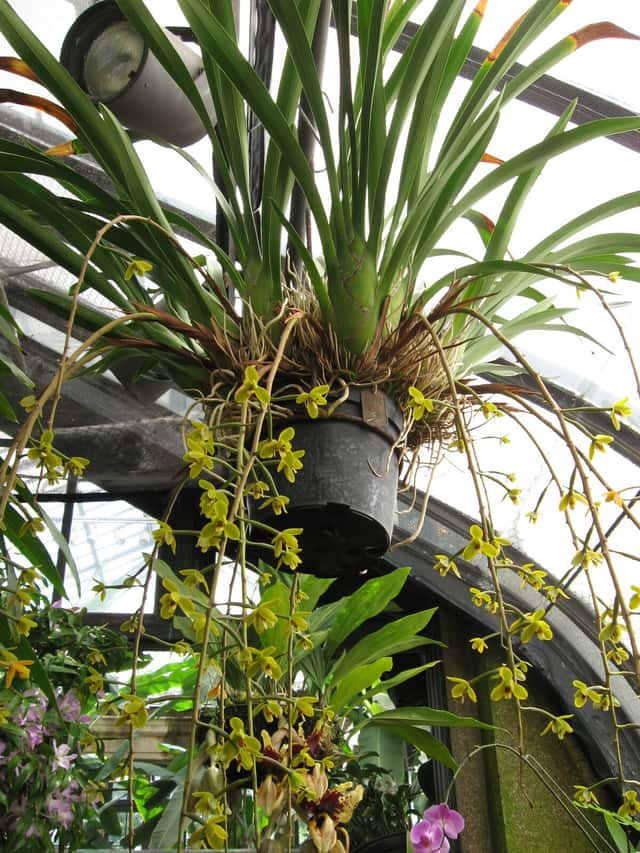
Cymbidium madidum is an orchid from eastern Australia, found from Cape York in Queensland south to the Hastings River in New South Wales. It grows on trees with thick fibrous or papery bark, such as paperbarks, and sometimes on rocks and cliffs in rainforest and other wet places. It forms large clumps of oval pseudobulbs, each carrying four to eight strap-like leaves up to 90 cm long. From late winter to summer it produces arching sprays of 10 to 70 small olive-green flowers with a yellow lip, which hang below the leaves.
How to Propagate Giant Boat-lip Orchid?
Division
Use sterilised tools. Leafless back bulbs can also be potted alone and may sprout, but they take two to four years to flower.
- 1 Wait until flowering has finished
- 2 Take the plant out of the pot and remove the old mix
- 3 Split the clump into pieces with three to five pseudobulbs each
- 4 Cut off dead roots and let the cuts dry
- 5 Pot each piece in fresh orchid bark
Materials needed:
How Big Does Giant Boat-lip Orchid Grow?
TLDR: Giant Boat-lip Orchid can reach up to 90cm tall with Slow growth rate.
Max height
90cm
Growth rate
Slow
Foliage
Evergreen
Plant Uses
Ornamental
Great for decoration
Medicinal Uses
- Traditional use of the pseudobulbs by Aboriginal Australians and early settlers to treat dysentery
Is your plant showing symptoms?
Click on the symptom to discover possible causes:
What Diseases Commonly Affect Giant Boat-lip Orchid?
TLDR: Giant Boat-lip Orchid is susceptible to 13 known diseases. Monitor regularly for early detection.
Scale Insects
Scale insects are small sap-sucking pests that appear as brown, shell-like bumps on plant stems and leaves. There are over 25 species, divided into armored (hard) and unarmored (soft) scales. They feed by piercing plant tissue and extracting sap, which weakens the plant and can lead to yellowing, stunted growth, and even death if left untreated. They also excrete honeydew, which attracts ants and promotes sooty mold growth.
Mealybugs
Mealybugs are small, soft-bodied insects covered with a white, waxy, cottony material. They are common pests of houseplants and outdoor plants in mild climates. These sap-sucking insects feed on plant tissue, causing damage, stunted growth, and can lead to plant death if left untreated. They produce sticky honeydew which attracts sooty mold.
Spider Mites
Spider mites are tiny arachnids (less than 1/20 inch long) related to spiders and ticks that feed on plant sap. They thrive in hot, dry conditions and can cause significant damage to ornamental and vegetable plants. During severe infestations, crop losses can reach 14% or higher as these pests disrupt vital plant processes including photosynthesis, carbon dioxide absorption, and transpiration.
Mosaic Virus
Mosaic virus is a group of plant viruses that cause mottled, patchy patterns on leaves and can affect a wide variety of plants. The virus creates characteristic yellow, white, and green mosaic patterns, often accompanied by stunted growth and deformed plant parts. This highly contagious disease spreads rapidly through insect vectors and contaminated tools.
Fun Facts
The name madidum is Latin for soaked or wet, a nod to the damp places where it grows
One flower spike can carry up to 70 flowers
In the wild it often grows on paperbark trees
John Lindley described it in 1840
Frequently asked questions
Why is my Cymbidium madidum not flowering?
How often should I water Cymbidium madidum?
Is Cymbidium madidum toxic to pets?
When does Cymbidium madidum flower?
Compare with similar plants
| Attribute | Difficulty | Light | Watering | Pet Safe |
|---|---|---|---|---|
| Dark Fieldcap | Medium | Low light | 2d | ⚠️ |
| Azalea | Medium | Partial shade | 3d | ⚠️ |
| Muriel's Bamboo | Medium | Partial shade | 3d | ✓ |
| Bougainvillea | Medium | Direct sun | 7d | ⚠️ |




