Francoaceae
Giant Honey Flower (Melianthus major)
Melianthus major
A fast, easy shrub for a warm, sunny, sheltered spot with good drainage. Water well in dry weather, cut it back hard in early spring or whenever it gets leggy, and mulch the base in winter where frosts are hard.
Every 7 days
Bright indirect
-5° - 35°C
30% - 70%
Categories
What is Giant Honey Flower?
Giant Honey Flower (Melianthus major) is a easy-care plant from the Francoaceae family. Giant honey flower (Melianthus major) is an evergreen shrub from the Cape region of South Africa, where it grows on sandstone slopes beside streams. It reaches 2-3 m tall and spreads by suckers into a wide clump. Its main attraction is the foliage: large, deeply cut blue-green leaves 30-50 cm long w...
Giant Honey Flower grows up to 3.0m, spread of 300cm, watering every 7 days, -5°C – 35°C, 30–70% humidity. It is not suitable for indoor environments and not safe for pets.
Unlike many tropical plants, Giant Honey Flower tolerates watering mistakes. Best for beginners. Without precautions, ingestion can cause irritation in pets. Keep out of reach of cats and dogs.
How to Care for Giant Honey Flower?
TLDR: Giant Honey Flower needs Bright indirect, watering every 7 days, and temperatures between -5-35°C with 30-70% humidity.
How Often Should You Water Giant Honey Flower?
Water generously during the growing season, about once a week in dry weather; it grows lushest with plenty of water. In winter keep it on the dry side, as cold, wet roots can rot.
How Much Light Does Giant Honey Flower Need?
Full sun and warmth; shelter it from cold, drying winds.
What Is the Best Soil for Giant Honey Flower?
Deep, fertile soil that drains well. It tolerates poorer soils but grows best in rich, moist ground.
What Pot Should You Use for Giant Honey Flower?
Suitable for a large, deep container with drainage holes. In cold areas, grow it in a pot outdoors in summer and move it to a frost-free greenhouse or conservatory in late autumn.
What Is Giant Honey Flower and Where Does It Come From?
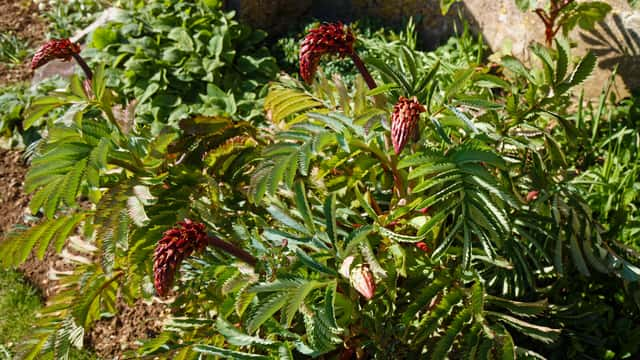
Giant honey flower (Melianthus major) is an evergreen shrub from the Cape region of South Africa, where it grows on sandstone slopes beside streams. It reaches 2-3 m tall and spreads by suckers into a wide clump. Its main attraction is the foliage: large, deeply cut blue-green leaves 30-50 cm long with toothed leaflets, which give off a strong, unpleasant, nutty smell when touched. In spring tall spikes of dark maroon flowers rise above the leaves and drip with black nectar that attracts sunbirds and bees, followed by papery, balloon-like pods. All parts of the plant are poisonous.
How to Propagate Giant Honey Flower?
Seed
In cold climates sow in spring under cover. Wear gloves when handling the seed pods.
- 1 Sow seed in trays of free-draining seed mix
- 2 Cover lightly with sand or fine bark
- 3 Keep moist in a warm, bright spot
- 4 Pot up seedlings when they have a few leaves
- 5 Plant out once they are strong
Materials needed:
Basal cuttings
Cuttings can be taken at any time of year when new basal shoots are available.
- 1 Take a young shoot sprouting from the base of the plant
- 2 Remove the lower leaves
- 3 Insert into moist, gritty compost
- 4 Keep in a bright, sheltered place until it roots
Materials needed:
Division
Divide every few years when clumps become crowded. Wear gloves: the sap and leaves are toxic.
- 1 Dig up a section of a congested clump with roots and shoots
- 2 Replant it at once in prepared soil
- 3 Water well
Materials needed:
How Big Does Giant Honey Flower Grow?
TLDR: Giant Honey Flower can reach up to 3.0m tall with Fast growth rate.
Max height
3.0m
Spread
3.0m
Growth rate
Fast
Foliage
Evergreen
Warning: Toxic Plant
This plant can be toxic if ingested. Keep out of reach of:
Plant Uses
Ornamental
Great for decoration
Medicinal
Medicinal properties
Medicinal Uses
- Traditionally the leaves are used externally in South Africa in poultices for wounds, sores and aching joints (toxic if taken internally)
Is your plant showing symptoms?
Click on the symptom to discover possible causes:
What Diseases Commonly Affect Giant Honey Flower?
TLDR: Giant Honey Flower is susceptible to 3 known diseases. Monitor regularly for early detection.
Spider Mites
Spider mites are tiny arachnids (less than 1/20 inch long) related to spiders and ticks that feed on plant sap. They thrive in hot, dry conditions and can cause significant damage to ornamental and vegetable plants. During severe infestations, crop losses can reach 14% or higher as these pests disrupt vital plant processes including photosynthesis, carbon dioxide absorption, and transpiration.
Whiteflies
Whiteflies are small, soft-bodied, winged insects closely related to aphids and mealybugs. They are moth-like in appearance, about 1/16 inch long, triangular in shape, and gray-white in color. These sap-sucking pests feed on plant tissue, causing yellowing, stunted growth, and wilting. They also excrete honeydew, which attracts ants and promotes sooty mold growth. Whiteflies can transmit serious plant viruses.
Root Rot
Root rot is a serious fungal disease that affects the root system of plants, causing them to decay and die. It is primarily caused by overwatering, poor drainage, or soil-borne fungi such as Pythium, Phytophthora, Rhizoctonia, and Fusarium. The disease thrives in waterlogged conditions where roots are deprived of oxygen, making them susceptible to fungal infection.
Fun Facts
The flowers produce so much black nectar that it drips from them.
Melianthus means honey flower in Greek.
After pollination each flower twists upside down on its stalk.
It reached European gardens in the Netherlands in 1673, 80 years before Linnaeus named it.
Frequently asked questions
Is giant honey flower poisonous?
Is Melianthus major hardy?
How do I prune Melianthus major?
Why do the leaves smell bad?
Compare with similar plants
| Attribute | Difficulty | Light | Watering | Pet Safe |
|---|---|---|---|---|
| Field Maple | Easy | Bright indirect | 14d | ✓ |
| Iberian Houseleek | Easy | Direct sun | 14d | ✓ |
| Silver Birch | Easy | Direct sun | 14d | ✓ |
| Common Blanketflower | Easy | Direct sun | 10d | ✓ |





