Portulacaceae
Gillies' Purslane: Full Sun Plant
Portulaca gilliesii
Very low-maintenance succulent. Needs full sun (6-8 h/day), sandy well-draining soil (pH 6.0-7.0) and sparse watering, letting the soil dry out completely between waterings. Avoid excess humidity.
Every 10 days
Direct sun
-3° - 30°C
% - %
Categories
What is Gillies' Purslane?
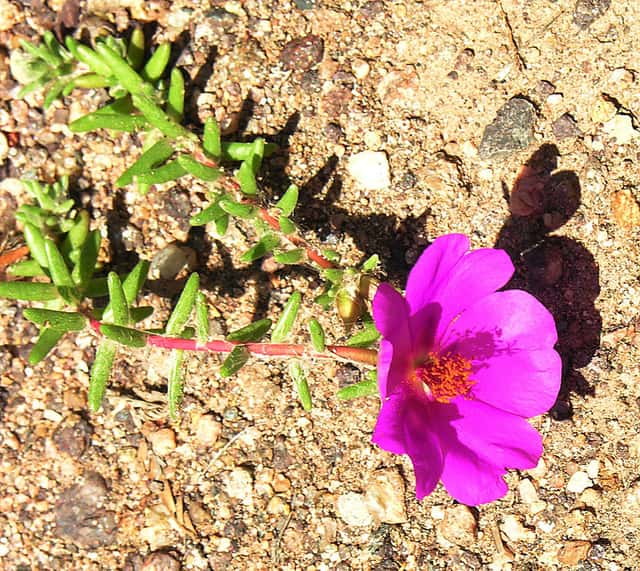
Gillies' Purslane (Portulaca gilliesii) is a easy-care plant from the Portulacaceae family. Gillies' Purslane (Portulaca gilliesii) is a succulent native to South America, with smooth, fleshy, often reddish prostrate stems reaching about 30 cm. In summer it bears small reddish-purple flowers. It is exceptionally drought-tolerant and ideal for xeriscaping and low-maintenance gardens. It con...
Gillies' Purslane grows up to 30cm, spread of 40cm, watering every 10 days, -3°C – 30°C. It is suitable for indoor environments and not safe for pets.
Unlike many tropical plants, Gillies' Purslane tolerates watering mistakes. Best for beginners. Without precautions, ingestion can cause irritation in pets. Keep out of reach of cats and dogs. Without adequate drainage, root rot can develop within 20 days.
How to Care for Gillies' Purslane?
TLDR: Gillies' Purslane needs Direct sun, watering every 10 days, and temperatures between -3-30°C with 40-70% humidity.
How Often Should You Water Gillies' Purslane?
The fleshy leaves store water; only water when the soil is dry to the touch. Keep nearly dry in winter. Overwatering is the primary cause of rot.
How Much Light Does Gillies' Purslane Need?
Requires strong, direct sunlight for compact growth and abundant flowering. In very hot climates a little afternoon shade prevents leaf scorch.
What Is the Best Soil for Gillies' Purslane?
Use a cactus/succulent mix with coarse sand or perlite and fast drainage.
What Pot Should You Use for Gillies' Purslane?
Porous ceramic or terracotta pot with drainage holes, minimum 15 cm diameter.
Care Schedule
Fertilize
Every 30 days
Repot
Every 365 days
What Is Gillies' Purslane and Where Does It Come From?
Gillies' Purslane (Portulaca gilliesii) is a succulent native to South America, with smooth, fleshy, often reddish prostrate stems reaching about 30 cm. In summer it bears small reddish-purple flowers. It is exceptionally drought-tolerant and ideal for xeriscaping and low-maintenance gardens. It contains calcium oxalate and is mildly toxic if ingested.
How to Propagate Gillies' Purslane?
Seeds
Do not cover seeds; they need light to germinate.
- 1 Surface-sow on sandy mix
- 2 Press lightly, do not cover (needs light)
- 3 Keep moist at 20-28 °C until germination
Materials needed:
Stem cutting
Fallen stems root on their own in soil.
- 1 Take 4-6 cm cuttings
- 2 Let callous for 2-4 hours
- 3 Plant in sandy, well-draining mix
Materials needed:
How Big Does Gillies' Purslane Grow?
TLDR: Gillies' Purslane can reach up to 30cm tall with Medium growth rate.
Max height
30cm
Spread
40cm
Growth rate
Medium
Foliage
Semi-evergreen
Warning: Toxic Plant
This plant can be toxic if ingested. Keep out of reach of:
Plant Uses
Ornamental
Great for decoration
Is your plant showing symptoms?
Click on the symptom to discover possible causes:
What Diseases Commonly Affect Gillies' Purslane?
TLDR: Gillies' Purslane is susceptible to 6 known diseases. Monitor regularly for early detection.
Root Rot
Root rot is a serious fungal disease that affects the root system of plants, causing them to decay and die. It is primarily caused by overwatering, poor drainage, or soil-borne fungi such as Pythium, Phytophthora, Rhizoctonia, and Fusarium. The disease thrives in waterlogged conditions where roots are deprived of oxygen, making them susceptible to fungal infection.
White Rust (Albugo portulacae)
White rust is a disease caused by a fungal-like oomycete that primarily attacks purslane. Characteristic white pustules filled with spores form on the leaves. Severe infestations lead to the deformation of leaves and stems, weakening the plant and potentially causing death. It spreads particularly during humid weather and moderate temperatures.
Aphids
Aphids are small, soft-bodied, pear-shaped insects (1/16 to 1/8 inch long) that feed by sucking nutrient-rich sap from plants. They reproduce rapidly and can quickly weaken plants, causing distorted growth and transmitting plant viruses. Aphids come in various colors including green, black, red, yellow, brown, and gray. They secrete honeydew, a sticky substance that attracts ants and encourages sooty mold growth.
Slugs and Snails
Slugs and snails are mollusks that feed on plant tissue, causing irregular holes in leaves and damage to young seedlings. They are most active at night and in moist conditions, leaving characteristic silvery slime trails. These pests can quickly devastate gardens, especially during wet seasons.
Meaning & Symbolism
Represents resilience and ephemeral beauty; persistence in harsh, arid environments.
Compare with similar plants
| Attribute | Difficulty | Light | Watering | Pet Safe |
|---|---|---|---|---|
| Field Maple | Easy | Bright indirect | 14d | ✓ |
| Silver Birch | Easy | Direct sun | 14d | ✓ |
| Common Blanketflower | Easy | Direct sun | 10d | ✓ |
| Cushion Bush | Easy | Direct sun | 14d | ✓ |





