Iridaceae
Gladiolus care guide
Gladiolus
Easy summer bulb for full sun. Plant corms in spring after the last frost in loose, well-drained, fertile soil, water about once a week (2.5 cm of water), feed when the plants are 15-25 cm tall and again when the spike appears, and stake tall varieties. Flowers appear 65-100 days after planting. Outside USDA zones 7-10, lift the corms in autumn and store them dry and frost-free.
Every 7 days
Bright indirect
5° - 30°C
50% - 70%
Categories
What is Gladiolus?
Gladiolus (Gladiolus) is a easy-care plant from the Iridaceae family. Gladiolus is a genus of about 260 species in the iris family (Iridaceae), most of them native to southern Africa, with others from tropical Africa, the Mediterranean and western Asia. Plants grow from a flattened corm and produce fans of stiff, sword-shaped leaves and a tall spike of funnel-shaped f...
Gladiolus grows up to 1.8m, spread of 60cm, watering every 7 days, 5°C – 30°C, 50–70% humidity. It is not suitable for indoor environments and not safe for pets.
Unlike many tropical plants, Gladiolus tolerates watering mistakes. Best for beginners. Without precautions, ingestion can cause irritation in pets. Keep out of reach of cats and dogs.
How to Care for Gladiolus?
TLDR: Gladiolus needs Bright indirect, watering every 7 days, and temperatures between 5-30°C with 50-70% humidity.
How Often Should You Water Gladiolus?
Give about 2.5 cm (1 inch) of water per week when it does not rain, soaking the soil deeply rather than sprinkling. Keep the soil evenly moist from spike formation to flowering, since drought shortens the flower spike. Avoid waterlogging, which rots the corms, and keep watering while the leaves stay green after flowering.
How Much Light Does Gladiolus Need?
Needs full sun, at least 6 hours of direct light a day. In shade the plants lean, the spikes are weak and some corms do not flower at all. Choose a spot sheltered from strong wind, which knocks over the tall spikes.
What Is the Best Soil for Gladiolus?
Loose, fertile, well-drained loam or sandy loam with organic matter, pH 6.0-7.0. Heavy clay should be improved with compost; soggy soil causes corm rot.
What Pot Should You Use for Gladiolus?
A deep pot, at least 30 cm deep and wide, with drainage holes; heavy terracotta helps keep tall spikes from tipping over. Dwarf varieties suit containers best.
Care Schedule
Fertilize
Every 30 days
What Is Gladiolus and Where Does It Come From?
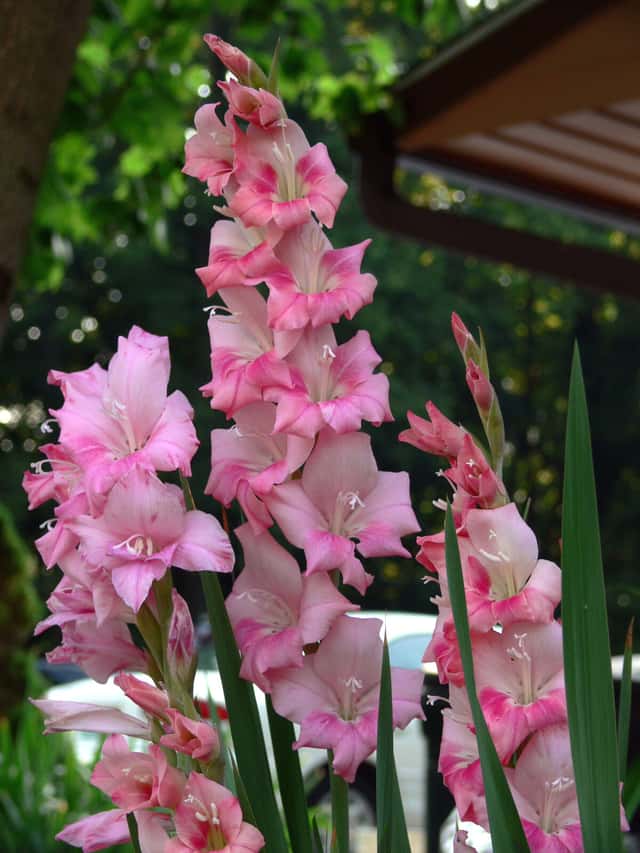
Gladiolus is a genus of about 260 species in the iris family (Iridaceae), most of them native to southern Africa, with others from tropical Africa, the Mediterranean and western Asia. Plants grow from a flattened corm and produce fans of stiff, sword-shaped leaves and a tall spike of funnel-shaped flowers that open from the bottom up. The gladiolus sold in garden centres and florists are mostly large-flowered hybrids (Gladiolus x hortulanus), 60 to 180 cm tall, in almost every colour except true blue; the care on this page is based on them.
How to Propagate Gladiolus?
Cormels
Cormels give plants identical to the parent. Keep each variety labelled, since they look alike once lifted.
- 1 When lifting the corms in autumn, collect the small cormels attached at the base
- 2 Store them dry and cool over winter with the large corms
- 3 In spring, soak them in water for a day to soften the hard coat
- 4 Plant them 2-5 cm deep in a nursery row and grow on for 2-3 seasons until they flower
Materials needed:
Corm division
Only divide healthy corms and use a clean blade to avoid spreading rot.
- 1 Choose a large, healthy corm with several buds
- 2 Cut it into pieces with a clean knife, each with at least one bud and part of the base
- 3 Let the cut surfaces dry for 1-2 days
- 4 Plant the pieces 10 cm deep in well-drained soil
Materials needed:
How Big Does Gladiolus Grow?
TLDR: Gladiolus can reach up to 1.8m tall with Fast growth rate.
Max height
1.8m
Spread
60cm
Growth rate
Fast
Foliage
Deciduous
Warning: Toxic Plant
This plant can be toxic if ingested. Keep out of reach of:
Plant Uses
Ornamental
Great for decoration
Is your plant showing symptoms?
Click on the symptom to discover possible causes:
What Diseases Commonly Affect Gladiolus?
TLDR: Gladiolus is susceptible to 11 known diseases. Monitor regularly for early detection.
Thrips
Thrips are tiny cigar-shaped insects (1/25-inch long) that damage plants by sucking plant juices and scraping at fruits, flowers, and leaves. With over 6,000 species and rapid reproduction (lifecycle as short as 14 days), they can quickly infest plants and transmit viruses like tomato spotted wilt virus.
Gray Mold (Botrytis Blight)
Gray mold, caused by the fungus Botrytis cinerea, is one of the most common fungal diseases in plants. It affects over 200 plant species, including ornamentals, vegetables, fruits, and houseplants. The disease thrives in cool, humid conditions with poor air circulation, causing grayish spots and soft rot on infected tissues.
Fusarium Wilt
Fusarium is a soil-borne fungus that primarily attacks the roots and vascular tissues of plants. It enters through small wounds or stressed roots, is favored by warm temperatures and waterlogging, and then obstructs the flow of sap. Symptoms include yellowing, often on only one side of the plant, wilting even with moist soil, stunted growth, and, when cutting the stem, internal brown streaks. It frequently affects tomatoes, peppers, eggplants, basil, cucumbers, and zucchini, as well as ornamentals like carnations and cyclamen. In potted plants, it can manifest as root rot with a darkened crown.
Mosaic Virus
Mosaic virus is a group of plant viruses that cause mottled, patchy patterns on leaves and can affect a wide variety of plants. The virus creates characteristic yellow, white, and green mosaic patterns, often accompanied by stunted growth and deformed plant parts. This highly contagious disease spreads rapidly through insect vectors and contaminated tools.
Meaning & Symbolism
Strength of character, integrity and remembrance. The name comes from Latin gladius, "sword", after the leaf shape, and the flower is linked to Roman gladiators. It is the birth flower of August.
Fun Facts
The name comes from the Latin gladius, meaning sword, because of the leaf shape.
Most of the roughly 260 wild species grow in South Africa.
The flowers on a spike open from the bottom up, so cut stems keep opening for days in a vase.
Frequently asked questions
When should I plant gladiolus corms?
How deep do you plant gladiolus?
Is gladiolus toxic to cats and dogs?
Do I need to dig up gladiolus in winter?
Why are the leaves of my gladiolus silvery and the flowers deformed?
Compare with similar plants
| Attribute | Difficulty | Light | Watering | Pet Safe |
|---|---|---|---|---|
| Field Maple | Easy | Bright indirect | 14d | ✓ |
| Iberian Houseleek | Easy | Direct sun | 14d | ✓ |
| Silver Birch | Easy | Direct sun | 14d | ✓ |
| Common Blanketflower | Easy | Direct sun | 10d | ✓ |