Euphorbiaceae
Gopher spurge (Euphorbia rigida)
Euphorbia rigida
A plant for full sun and almost no water, for dry borders, rock gardens and pots. Drainage is everything: heavy, wet soil kills it. Wear gloves when handling it and cut flowered stems after blooming to stop it self-seeding.
Every 14 days
Direct sun
-15° - °C
% - %
Categories
What is Gopher spurge?
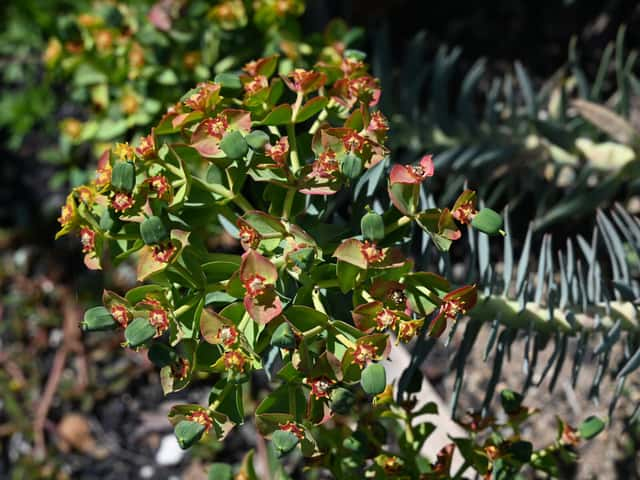
Gopher spurge (Euphorbia rigida) is a easy-care plant from the Euphorbiaceae family. Euphorbia rigida is a fleshy-stemmed perennial in the spurge family, native to southern Europe, Turkey, Iran and northwest Africa. It forms clumps 30 to 60 cm tall, with upright or sprawling stems clothed in thick, lance-shaped, blue-grey leaves arranged in a spiral, which turn bronze and red in aut...
Gopher spurge grows up to 60cm, spread of 90cm, watering every 14 days. It is not suitable for indoor environments and not safe for pets.
Unlike many tropical plants, Gopher spurge tolerates watering mistakes. Best for beginners. Without precautions, ingestion can cause irritation in pets. Keep out of reach of cats and dogs.
How to Care for Gopher spurge?
TLDR: Gopher spurge needs Direct sun, watering every 14 days, and temperatures between -15-30°C with 40-70% humidity.
How Often Should You Water Gopher spurge?
Once established, water only if it droops after several weeks without rain, and never in winter. In pots, let the mix dry out completely between waterings.
How Much Light Does Gopher spurge Need?
Full sun keeps it compact and well coloured; it tolerates part shade, but the stems get leggy and flop.
What Is the Best Soil for Gopher spurge?
Poor, sandy or rocky, very well-drained soil, pH 6 to 8.5. It tolerates salt. Avoid heavy clay.
What Pot Should You Use for Gopher spurge?
A terracotta pot with good drainage holes and a cactus and succulent mix.
What Is Gopher spurge and Where Does It Come From?
Euphorbia rigida is a fleshy-stemmed perennial in the spurge family, native to southern Europe, Turkey, Iran and northwest Africa. It forms clumps 30 to 60 cm tall, with upright or sprawling stems clothed in thick, lance-shaped, blue-grey leaves arranged in a spiral, which turn bronze and red in autumn. In spring each stem tip opens into clusters of chartreuse to bright yellow bracts that bees love. It is one of the most drought-tolerant spurges and suits rock gardens and low-water planting. Like every euphorbia, it has an irritant, toxic milky sap.
How to Propagate Gopher spurge?
Stem cuttings
The sap irritates skin and eyes: wear gloves and eye protection and wash tools afterwards.
- 1 Wearing gloves, cut a stem about 20 cm long in spring or summer
- 2 Dip the cut end in cold water to stop the sap and let it dry for a few hours
- 3 Strip the leaves from the lower three quarters
- 4 Bury about 7 cm in cactus mix and keep warm and bright, out of direct sun
- 5 Water sparingly until rooted
Materials needed:
Seed
It self-seeds readily; often you only need to move the seedlings that come up around it.
- 1 Let a few stems dry on the plant to release seed
- 2 Sow promptly, as the seed loses viability quickly
- 3 Use a sandy mix and keep it lightly moist
Materials needed:
Clump division
Useful for renewing old plants, which are fairly short-lived.
- 1 Lift the clump in early spring
- 2 Separate sections with their own roots
- 3 Replant in well-drained soil
Materials needed:
How Big Does Gopher spurge Grow?
TLDR: Gopher spurge can reach up to 60cm tall with Medium growth rate.
Max height
60cm
Spread
90cm
Growth rate
Medium
Foliage
Evergreen
Warning: Toxic Plant
This plant can be toxic if ingested. Keep out of reach of:
Plant Uses
Ornamental
Great for decoration
Ground Cover
Soil coverage
Is your plant showing symptoms?
Click on the symptom to discover possible causes:
What Diseases Commonly Affect Gopher spurge?
TLDR: Gopher spurge is susceptible to 4 known diseases. Monitor regularly for early detection.
Root Rot
Root rot is a serious fungal disease that affects the root system of plants, causing them to decay and die. It is primarily caused by overwatering, poor drainage, or soil-borne fungi such as Pythium, Phytophthora, Rhizoctonia, and Fusarium. The disease thrives in waterlogged conditions where roots are deprived of oxygen, making them susceptible to fungal infection.
Spider Mites
Spider mites are tiny arachnids (less than 1/20 inch long) related to spiders and ticks that feed on plant sap. They thrive in hot, dry conditions and can cause significant damage to ornamental and vegetable plants. During severe infestations, crop losses can reach 14% or higher as these pests disrupt vital plant processes including photosynthesis, carbon dioxide absorption, and transpiration.
Powdery Mildew
Powdery mildew is a common fungal disease caused by various fungi species including Erysiphe, Podosphaera, Oïdium, and Leveillula. It affects over 10,000 plant species worldwide. The disease thrives in warm, dry climates with high humidity and appears as a distinctive white powdery coating on plant surfaces.
Fusarium Wilt
Fusarium is a soil-borne fungus that primarily attacks the roots and vascular tissues of plants. It enters through small wounds or stressed roots, is favored by warm temperatures and waterlogging, and then obstructs the flow of sap. Symptoms include yellowing, often on only one side of the plant, wilting even with moist soil, stunted growth, and, when cutting the stem, internal brown streaks. It frequently affects tomatoes, peppers, eggplants, basil, cucumbers, and zucchini, as well as ornamentals like carnations and cyclamen. In potted plants, it can manifest as root rot with a darkened crown.
Fun Facts
It is called gopher spurge because it is said to keep burrowing rodents away
The blue-grey leaves turn bronze and red in cold weather
The yellow parts that look like flowers are bracts; the true flowers are tiny
Frequently asked questions
Is Euphorbia rigida poisonous?
How often should I water it?
Is it frost hardy?
Should I cut off the flowers?
Compare with similar plants
| Attribute | Difficulty | Light | Watering | Pet Safe |
|---|---|---|---|---|
| Field Maple | Easy | Bright indirect | 14d | ✓ |
| Iberian Houseleek | Easy | Direct sun | 14d | ✓ |
| Silver Birch | Easy | Direct sun | 14d | ✓ |
| Common Blanketflower | Easy | Direct sun | 10d | ✓ |





