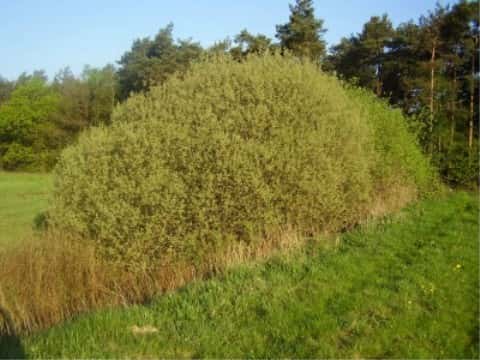
Salicaceae
Grey Willow (Salix cinerea)
Salix cinerea
Grow grey willow in full sun with consistently moist to wet soil; it struggles in shade and dry conditions. Water generously, prune annually to control size and shape, and expect vigorous growth once established near water sources.
Every 3 days
Direct sun
° - °C
% - %
Categories
What is Grey Willow?
Grey Willow (Salix cinerea) is a easy-care plant from the Salicaceae family. Salix cinerea, the grey willow (also called grey sallow), is a fast-establishing deciduous shrub or small tree native to Europe and western Asia. It thrives in wet, poorly drained soils along riverbanks, ditches and marshes, producing fuzzy grey-to-yellow catkins in early spring before the leaves em...
Grey Willow grows up to 10.0m, spread of 400cm, watering every 3 days. It is not suitable for indoor environments and safe for pets.
Unlike many tropical plants, Grey Willow tolerates watering mistakes. Best for beginners. Unlike many popular species, Grey Willow is safe to keep around pets.
How to Care for Grey Willow?
TLDR: Grey Willow needs Direct sun, watering every 3 days, and temperatures between 15-30°C with 40-70% humidity.
How Often Should You Water Grey Willow?
Keep the soil consistently moist to wet; grey willow is very sensitive to drying out, so never let the root zone dry completely, especially during the growing season.
How Much Light Does Grey Willow Need?
Plant in full sun; grey willow cannot tolerate shade and needs abundant direct light to flower and grow well.
What Is the Best Soil for Grey Willow?
Adaptable to sandy, loamy or clay soils as long as they stay moist to waterlogged; slightly acidic to neutral pH is ideal, and it tolerates poor drainage better than most trees.
What Pot Should You Use for Grey Willow?
Best grown in the ground near ponds or streams; if containerized, use a large, deep pot with drainage that can be kept in a saucer of water to maintain constant moisture.
What Is Grey Willow and Where Does It Come From?
Salix cinerea, the grey willow (also called grey sallow), is a fast-establishing deciduous shrub or small tree native to Europe and western Asia. It thrives in wet, poorly drained soils along riverbanks, ditches and marshes, producing fuzzy grey-to-yellow catkins in early spring before the leaves emerge. Its dense, downy grey-green foliage and tolerance of waterlogged ground make it a valuable pioneer species for wetland restoration and a key early-season nectar source for bees.
How to Propagate Grey Willow?
Hardwood stem cutting
Willow cuttings root extremely easily even without rooting hormone; changing the water weekly speeds up rooting when propagating in water.
- 1 Cut a healthy, pencil-thick dormant stem about 20-30 cm long between November and February.
- 2 Remove any side shoots and insert two-thirds of the cutting into moist soil or a container of water.
- 3 Keep the growing medium consistently moist and in a sheltered, bright spot until roots form.
- 4 Transplant to its permanent, sunny, moist location once a strong root system develops.
Materials needed:
Seed propagation
Seed viability is extremely short, so cuttings are the far more reliable propagation method.
- 1 Collect fluffy seed as soon as catkins ripen in late spring.
- 2 Sow immediately on the surface of moist, well-aerated soil, as viability drops within days.
- 3 Keep consistently moist and in bright light until germination.
Materials needed:
How Big Does Grey Willow Grow?
TLDR: Grey Willow can reach up to 10.0m tall with Medium growth rate.
Max height
10.0m
Spread
4.0m
Growth rate
Medium
Foliage
Deciduous
Plant Uses
Ornamental
Great for decoration
Medicinal
Medicinal properties
Medicinal Uses
- Bark historically used as a source of salicin (a natural precursor to salicylic acid) for treating fevers, rheumatism and pain
Is your plant showing symptoms?
Click on the symptom to discover possible causes:
What Diseases Commonly Affect Grey Willow?
TLDR: Grey Willow is susceptible to 6 known diseases. Monitor regularly for early detection.
Anthracnose
Anthracnose is a fungal disease caused by fungi in the genus Colletotrichum that affects many plants, including vegetables, fruits, and trees. The disease thrives in cool, wet conditions, causing dark, sunken lesions on leaves, stems, flowers, and fruits.
Rust
Rust is a common fungal disease caused by fungi in the order Pucciniales that affects a wide variety of plants. The disease gets its name from the characteristic orange, yellow, or reddish-brown pustules that appear on leaves, resembling metal rust. This obligate fungal parasite requires living plants to survive and can cause significant economic losses in agricultural crops.
Canker
Canker is a disease caused by various fungi and bacteria that create necrotic, sunken areas on bark of branches, stems, and trunks. Pathogens enter through wounds and natural openings, especially when plants are stressed. Canker can gradually weaken or kill branches by disrupting water and nutrient flow.
Aphids
Aphids are small, soft-bodied, pear-shaped insects (1/16 to 1/8 inch long) that feed by sucking nutrient-rich sap from plants. They reproduce rapidly and can quickly weaken plants, causing distorted growth and transmitting plant viruses. Aphids come in various colors including green, black, red, yellow, brown, and gray. They secrete honeydew, a sticky substance that attracts ants and encourages sooty mold growth.
Meaning & Symbolism
Willows have long symbolized flexibility, resilience, and renewal; the grey willow's early spring catkins also represent the return of life after winter and are prized by pollinators.
Fun Facts
Grey willow catkins appear before the leaves and are one of the earliest and most important nectar sources for bees in early spring.
Its bark contains salicin, the natural compound from which aspirin was originally derived.
As a pioneer species, it can rapidly colonize bare, waterlogged ground left by floods or disturbance.
Frequently asked questions
Is grey willow toxic to cats or dogs?
How much water does grey willow need?
Can grey willow grow in shade?
What pests and diseases affect grey willow?
Compare with similar plants
| Attribute | Difficulty | Light | Watering | Pet Safe |
|---|---|---|---|---|
| Field Maple | Easy | Bright indirect | 14d | ✓ |
| Silver Birch | Easy | Direct sun | 14d | ✓ |
| Common Blanketflower | Easy | Direct sun | 10d | ✓ |
| Cushion Bush | Easy | Direct sun | 14d | ✓ |





