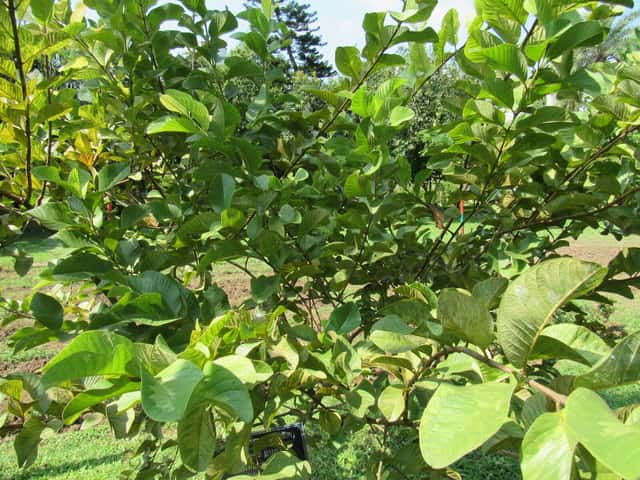
Myrtaceae
Guava (Psidium)
Psidium
Grow in full sun and well-drained soil. Water weekly until established, then during dry spells and while flowering and fruiting. Feed 3 or 4 times a year and prune to keep the canopy open and low. Young plants are killed by hard frost.
Every 7 days
Direct sun
° - °C
% - %
Categories
What is Guava?
Guava (Psidium) is a easy-care plant from the Myrtaceae family. Psidium is the guava genus, with about 70 species of evergreen shrubs and trees, all native to the Americas, from Mexico and the Caribbean to Argentina. Brazil holds many of them, a large share found nowhere else. The leaves are opposite and smell spicy when crushed, the bark is often smooth and pee...
Guava grows up to 10.0m, watering every 7 days. It is not suitable for indoor environments and safe for pets.
Unlike many tropical plants, Guava tolerates watering mistakes. Best for beginners. Unlike many popular species, Guava is safe to keep around pets.
How to Care for Guava?
TLDR: Guava needs Direct sun, watering every 7 days, and temperatures between 15-30°C with 40-70% humidity.
How Often Should You Water Guava?
Keep the soil moist through the first year without waterlogging it. Established plants handle drought, but fruit better when watered during flowering.
How Much Light Does Guava Need?
Give at least 6 hours of direct sun. In shade guavas get leggy and fruit poorly.
What Is the Best Soil for Guava?
Sandy, loamy or rocky soil all work as long as it drains. Soggy soil rots the roots.
What Pot Should You Use for Guava?
A large, deep pot of 40 litres or more with drainage holes. Small araçás do well in containers; common guava prefers the ground.
Care Schedule
Fertilize
Every 90 days
What Is Guava and Where Does It Come From?
Psidium is the guava genus, with about 70 species of evergreen shrubs and trees, all native to the Americas, from Mexico and the Caribbean to Argentina. Brazil holds many of them, a large share found nowhere else. The leaves are opposite and smell spicy when crushed, the bark is often smooth and peels in flakes, and the white flowers carry a brush of stamens. The fruits are many-seeded berries and nearly all are edible, from the common guava to the strawberry guava and the Brazilian araçás. Common guava (Psidium guajava) and strawberry guava (Psidium cattleyanum) have their own entries.
How to Propagate Guava?
Seed
Seedlings vary and can take 3 to 8 years to fruit. To copy a good plant, use air layering or grafting.
- 1 Take seeds from fully ripe fruit
- 2 Rinse off the pulp and let them dry in the shade for a day
- 3 Sow 1 cm deep in light compost
- 4 Keep moist, warm and bright
- 5 Pot up individually at 4 to 6 leaves
Materials needed:
Air layering
This is the easiest home method for guavas: the new plant matches its parent and fruits early.
- 1 Pick a one-year-old branch about pencil thickness or a little more
- 2 Remove a 2-3 cm ring of bark
- 3 Wrap with moist sphagnum or compost and seal in plastic
- 4 When roots show through the plastic, cut below them and pot up
Materials needed:
Grafting
Native araçás are being tested as rootstocks to give common guava resistance to root-knot nematodes.
- 1 Use a vigorous seedling as rootstock
- 2 Cut a green, still-squared shoot tip from the variety you want
- 3 Make a cleft or veneer graft and wrap it with tape
- 4 Keep in light shade until the scion sprouts
Materials needed:
How Big Does Guava Grow?
TLDR: Guava can reach up to 10.0m tall with Medium growth rate.
Max height
10.0m
Foliage
Evergreen
Plant Uses
Ornamental
Great for decoration
Edible
Can be consumed
Medicinal
Medicinal properties
Medicinal Uses
- Guava leaf tea is a folk remedy for diarrhoea
Culinary Uses
- Fresh fruit
- Guava paste and jams
- Juices and ice cream
Is your plant showing symptoms?
Click on the symptom to discover possible causes:
What Diseases Commonly Affect Guava?
TLDR: Guava is susceptible to 8 known diseases. Monitor regularly for early detection.
Anthracnose
Anthracnose is a fungal disease caused by fungi in the genus Colletotrichum that affects many plants, including vegetables, fruits, and trees. The disease thrives in cool, wet conditions, causing dark, sunken lesions on leaves, stems, flowers, and fruits.
Rust
Rust is a common fungal disease caused by fungi in the order Pucciniales that affects a wide variety of plants. The disease gets its name from the characteristic orange, yellow, or reddish-brown pustules that appear on leaves, resembling metal rust. This obligate fungal parasite requires living plants to survive and can cause significant economic losses in agricultural crops.
Root Rot
Root rot is a serious fungal disease that affects the root system of plants, causing them to decay and die. It is primarily caused by overwatering, poor drainage, or soil-borne fungi such as Pythium, Phytophthora, Rhizoctonia, and Fusarium. The disease thrives in waterlogged conditions where roots are deprived of oxygen, making them susceptible to fungal infection.
Root-Knot Nematodes
Root-knot nematodes (Meloidogyne species) are microscopic roundworms that parasitize plant roots, causing characteristic galls or knots. These soil-borne pests are among the most economically damaging plant pathogens worldwide, affecting a wide range of ornamental and edible plants. The nematodes inject enzymes into root cells, causing abnormal swelling and disrupting water and nutrient uptake.
Meaning & Symbolism
Across tropical America the guava tree is a backyard and childhood tree, part of home-made sweets and folk songs.
Fun Facts
Myrtle rust, a disease that now attacks eucalyptus worldwide, was first described on a guava in Brazil and is named Austropuccinia psidii
Strawberry guava has become one of the worst invasive plants in Hawaii
A single guava can hold more vitamin C than an orange
Frequently asked questions
Are guavas related to feijoa and jaboticaba?
Can I grow a guava in a pot?
Why do my guavas have worms inside?
Are guava trees toxic to cats and dogs?
Compare with similar plants
| Attribute | Difficulty | Light | Watering | Pet Safe |
|---|---|---|---|---|
| Field Maple | Easy | Bright indirect | 14d | ✓ |
| Iberian Houseleek | Easy | Direct sun | 14d | ✓ |
| Silver Birch | Easy | Direct sun | 14d | ✓ |
| Common Blanketflower | Easy | Direct sun | 10d | ✓ |





