Geraniaceae
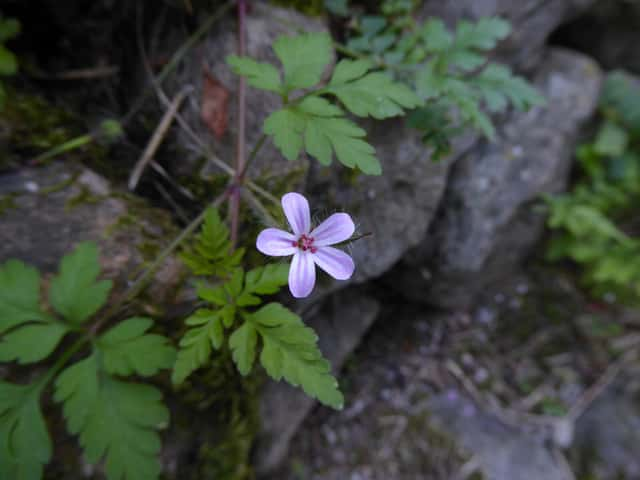
Herb-Robert (Geranium robertianum)
Geranium robertianum
It looks after itself: sun or part shade, almost any soil, dry or moist. It seeds freely, so if you do not want it everywhere, pull plants before the seed pods ripen. The shallow roots make it easy to pull.
Every 7 days
Partial shade
° - °C
40% - 80%
Categories
What is Herb-Robert?
Herb-Robert (Geranium robertianum) is a easy-care plant from the Geraniaceae family. Herb-Robert (Geranium robertianum) is a small wild cranesbill, usually annual or biennial, growing up to 40 cm tall. Its hairy leaves are deeply cut into three to five lobes, and leaves and stems turn red in dry, sunny spots and in autumn. From spring to late autumn it has pink, occasionally white,...
Herb-Robert grows up to 40cm, spread of 40cm, watering every 7 days, 40–80% humidity. It is not suitable for indoor environments and safe for pets.
Unlike many tropical plants, Herb-Robert tolerates watering mistakes. Best for beginners. Unlike many popular species, Herb-Robert is safe to keep around pets.
How to Care for Herb-Robert?
TLDR: Herb-Robert needs Partial shade, watering every 7 days, and temperatures between 15-30°C with 40-80% humidity.
How Often Should You Water Herb-Robert?
Usually needs no watering in the ground. In pots or long dry spells, water about once a week.
How Much Light Does Herb-Robert Need?
Part shade to sun. It grows best in dappled shade at the edge of trees.
What Is the Best Soil for Herb-Robert?
Any moderately fertile soil, from sandy to clay. It even grows in cracks in walls.
What Pot Should You Use for Herb-Robert?
Rarely grown in pots. If you want it, any small pot with a drainage hole will do.
What Is Herb-Robert and Where Does It Come From?
Herb-Robert (Geranium robertianum) is a small wild cranesbill, usually annual or biennial, growing up to 40 cm tall. Its hairy leaves are deeply cut into three to five lobes, and leaves and stems turn red in dry, sunny spots and in autumn. From spring to late autumn it has pink, occasionally white, five-petalled flowers 1 to 1.5 cm across, followed by red beaked seed pods that flick out sticky seeds. Crushed leaves have a strong, unpleasant smell. It is native to Europe, North Africa and temperate Asia, where it grows in hedgerows, woodland edges, walls and waste ground. In North America it has spread widely, and Washington State lists it as a noxious weed.
How to Propagate Herb-Robert?
Seed
It self-seeds readily. Seeds stay alive in the soil for six years or more, so it can come back for years after you remove the plants.
- 1 Scatter seed where you want it to grow in spring
- 2 Rake it in lightly
- 3 Keep the soil moist until seedlings appear
Materials needed:
How Big Does Herb-Robert Grow?
TLDR: Herb-Robert can reach up to 40cm tall with Fast growth rate.
Max height
40cm
Spread
40cm
Growth rate
Fast
Plant Uses
Medicinal
Medicinal properties
Ground Cover
Soil coverage
Medicinal Uses
- Traditional herbal astringent for bleeding and diarrhoea
- Used in folk medicine as a poultice on bruises and sore joints
- Fresh leaves rubbed on skin as a mosquito repellent
Culinary Uses
- Fresh leaves are sometimes added to salads and leaves and flowers were once used for tea; confirm the plant before eating any
Is your plant showing symptoms?
Click on the symptom to discover possible causes:
What Diseases Commonly Affect Herb-Robert?
TLDR: Herb-Robert is susceptible to 3 known diseases. Monitor regularly for early detection.
Rust
Rust is a common fungal disease caused by fungi in the order Pucciniales that affects a wide variety of plants. The disease gets its name from the characteristic orange, yellow, or reddish-brown pustules that appear on leaves, resembling metal rust. This obligate fungal parasite requires living plants to survive and can cause significant economic losses in agricultural crops.
Downy Mildew
Downy mildew is a fungal-like disease caused by oomycetes (water molds) that thrives in cool, wet conditions. It affects a wide range of plants, causing yellowing leaves with fuzzy white-gray growth underneath, leading to defoliation and reduced yields if left untreated.
Powdery Mildew
Powdery mildew is a common fungal disease caused by various fungi species including Erysiphe, Podosphaera, Oïdium, and Leveillula. It affects over 10,000 plant species worldwide. The disease thrives in warm, dry climates with high humidity and appears as a distinctive white powdery coating on plant surfaces.
Fun Facts
The genus name comes from the Greek for crane, after the long beak of the seed pod
The ripe pod flicks its seeds away, and the sticky seeds then travel on animals and shoes
It may be named after Saint Robert, a monk said to have used it to treat the sick around the year 1000
Frequently asked questions
Is herb-Robert a weed?
How do I get rid of herb-Robert?
Why does herb-Robert smell bad?
Why are the leaves turning red?
Compare with similar plants
| Attribute | Difficulty | Light | Watering | Pet Safe |
|---|---|---|---|---|
| Field Maple | Easy | Bright indirect | 14d | ✓ |
| Iberian Houseleek | Easy | Direct sun | 14d | ✓ |
| Silver Birch | Easy | Direct sun | 14d | ✓ |
| Common Blanketflower | Easy | Direct sun | 10d | ✓ |





