Balsaminaceae
Himalayan balsam (Impatiens glandulifera)
Impatiens glandulifera
Riverside annual for sun or part shade and constantly moist soil. It grows on its own and very fast; the main job is stopping it from spreading seed.
Every 2 days
Partial shade
2° - 30°C
% - %
Categories
What is Himalayan balsam?
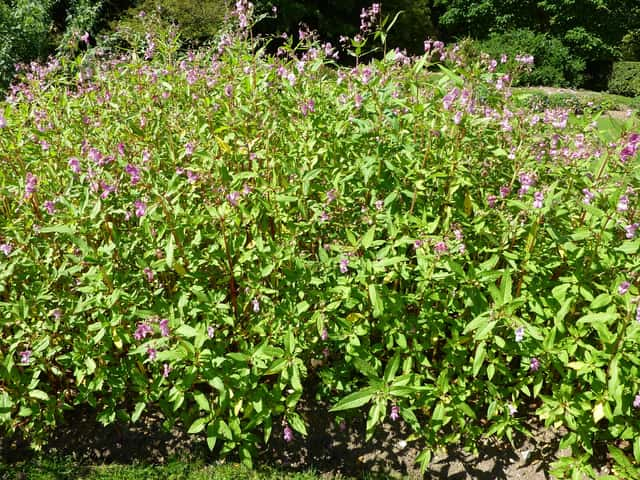
Himalayan balsam (Impatiens glandulifera) is a easy-care plant from the Balsaminaceae family. Himalayan balsam is an annual from the Himalayas that reaches 1 to 2 m in a single summer. It has thick, hollow, reddish stems, long toothed leaves and, from summer into fall, pink to purple helmet-shaped flowers full of nectar. The ripe pods explode when touched and fling the seeds up to 7 m. That...
Himalayan balsam grows up to 2.0m, watering every 2 days, 2°C – 30°C. It is not suitable for indoor environments and safe for pets.
Unlike many tropical plants, Himalayan balsam tolerates watering mistakes. Best for beginners. Unlike many popular species, Himalayan balsam is safe to keep around pets.
How to Care for Himalayan balsam?
TLDR: Himalayan balsam needs Partial shade, watering every 2 days, and temperatures between 2-30°C with 40-70% humidity.
How Often Should You Water Himalayan balsam?
Likes soil that never dries out, like a riverbank. In a pot, water every 1 to 2 days in summer. It wilts quickly when dry.
How Much Light Does Himalayan balsam Need?
Part shade or dappled sun. It also grows in full sun if the soil stays moist.
What Is the Best Soil for Himalayan balsam?
Rich, loose, moist soil, like a riverbank or woodland edge. It tolerates short periods of waterlogging.
What Pot Should You Use for Himalayan balsam?
If it is legal where you live, use a large deep pot of 30 liters or more, away from rivers and ditches, and deadhead before pods form.
What Is Himalayan balsam and Where Does It Come From?
Himalayan balsam is an annual from the Himalayas that reaches 1 to 2 m in a single summer. It has thick, hollow, reddish stems, long toothed leaves and, from summer into fall, pink to purple helmet-shaped flowers full of nectar. The ripe pods explode when touched and fling the seeds up to 7 m. That is why it became a major weed in Europe and North America: it forms dense stands along rivers and crowds out native plants. In the European Union it has been banned from planting, sale and transport since 2017.
How to Propagate Himalayan balsam?
Seed
Seeds need cold to germinate. One plant drops hundreds of seeds, which stay viable in the soil for about 2 years.
- 1 Only grow it where it is legal and far from waterways
- 2 Sow in fall or chill the seeds for 6 weeks
- 3 Sow in spring, barely covered, in moist soil
- 4 Pull plants before they set pods if you do not want it to spread
Materials needed:
How Big Does Himalayan balsam Grow?
TLDR: Himalayan balsam can reach up to 2.0m tall with Fast growth rate.
Max height
2.0m
Growth rate
Fast
Plant Uses
Ornamental
Great for decoration
Edible
Can be consumed
Culinary Uses
- Seeds, green pods and young leaves are edible in moderation because of oxalates
- The flowers are made into jam in Europe
Is your plant showing symptoms?
Click on the symptom to discover possible causes:
What Diseases Commonly Affect Himalayan balsam?
TLDR: Himalayan balsam is susceptible to 1 known diseases. Monitor regularly for early detection.
Fun Facts
It is the tallest annual plant in Britain
It reached England in 1839, the same year as giant hogweed and Japanese knotweed
A Himalayan rust fungus was released in the UK in 2014 to control it
Frequently asked questions
Can I grow Himalayan balsam?
How do I get rid of Himalayan balsam?
Is Himalayan balsam edible?
Why do the seed pods explode?
Compare with similar plants
| Attribute | Difficulty | Light | Watering | Pet Safe |
|---|---|---|---|---|
| Field Maple | Easy | Bright indirect | 14d | ✓ |
| Iberian Houseleek | Easy | Direct sun | 14d | ✓ |
| Silver Birch | Easy | Direct sun | 14d | ✓ |
| Common Blanketflower | Easy | Direct sun | 10d | ✓ |





