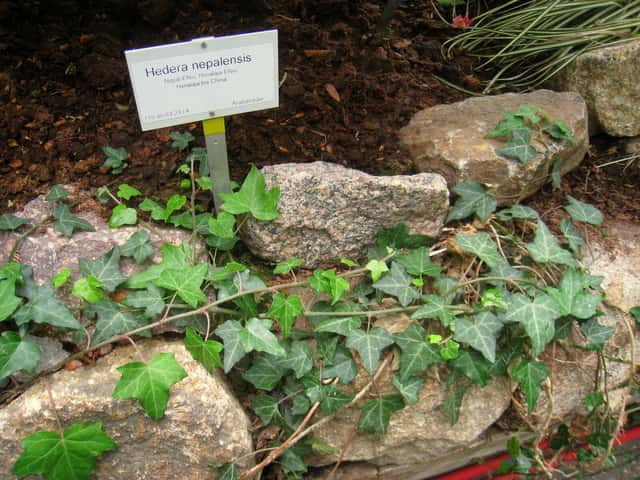
Araliaceae
Himalayan Ivy (Hedera nepalensis)
Hedera nepalensis
An easy climber for part to full shade in rich, moist, well-drained soil. Good on walls and as ground cover. All parts are poisonous: keep it away from children and pets.
Every 7 days
Partial shade
° - °C
% - %
Categories
What is Himalayan Ivy?
Himalayan Ivy (Hedera nepalensis) is a easy-care plant from the Araliaceae family. Himalayan ivy (Hedera nepalensis) is an evergreen climber in the ivy family (Araliaceae), native to the Himalaya and South-East Asia, from Afghanistan to China and Vietnam, at 1,000-3,000 m. It climbs rocks, walls and tree trunks with aerial roots and can exceed 15 m. The leaves are leathery, grey-g...
Himalayan Ivy grows up to 30.0m, watering every 7 days. It is not suitable for indoor environments and not safe for pets.
Unlike many tropical plants, Himalayan Ivy tolerates watering mistakes. Best for beginners. Without precautions, ingestion can cause irritation in pets. Keep out of reach of cats and dogs.
How to Care for Himalayan Ivy?
TLDR: Himalayan Ivy needs Partial shade, watering every 7 days, and temperatures between 15-30°C with 40-70% humidity.
How Often Should You Water Himalayan Ivy?
Water regularly in the first year, about once a week, to establish the roots. After that, water when the surface dries, without waterlogging.
How Much Light Does Himalayan Ivy Need?
Part shade to full shade; it takes gentle sun but prefers a sheltered spot.
What Is the Best Soil for Himalayan Ivy?
Fertile, humus-rich soil that stays moist but drains well; tolerates a wide pH range.
What Pot Should You Use for Himalayan Ivy?
A large planter with drainage holes, with a support or wall to climb.
What Is Himalayan Ivy and Where Does It Come From?
Himalayan ivy (Hedera nepalensis) is an evergreen climber in the ivy family (Araliaceae), native to the Himalaya and South-East Asia, from Afghanistan to China and Vietnam, at 1,000-3,000 m. It climbs rocks, walls and tree trunks with aerial roots and can exceed 15 m. The leaves are leathery, grey-green with paler veins, triangular to lance-shaped, often with two basal lobes. From fall to winter it bears small yellowish flowers followed by orange to reddish berries. It is a little less cold hardy than common ivy.
How to Propagate Himalayan Ivy?
Stem cuttings
Wear gloves: the sap can irritate skin.
- 1 Cut 10-15 cm pieces of young stem with a few nodes
- 2 Remove the lower leaves
- 3 Insert into moist mix or stand in water until rooted
- 4 Keep in light shade
Materials needed:
Layering
Stems already running along the ground often root by themselves.
- 1 Lay a trailing stem on the soil
- 2 Pin a node down and cover with soil
- 3 Sever from the parent once rooted
Materials needed:
How Big Does Himalayan Ivy Grow?
TLDR: Himalayan Ivy can reach up to 30.0m tall with Medium growth rate.
Max height
30.0m
Growth rate
Medium
Foliage
Evergreen
Warning: Toxic Plant
This plant can be toxic if ingested. Keep out of reach of:
Plant Uses
Ornamental
Great for decoration
Ground Cover
Soil coverage
Is your plant showing symptoms?
Click on the symptom to discover possible causes:
What Diseases Commonly Affect Himalayan Ivy?
TLDR: Himalayan Ivy is susceptible to 4 known diseases. Monitor regularly for early detection.
Slugs and Snails
Slugs and snails are mollusks that feed on plant tissue, causing irregular holes in leaves and damage to young seedlings. They are most active at night and in moist conditions, leaving characteristic silvery slime trails. These pests can quickly devastate gardens, especially during wet seasons.
Spider Mites
Spider mites are tiny arachnids (less than 1/20 inch long) related to spiders and ticks that feed on plant sap. They thrive in hot, dry conditions and can cause significant damage to ornamental and vegetable plants. During severe infestations, crop losses can reach 14% or higher as these pests disrupt vital plant processes including photosynthesis, carbon dioxide absorption, and transpiration.
Scale Insects
Scale insects are small sap-sucking pests that appear as brown, shell-like bumps on plant stems and leaves. There are over 25 species, divided into armored (hard) and unarmored (soft) scales. They feed by piercing plant tissue and extracting sap, which weakens the plant and can lead to yellowing, stunted growth, and even death if left untreated. They also excrete honeydew, which attracts ants and promotes sooty mold growth.
Bacterial Leaf Spot
Bacterial leaf spot is a plant disease caused by bacteria in the Xanthomonas and Pseudomonas genera that affects various ornamental and edible plants. The bacteria infect leaves through wounds or natural openings, causing characteristic lesions that can lead to premature leaf drop and plant weakening.
Fun Facts
Its berries ripen orange to red, unlike the black berries of English ivy.
In the wild it grows at 1,000-3,000 m.
It climbs trunks and rocks with aerial roots and needs no tying in.
Frequently asked questions
Is Himalayan ivy poisonous?
Does it like sun?
How is it different from English ivy?
How do I propagate it?
Compare with similar plants
| Attribute | Difficulty | Light | Watering | Pet Safe |
|---|---|---|---|---|
| Field Maple | Easy | Bright indirect | 14d | ✓ |
| Iberian Houseleek | Easy | Direct sun | 14d | ✓ |
| Silver Birch | Easy | Direct sun | 14d | ✓ |
| Common Blanketflower | Easy | Direct sun | 10d | ✓ |
Choose & Compare
Sources & References
- Wikipedia - Hedera nepalensis
- Trees and Shrubs Online - Hedera nepalensis
- Plantlust - Hedera nepalensis (search snippet: sun to mostly shade, rich well-drained soil)
- Rob's Plants - Hedera nepalensis (search snippet: USDA 7-10)
- Rita's Garden Path - Nepal ivy (var. sinensis) (search snippet)
- Harvest to Table - How to grow Hedera (genus-level: slugs/snails)





