Orchidaceae
Honohono Orchid (Dendrobium anosmum): Care Guide & Growing Tips
Dendrobium anosmum
A medium-difficulty orchid requiring bright indirect light, high humidity, and excellent air circulation. Needs a distinct dry rest period in autumn-winter to trigger spring flowering. Fertilize every two weeks during active growth. Best grown in hanging baskets or mounted on cork bark.
Every 4 days
Bright indirect
15° - 30°C
70% - 90%
Categories
What is Honohono Orchid?
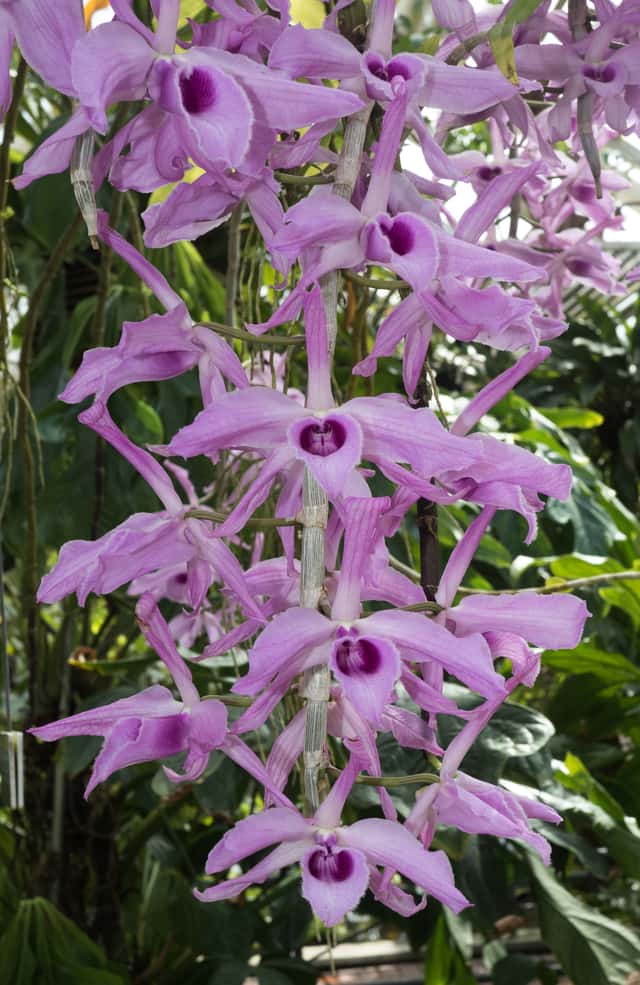
Honohono Orchid (Dendrobium anosmum) is a medium-care plant from the Orchidaceae family. Dendrobium anosmum, commonly known as the honohono orchid or sanggumay, is a pendulous epiphytic orchid native to the Philippines, New Guinea, Thailand, and Sri Lanka. It produces long, cane-like deciduous pseudobulbs adorned with fragrant flowers in shades of pink, white, and lavender-purple, bloom...
Honohono Orchid grows up to 1.3m, spread of 60cm, watering every 4 days, 15°C – 30°C, 70–90% humidity. It is suitable for indoor environments and safe for pets.
Unlike many popular species, Honohono Orchid is safe to keep around pets. Without adequate drainage, root rot can develop within 8 days.
How to Care for Honohono Orchid?
TLDR: Honohono Orchid needs Bright indirect, watering every 4 days, and temperatures between 15-30°C with 70-90% humidity.
How Often Should You Water Honohono Orchid?
Water every 2-4 days during the growing season (spring through summer), allowing the medium to dry slightly between waterings. In autumn and winter, gradually reduce watering to once a week or less to encourage dormancy and subsequent flowering. Never allow the roots to sit in standing water.
How Much Light Does Honohono Orchid Need?
Provide bright indirect light, equivalent to 10,000-30,000 lux. An east- or west-facing windowsill with a sheer curtain is ideal. Insufficient light results in dark green leaves and poor flowering; too much direct sun causes leaf scorch.
What Is the Best Soil for Honohono Orchid?
Use a fast-draining epiphytic orchid mix of coarse bark, charcoal, and perlite. Hanging wooden baskets or cork bark mounts best replicate natural growing conditions and promote healthy roots. Avoid dense, moisture-retaining mixes.
What Pot Should You Use for Honohono Orchid?
Hanging wooden baskets or small terracotta pots with ample drainage holes. Cork bark or tree-fern slab mounts are ideal as they mimic the orchid's natural epiphytic habitat and provide excellent root aeration.
Care Schedule
Fertilize
Every 14 days
Misting
Every 2 days
Repot
Every 730 days
What Is Honohono Orchid and Where Does It Come From?
Dendrobium anosmum, commonly known as the honohono orchid or sanggumay, is a pendulous epiphytic orchid native to the Philippines, New Guinea, Thailand, and Sri Lanka. It produces long, cane-like deciduous pseudobulbs adorned with fragrant flowers in shades of pink, white, and lavender-purple, blooming profusely in spring. Despite the misleading epithet "anosmum" (odorless), most plants emit a delightfully sweet fragrance.
How to Propagate Honohono Orchid?
Division
Divide immediately after flowering when new roots are just emerging. Always use sterilized tools to prevent disease spread. Dust cuts with powdered fungicide.
- 1 Remove plant from pot or mount right after flowering when new roots are emerging
- 2 Divide pseudobulbs into groups of 3-5, ensuring each division has healthy roots
- 3 Place each division in fresh orchid medium in a small pot or wooden basket
- 4 Keep lightly moist in bright indirect light until established
Materials needed:
Pseudobulb Cutting (Keiki Method)
Old pseudobulbs naturally produce keikis (plantlets) at their nodes. Once detached with established roots, these grow into independent plants.
- 1 Cut old leafless pseudobulbs with at least 2-3 nodes after flowering
- 2 Lay them horizontally on moist sphagnum moss or perlite
- 3 Maintain high humidity (70-80%) and moderate indirect light
- 4 Wait for keikis (baby plants) to develop at nodes; detach once they have 3-5 cm roots
Materials needed:
How Big Does Honohono Orchid Grow?
TLDR: Honohono Orchid can reach up to 1.3m tall with Medium growth rate.
Max height
1.3m
Spread
60cm
Growth rate
Medium
Foliage
Deciduous
Plant Uses
Ornamental
Great for decoration
Aromatic
Pleasant fragrance
Is your plant showing symptoms?
Click on the symptom to discover possible causes:
What Diseases Commonly Affect Honohono Orchid?
TLDR: Honohono Orchid is susceptible to 14 known diseases. Monitor regularly for early detection.
Root Rot
Root rot is a serious fungal disease that affects the root system of plants, causing them to decay and die. It is primarily caused by overwatering, poor drainage, or soil-borne fungi such as Pythium, Phytophthora, Rhizoctonia, and Fusarium. The disease thrives in waterlogged conditions where roots are deprived of oxygen, making them susceptible to fungal infection.
Phytophthora Blight
Devastating fungal disease caused by Phytophthora species (primarily P. capsici and P. infestans), famously responsible for the Irish Potato Famine in the 1840s. Affects all plant parts including roots, stems, leaves, and fruits in warm, wet conditions. The pathogen is technically an oomycete (water mold) that thrives in saturated soils and can survive in soil for 5+ years.
Leaf Spot
Leaf spot is a common fungal disease caused by various pathogens including Alternaria, Ascochyta, Colletotrichum, Septoria, and Venturia. It primarily affects leaves, causing discolored spots that can lead to premature leaf drop if left untreated.
Bacterial Soft Rot
Bacterial soft rot is a destructive plant disease caused primarily by bacteria from the genera Pectobacterium (formerly Erwinia) and Dickeya. These bacteria produce enzymes that break down plant cell walls, causing rapid and foul-smelling tissue decomposition. It mainly affects succulent tissues such as tubers, fruits, stems, and bulbs, being especially problematic in warm and humid conditions.
Meaning & Symbolism
In the Philippines, the sanggumay orchid symbolizes natural beauty, tropical elegance, and the rich biodiversity of Southeast Asian flora.
Fun Facts
Despite its name "anosmum" meaning odorless in Latin, most Dendrobium anosmum plants actually produce a delightfully sweet, raspberry-like fragrance, especially in the morning.
The honohono orchid is celebrated in the Philippines as the "sanggumay," and its blooms are frequently used in traditional garlands and offerings.
Each pseudobulb flowers only once, but a mature plant can produce dozens of pseudobulbs, creating a spectacular cascading display of hundreds of flowers.
The flowers emerge from bare, leafless canes in late winter before the new leaves appear, making it one of the most dramatic floral displays in the orchid world.
Frequently asked questions
How often should I water my honohono orchid?
Why did my Dendrobium anosmum drop all its leaves?
How do I get my honohono orchid to bloom?
Is the honohono orchid toxic to pets?
What is the best medium for growing Dendrobium anosmum?
Compare with similar plants
| Attribute | Difficulty | Light | Watering | Pet Safe |
|---|---|---|---|---|
| Dark Fieldcap | Medium | Low light | 2d | ⚠️ |
| Azalea | Medium | Partial shade | 3d | ⚠️ |
| Muriel's Bamboo | Medium | Partial shade | 3d | ✓ |
| Bougainvillea | Medium | Direct sun | 7d | ⚠️ |



