Malvaceae
Country Mallow: Full Sun Plant
Sida cordifolia
Country mallow is a tough, sun-loving subshrub that thrives with at least 6 hours of direct light daily, infrequent watering once the soil dries out, and well-draining, slightly acidic to neutral soil. It tolerates heat and poor soil well but dislikes soggy roots and low light.
Every 9 days
Direct sun
15° - 35°C
30% - 60%
Categories
What is Country Mallow?
Country Mallow (Sida cordifolia) is a easy-care plant from the Malvaceae family. Sida cordifolia, commonly called country mallow or flannel weed, is a perennial subshrub in the mallow family (Malvaceae) native to India and now naturalized throughout the tropics and subtropics. It grows 50-200 cm tall on branched, woody-based stems, with heart-shaped, velvety leaves covered in so...
Country Mallow grows up to 2.0m, spread of 100cm, watering every 9 days, 15°C – 35°C, 30–60% humidity. It is suitable for indoor environments and not safe for pets.
Unlike many tropical plants, Country Mallow tolerates watering mistakes. Best for beginners. Without precautions, ingestion can cause irritation in pets. Keep out of reach of cats and dogs. Without adequate drainage, root rot can develop within 18 days.
How to Care for Country Mallow?
TLDR: Country Mallow needs Direct sun, watering every 9 days, and temperatures between 15-35°C with 30-60% humidity.
How Often Should You Water Country Mallow?
Let the soil dry out almost completely between waterings - this plant is drought-tolerant and overwatering is the main cause of root rot. Water deeply, then wait until the top several centimeters are dry before watering again.
How Much Light Does Country Mallow Need?
Give it full, direct sun for at least 6 hours a day. It does not perform well in low light and will grow leggy with poor flowering if shaded.
What Is the Best Soil for Country Mallow?
Use a light, well-draining sandy-loamy mix with a slightly acidic to neutral pH (around 6-7.5). Good drainage is essential to prevent root rot.
What Pot Should You Use for Country Mallow?
An unglazed terracotta pot with ample drainage holes suits this plant best, letting excess moisture evaporate and protecting its drought-adapted roots from staying wet.
Care Schedule
Fertilize
Every 30 days
Rotate
Every 14 days
Repot
Every 365 days
What Is Country Mallow and Where Does It Come From?
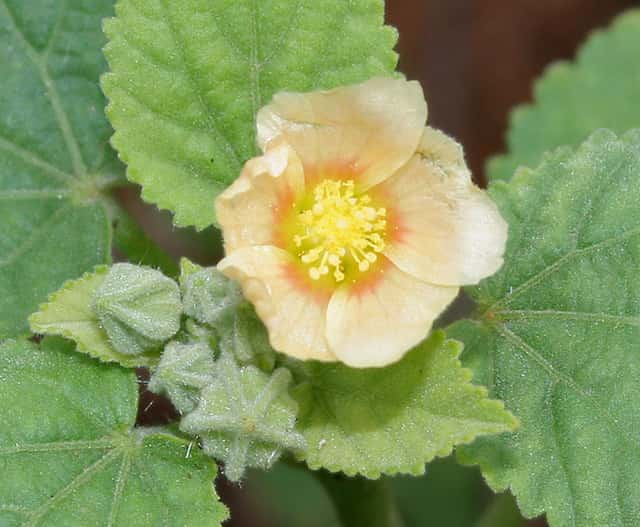
Sida cordifolia, commonly called country mallow or flannel weed, is a perennial subshrub in the mallow family (Malvaceae) native to India and now naturalized throughout the tropics and subtropics. It grows 50-200 cm tall on branched, woody-based stems, with heart-shaped, velvety leaves covered in soft white hairs and small yellow flowers, sometimes with orange centers. Long valued in Ayurvedic medicine as "Bala," it has also spread widely as a roadside and pasture weed, and is now considered invasive in parts of Africa, Australia, the southern United States, and several Pacific islands.
How to Propagate Country Mallow?
Seed Propagation
Seeds have a hard coat and may benefit from a brief soak in warm water before sowing to improve germination.
- 1 Sow seeds 0.5-1 cm deep in a well-draining, sandy-loamy mix
- 2 Keep soil lightly moist and in a warm spot (20-30C) until germination
- 3 Thin or transplant seedlings once they have 2-3 true leaves
- 4 Harden off before moving to full sun outdoors
Materials needed:
How Big Does Country Mallow Grow?
TLDR: Country Mallow can reach up to 2.0m tall with Fast growth rate.
Max height
2.0m
Spread
1.0m
Growth rate
Fast
Foliage
Evergreen
Warning: Toxic Plant
This plant can be toxic if ingested. Keep out of reach of:
Plant Uses
Medicinal
Medicinal properties
Medicinal Uses
- Known as "Bala" (Sanskrit for "strength") in Ayurvedic, Unani and Siddha medicine, traditionally used as a Rasayana (restorative tonic) for vitality.
- Folk use across India, Brazil ("malva branca") and parts of Africa for respiratory complaints such as asthma, nasal congestion and coughs.
- Also used traditionally for inflammation, rheumatism, fevers, and as a wound-healing poultice.
- Contains alkaloids including ephedrine and pseudoephedrine (the same class found in Ephedra); reported levels are low (roughly 0.8-1.2% in the whole plant) but variable, and some analyses detect none at all - its presence remains scientifically contested.
- CAUTION: sustained or high-dose use carries real cardiovascular risk (rapid heart rate, elevated blood pressure, arrhythmia); the plant has drawn the same regulatory scrutiny as ephedra-based weight-loss and performance supplements, several of which are restricted or banned in the US and elsewhere.
- Not recommended for therapeutic use without medical supervision; contraindicated for people with hypertension or heart conditions, or those taking other stimulants. Informational only - not a recommendation for self-medication.
Is your plant showing symptoms?
Click on the symptom to discover possible causes:
What Diseases Commonly Affect Country Mallow?
TLDR: Country Mallow is susceptible to 6 known diseases. Monitor regularly for early detection.
Root Rot
Root rot is a serious fungal disease that affects the root system of plants, causing them to decay and die. It is primarily caused by overwatering, poor drainage, or soil-borne fungi such as Pythium, Phytophthora, Rhizoctonia, and Fusarium. The disease thrives in waterlogged conditions where roots are deprived of oxygen, making them susceptible to fungal infection.
Aphids
Aphids are small, soft-bodied, pear-shaped insects (1/16 to 1/8 inch long) that feed by sucking nutrient-rich sap from plants. They reproduce rapidly and can quickly weaken plants, causing distorted growth and transmitting plant viruses. Aphids come in various colors including green, black, red, yellow, brown, and gray. They secrete honeydew, a sticky substance that attracts ants and encourages sooty mold growth.
Whiteflies
Whiteflies are small, soft-bodied, winged insects closely related to aphids and mealybugs. They are moth-like in appearance, about 1/16 inch long, triangular in shape, and gray-white in color. These sap-sucking pests feed on plant tissue, causing yellowing, stunted growth, and wilting. They also excrete honeydew, which attracts ants and promotes sooty mold growth. Whiteflies can transmit serious plant viruses.
Spider Mites
Spider mites are tiny arachnids (less than 1/20 inch long) related to spiders and ticks that feed on plant sap. They thrive in hot, dry conditions and can cause significant damage to ornamental and vegetable plants. During severe infestations, crop losses can reach 14% or higher as these pests disrupt vital plant processes including photosynthesis, carbon dioxide absorption, and transpiration.
Meaning & Symbolism
In Ayurveda the plant is known as Bala, Sanskrit for "strength," reflecting its traditional role as a rejuvenating tonic (Rasayana) believed to restore physical vitality.
Compare with similar plants
| Attribute | Difficulty | Light | Watering | Pet Safe |
|---|---|---|---|---|
| Field Maple | Easy | Bright indirect | 14d | ✓ |
| Silver Birch | Easy | Direct sun | 14d | ✓ |
| Common Blanketflower | Easy | Direct sun | 10d | ✓ |
| Cushion Bush | Easy | Direct sun | 14d | ✓ |





