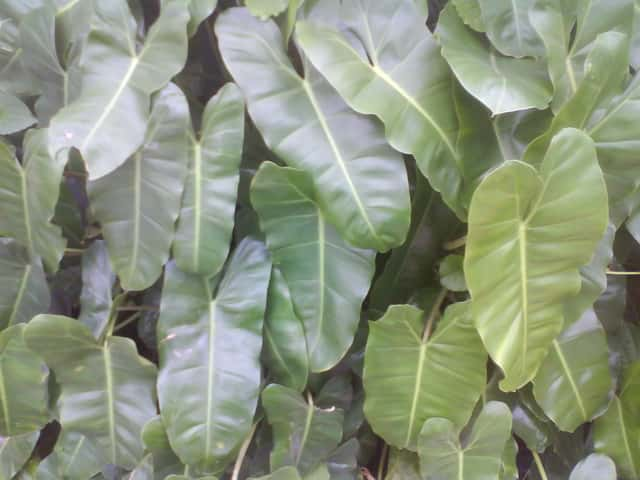
Araceae
Imbe Philodendron (Philodendron imbe)
Philodendron imbe
An easy indoor philodendron: bright, indirect light, water when the top of the mix dries and warmth between 18 and 30 °C. Give it a moss pole or stake to climb for bigger leaves. Feed monthly during the growing season. It is toxic if chewed, so keep it away from pets and children.
Every 7 days
Partial shade
15° - 30°C
50% - 80%
Categories
What is Imbe Philodendron?
Imbe Philodendron (Philodendron imbe) is a easy-care plant from the Araceae family. Philodendron imbe is a climbing philodendron in the arum family (Araceae), described in the 19th century from Atlantic Forest plants in Rio de Janeiro, Brazil. It has large, leathery, glossy green leaves shaped like elongated hearts, with prominent veins and long petioles, and its stems send out aer...
Imbe Philodendron grows up to 4.9m, watering every 7 days, 15°C – 30°C, 50–80% humidity. It is suitable for indoor environments and not safe for pets.
Unlike many tropical plants, Imbe Philodendron tolerates watering mistakes. Best for beginners. Without precautions, ingestion can cause irritation in pets. Keep out of reach of cats and dogs. Without adequate drainage, root rot can develop within 14 days.
How to Care for Imbe Philodendron?
TLDR: Imbe Philodendron needs Partial shade, watering every 7 days, and temperatures between 15-30°C with 50-80% humidity.
How Often Should You Water Imbe Philodendron?
Water when the top 2–5 cm of mix is dry, usually about once a week in warm weather and less in winter. Both overwatering and underwatering make the leaves droop; never leave water standing in the saucer.
How Much Light Does Imbe Philodendron Need?
Bright, indirect light. It tolerates a few hours of gentle sun, but strong sun yellows and scorches the leaves; in low light new leaves come in smaller.
What Is the Best Soil for Imbe Philodendron?
A well-drained, airy mix, slightly acidic to neutral (pH 5.5–7): potting soil with coir or peat, perlite and orchid bark.
What Pot Should You Use for Imbe Philodendron?
A pot with drainage holes, only slightly larger than the root ball, with a moss pole or stake set in the centre. Repot every 2 years.
Care Schedule
Fertilize
Every 30 days
Repot
Every 730 days
What Is Imbe Philodendron and Where Does It Come From?
Philodendron imbe is a climbing philodendron in the arum family (Araceae), described in the 19th century from Atlantic Forest plants in Rio de Janeiro, Brazil. It has large, leathery, glossy green leaves shaped like elongated hearts, with prominent veins and long petioles, and its stems send out aerial roots that grip trunks and supports. With support it grows fast to about 5 m. A taxonomic twist: the original species is thought to be possibly extinct in the wild, and plants sold today as "imbe" are most likely its close relative Philodendron acutatum — care is the same.
How to Propagate Imbe Philodendron?
Stem cutting
Use clean shears and gloves, as the sap irritates skin. Cuttings with an aerial root root faster.
- 1 Cut a stem section with at least one node, one leaf and, ideally, an aerial root.
- 2 Place the node in water, damp sphagnum moss or perlite.
- 3 Keep warm and in indirect light, changing the water weekly.
- 4 Once roots are 3-5 cm long, pot up in free-draining mix.
Materials needed:
Air layering
A good method for large plants on a pole, with no risk of losing the cutting.
- 1 Pick a node with an aerial root on the stem.
- 2 Wrap the node in damp sphagnum moss and cover with plastic.
- 3 Keep the moss moist until roots appear.
- 4 Cut below the new roots and pot up.
Materials needed:
How Big Does Imbe Philodendron Grow?
TLDR: Imbe Philodendron can reach up to 4.9m tall with Fast growth rate.
Max height
4.9m
Growth rate
Fast
Foliage
Evergreen
Warning: Toxic Plant
This plant can be toxic if ingested. Keep out of reach of:
Plant Uses
Ornamental
Great for decoration
Is your plant showing symptoms?
Click on the symptom to discover possible causes:
What Diseases Commonly Affect Imbe Philodendron?
TLDR: Imbe Philodendron is susceptible to 6 known diseases. Monitor regularly for early detection.
Root Rot
Root rot is a serious fungal disease that affects the root system of plants, causing them to decay and die. It is primarily caused by overwatering, poor drainage, or soil-borne fungi such as Pythium, Phytophthora, Rhizoctonia, and Fusarium. The disease thrives in waterlogged conditions where roots are deprived of oxygen, making them susceptible to fungal infection.
Scale Insects
Scale insects are small sap-sucking pests that appear as brown, shell-like bumps on plant stems and leaves. There are over 25 species, divided into armored (hard) and unarmored (soft) scales. They feed by piercing plant tissue and extracting sap, which weakens the plant and can lead to yellowing, stunted growth, and even death if left untreated. They also excrete honeydew, which attracts ants and promotes sooty mold growth.
Mosaic Virus
Mosaic virus is a group of plant viruses that cause mottled, patchy patterns on leaves and can affect a wide variety of plants. The virus creates characteristic yellow, white, and green mosaic patterns, often accompanied by stunted growth and deformed plant parts. This highly contagious disease spreads rapidly through insect vectors and contaminated tools.
Mealybugs
Mealybugs are small, soft-bodied insects covered with a white, waxy, cottony material. They are common pests of houseplants and outdoor plants in mild climates. These sap-sucking insects feed on plant tissue, causing damage, stunted growth, and can lead to plant death if left untreated. They produce sticky honeydew which attracts sooty mold.
Fun Facts
Its name comes from "imbé", a Tupi-derived word used in Brazil for several climbing philodendrons.
The original species from Rio de Janeiro is thought to be possibly extinct in the wild.
Many plants sold as "imbe" are actually Philodendron acutatum.
Frequently asked questions
How often should I water Philodendron imbe?
Is Philodendron imbe toxic to cats and dogs?
Does it need a moss pole?
Why are new leaves small?
Compare with similar plants
| Attribute | Difficulty | Light | Watering | Pet Safe |
|---|---|---|---|---|
| Field Maple | Easy | Bright indirect | 14d | ✓ |
| Iberian Houseleek | Easy | Direct sun | 14d | ✓ |
| Silver Birch | Easy | Direct sun | 14d | ✓ |
| Common Blanketflower | Easy | Direct sun | 10d | ✓ |





