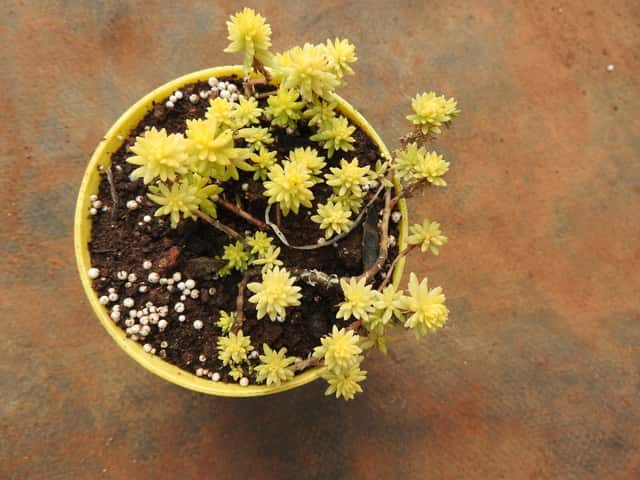
Crassulaceae
Japanese Stonecrop (Sedum japonicum)
Sedum japonicum
It wants direct sun and soil that drains. Once established it can handle a month without rain, and too much water is what usually does it in. In shade, 'Tokyo Sun' loses its yellow and turns green.
Every 14 days
Direct sun
-15° - °C
% - %
Categories
What is Japanese Stonecrop?
Japanese Stonecrop (Sedum japonicum) is a easy-care plant from the Crassulaceae family. Japanese stonecrop is a low, creeping succulent that stays green all year and covers the ground like a mat. It's native to East Asia, from southeastern China to Korea, Japan and Taiwan, where it grows on rocks and slopes. The shoots stay 1 to 2 in (2 to 4 cm) tall, and flower stems reach 4 to 8 in (...
Japanese Stonecrop grows up to 20cm, spread of 15cm, watering every 14 days. It is suitable for indoor environments and safe for pets.
Unlike many tropical plants, Japanese Stonecrop tolerates watering mistakes. Best for beginners. Unlike many popular species, Japanese Stonecrop is safe to keep around pets. Without adequate drainage, root rot can develop within 28 days.
How to Care for Japanese Stonecrop?
TLDR: Japanese Stonecrop needs Direct sun, watering every 14 days, and temperatures between -15-30°C with 40-70% humidity.
How Often Should You Water Japanese Stonecrop?
Water deeply, then wait until the soil is completely dry before watering again, usually about 14 days. A pot with no drainage hole will rot the roots.
How Much Light Does Japanese Stonecrop Need?
Full sun is best. In low light the yellow fades. Where summers are extremely hot, it may need afternoon shade.
What Is the Best Soil for Japanese Stonecrop?
Light soil with coarse sand or perlite that doesn't hold water. It does fine in poor soil, walls and rock gardens.
What Pot Should You Use for Japanese Stonecrop?
A shallow, wide pot with drainage holes, or a window box. It spreads sideways and can trail over the edge.
What Is Japanese Stonecrop and Where Does It Come From?
Japanese stonecrop is a low, creeping succulent that stays green all year and covers the ground like a mat. It's native to East Asia, from southeastern China to Korea, Japan and Taiwan, where it grows on rocks and slopes. The shoots stay 1 to 2 in (2 to 4 cm) tall, and flower stems reach 4 to 8 in (10 to 20 cm). In summer it puts out masses of small golden star-shaped flowers. The one you'll usually find for sale is 'Tokyo Sun', with bright yellow leaves.
How to Propagate Japanese Stonecrop?
Dividing the clump
This is the easiest way to get new plants and works through most of the growing season.
- 1 Pull off a piece of the clump with its roots
- 2 Plant it in a pot of fast-draining soil
- 3 Keep it in light shade until it settles in
- 4 Move it to its final spot once it's growing
Materials needed:
How Big Does Japanese Stonecrop Grow?
TLDR: Japanese Stonecrop can reach up to 20cm tall with Fast growth rate.
Max height
20cm
Spread
15cm
Growth rate
Fast
Foliage
Evergreen
Warning: Toxic Plant
This plant can be toxic if ingested. Keep out of reach of:
Plant Uses
Ornamental
Great for decoration
Ground Cover
Soil coverage
Is your plant showing symptoms?
Click on the symptom to discover possible causes:
What Diseases Commonly Affect Japanese Stonecrop?
TLDR: Japanese Stonecrop is susceptible to 8 known diseases. Monitor regularly for early detection.
Root Rot
Root rot is a serious fungal disease that affects the root system of plants, causing them to decay and die. It is primarily caused by overwatering, poor drainage, or soil-borne fungi such as Pythium, Phytophthora, Rhizoctonia, and Fusarium. The disease thrives in waterlogged conditions where roots are deprived of oxygen, making them susceptible to fungal infection.
Crown Rot
Crown rot is a serious fungal disease that attacks the crown (base) of the plant where the stem meets the soil. It is caused by various fungal pathogens including Phytophthora, Fusarium, and Rhizoctonia. The disease thrives in waterlogged conditions and can quickly spread to kill the entire plant if not addressed promptly.
Aphids
Aphids are small, soft-bodied, pear-shaped insects (1/16 to 1/8 inch long) that feed by sucking nutrient-rich sap from plants. They reproduce rapidly and can quickly weaken plants, causing distorted growth and transmitting plant viruses. Aphids come in various colors including green, black, red, yellow, brown, and gray. They secrete honeydew, a sticky substance that attracts ants and encourages sooty mold growth.
Slugs and Snails
Slugs and snails are mollusks that feed on plant tissue, causing irregular holes in leaves and damage to young seedlings. They are most active at night and in moist conditions, leaving characteristic silvery slime trails. These pests can quickly devastate gardens, especially during wet seasons.
Fun Facts
In the wild it grows on rocks and slopes up to about 3,300 ft (1,000 m)
Rabbits tend to leave sedums alone, but slugs go after them
Frequently asked questions
How often should I water Japanese stonecrop?
Why did my sedum lose its yellow color?
How cold can it get?
Is Japanese stonecrop toxic to cats and dogs?
Compare with similar plants
| Attribute | Difficulty | Light | Watering | Pet Safe |
|---|---|---|---|---|
| Field Maple | Easy | Bright indirect | 14d | ✓ |
| Iberian Houseleek | Easy | Direct sun | 14d | ✓ |
| Silver Birch | Easy | Direct sun | 14d | ✓ |
| Common Blanketflower | Easy | Direct sun | 10d | ✓ |





