Myrtaceae
Java plum (Syzygium cumini)
Syzygium cumini
An easy tree for warm climates. Plant it in full sun with at least 6 hours of direct light, in well-drained soil rich in organic matter. Water regularly for the first years; once established it tolerates drought and even flooding. Young trees are frost tender. Pruning keeps it at a manageable size and makes harvesting easier. Seedlings start fruiting at 8 to 10 years, grafted trees at 4 to 7.
Every 7 days
Direct sun
-4° - °C
% - %
Categories
What is Java plum?
Java plum (Syzygium cumini) is a easy-care plant from the Myrtaceae family. Java plum (Syzygium cumini), also called jamun or jambolan, is an evergreen tree in the myrtle family native to India, Myanmar and Sri Lanka. It grows fast and can reach 30 m, with a dense crown and thick, glossy leaves that are pinkish when young and smell of turpentine when crushed. Fragrant white...
Java plum grows up to 30.0m, watering every 7 days. It is not suitable for indoor environments and safe for pets.
Unlike many tropical plants, Java plum tolerates watering mistakes. Best for beginners. Unlike many popular species, Java plum is safe to keep around pets.
How to Care for Java plum?
TLDR: Java plum needs Direct sun, watering every 7 days, and temperatures between -4-30°C with 40-70% humidity.
How Often Should You Water Java plum?
Keep the soil moist for the first 2 to 3 years, watering about once a week without rain. Mature trees tolerate drought and only need water during long dry spells. Dry weather during flowering and fruiting helps the crop.
How Much Light Does Java plum Need?
Full sun, with at least 6 hours of direct sun a day. In shade it flowers and fruits poorly.
What Is the Best Soil for Java plum?
Best in well-drained soil rich in organic matter, but it adapts to sand, loam, clay, limestone and wet low ground.
What Pot Should You Use for Java plum?
It can grow in a large container (60 L or more) with drainage holes if pruned to size; in-ground planting is best.
What Is Java plum and Where Does It Come From?
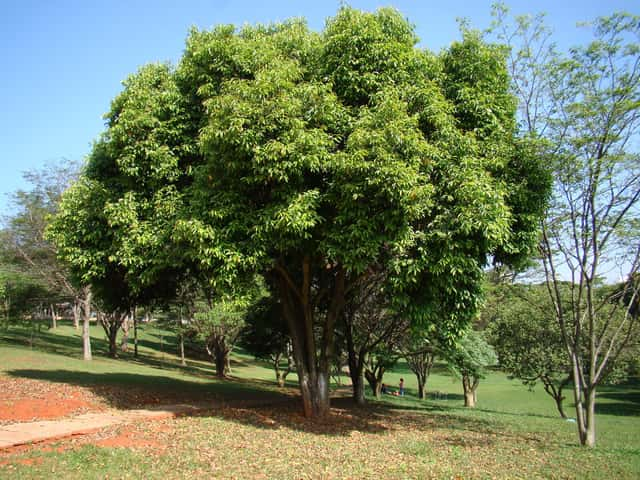
Java plum (Syzygium cumini), also called jamun or jambolan, is an evergreen tree in the myrtle family native to India, Myanmar and Sri Lanka. It grows fast and can reach 30 m, with a dense crown and thick, glossy leaves that are pinkish when young and smell of turpentine when crushed. Fragrant white to pinkish flowers attract bees and butterflies. The oval fruits turn from green to purple and then nearly black, stain hands and taste sweet with an astringent edge. It is widely planted in the tropics for fruit and shade, and has become invasive in South Florida, Hawaii and South Africa.
How to Propagate Java plum?
Seed
Seeds lose viability quickly, so sow within a few days. Seedlings take 8 to 10 years to fruit.
- 1 Take seeds from fully ripe fruit
- 2 Wash off the pulp
- 3 Sow right away, 1 to 2 cm deep, in moist mix
- 4 Keep warm and in bright light
- 5 Plant out when the seedling is about 30 cm tall
Materials needed:
Air layering
Layered or grafted trees fruit much sooner than seedlings, in 4 to 7 years.
- 1 Pick a branch 1 to 2 cm thick
- 2 Remove a 2 to 3 cm ring of bark
- 3 Wrap with moist moss or mix and cover with plastic
- 4 Once roots show, cut below the layer and pot it up
Materials needed:
How Big Does Java plum Grow?
TLDR: Java plum can reach up to 30.0m tall with Fast growth rate.
Max height
30.0m
Growth rate
Fast
Foliage
Evergreen
Plant Uses
Ornamental
Great for decoration
Edible
Can be consumed
Medicinal
Medicinal properties
Medicinal Uses
- In folk medicine, seed and leaf teas are used to lower blood sugar; animal studies on the seed exist, but there is no clinical proof.
- Bark and leaves are used for gargles and for diarrhea in Indian tradition.
Culinary Uses
- Ripe fruit is eaten fresh, sometimes with salt to cut the astringency.
- The fruit is made into jam, jelly, juice, sorbet, syrup, wine and vinegar.
- Its purple pigment (anthocyanins) is used as a natural food coloring.
Is your plant showing symptoms?
Click on the symptom to discover possible causes:
What Diseases Commonly Affect Java plum?
TLDR: Java plum is susceptible to 8 known diseases. Monitor regularly for early detection.
Anthracnose
Anthracnose is a fungal disease caused by fungi in the genus Colletotrichum that affects many plants, including vegetables, fruits, and trees. The disease thrives in cool, wet conditions, causing dark, sunken lesions on leaves, stems, flowers, and fruits.
Leaf Spot
Leaf spot is a common fungal disease caused by various pathogens including Alternaria, Ascochyta, Colletotrichum, Septoria, and Venturia. It primarily affects leaves, causing discolored spots that can lead to premature leaf drop if left untreated.
Phyllosticta Leaf Spot
Phyllosticta is a genus of fungi responsible for leaf spot diseases in a wide range of garden and indoor plants. These pathogens thrive in warm, humid conditions, spreading primarily through water splash and prolonged leaf wetness. Symptoms typically include small, circular lesions that transition from tan or light brown to having distinct dark brown or black margins. As the disease progresses, these spots may coalesce, leading to chlorosis (yellowing) and premature abscission (leaf drop). Characteristic pycnidia—tiny, black, pinhead-sized fruiting bodies—often develop within the lesions. Phyllosticta commonly affects ornamentals like hydrangeas, irises, peonies, lilacs, maples, and roses, as well as citrus and various fruit trees.
Root Rot
Root rot is a serious fungal disease that affects the root system of plants, causing them to decay and die. It is primarily caused by overwatering, poor drainage, or soil-borne fungi such as Pythium, Phytophthora, Rhizoctonia, and Fusarium. The disease thrives in waterlogged conditions where roots are deprived of oxygen, making them susceptible to fungal infection.
Meaning & Symbolism
Sacred in Hinduism, linked to Krishna and the worship of Ganesha, and often planted near temples. In Buddhism, the Buddha is said to have meditated in the shade of a jambu tree as a child.
Fun Facts
It can live for more than 100 years.
Its water-resistant wood was used for railway sleepers in India.
As it ripens, the fruit goes from green to pink, red, purple and almost black.
Frequently asked questions
How long does Java plum take to fruit?
Can I grow Java plum in a pot?
Is Java plum invasive?
Can it handle frost?
Compare with similar plants
| Attribute | Difficulty | Light | Watering | Pet Safe |
|---|---|---|---|---|
| Field Maple | Easy | Bright indirect | 14d | ✓ |
| Iberian Houseleek | Easy | Direct sun | 14d | ✓ |
| Silver Birch | Easy | Direct sun | 14d | ✓ |
| Common Blanketflower | Easy | Direct sun | 10d | ✓ |





