Crassulaceae
Jenny's Stonecrop (Sedum rupestre)
Sedum rupestre
Grow in full sun and lean, sharply drained soil. Water only once the soil has dried out completely, and avoid rich, fertile mixes that cause floppy, weak growth. Established plants are very drought tolerant and need almost no feeding. Trim lightly after flowering to keep the mat tidy.
Every 14 days
Bright indirect
-15° - °C
% - %
Categories
What is Jenny's Stonecrop?
Jenny's Stonecrop (Sedum rupestre) is a easy-care plant from the Crassulaceae family. Jenny's stonecrop is a low, mat-forming evergreen succulent native to central, western, and southern Europe. Its trailing stems are densely packed with narrow, cylindrical, blue-gray to gray-green leaves that resemble miniature spruce sprigs, giving rise to one of its other common names, blue spruce...
Jenny's Stonecrop grows up to 10cm, spread of 30cm, watering every 14 days. It is suitable for indoor environments and safe for pets.
Unlike many tropical plants, Jenny's Stonecrop tolerates watering mistakes. Best for beginners. Unlike many popular species, Jenny's Stonecrop is safe to keep around pets. Without adequate drainage, root rot can develop within 28 days.
How to Care for Jenny's Stonecrop?
TLDR: Jenny's Stonecrop needs Bright indirect, watering every 14 days, and temperatures between -15-30°C with 40-70% humidity.
How Often Should You Water Jenny's Stonecrop?
Let the soil dry out completely between waterings; this succulent is far more likely to suffer from overwatering and root or crown rot than from drought.
How Much Light Does Jenny's Stonecrop Need?
Give it full sun for the best foliage color; it tolerates light or partial shade but grows looser and less colorful with less light.
What Is the Best Soil for Jenny's Stonecrop?
Plant in gritty, well-draining soil — sandy or gravelly mixes are ideal. Neutral to alkaline pH is preferred, and rich or heavy, waterlogged soils should be avoided.
What Pot Should You Use for Jenny's Stonecrop?
A wide, shallow terracotta or unglazed clay pot with generous drainage holes suits its spreading, shallow-rooted habit and helps excess moisture evaporate.
What Is Jenny's Stonecrop and Where Does It Come From?
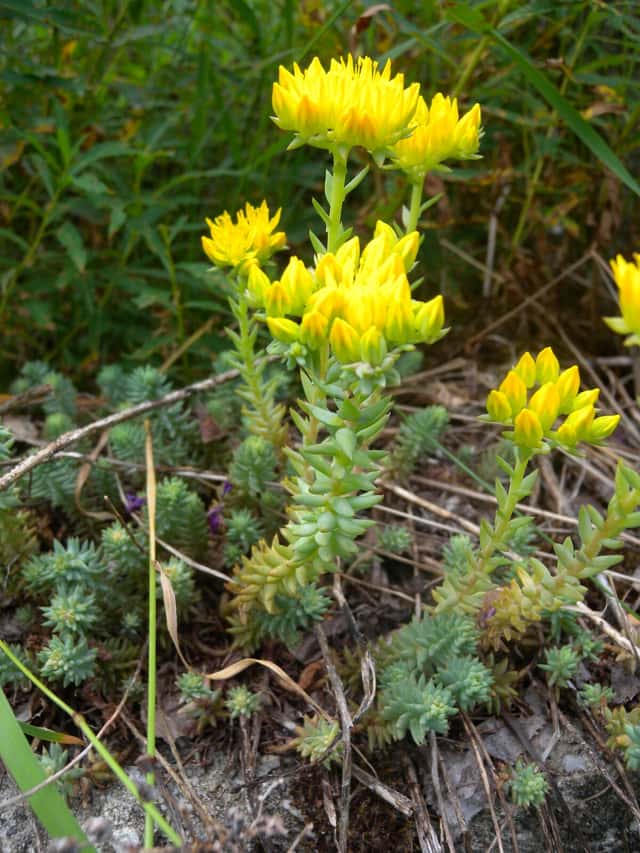
Jenny's stonecrop is a low, mat-forming evergreen succulent native to central, western, and southern Europe. Its trailing stems are densely packed with narrow, cylindrical, blue-gray to gray-green leaves that resemble miniature spruce sprigs, giving rise to one of its other common names, blue spruce stonecrop. In summer, upright flowering stems rise above the foliage mat and open into clusters of small, star-shaped yellow flowers that are pendent in bud and turn upward as they open. The plant spreads steadily by rooting along its stems, forming a dense groundcover that tolerates poor, dry soils and long dry spells once established. It is widely grown in rock gardens, on green roofs, in gravel gardens, and as a filler for containers and stone walls.
How to Propagate Jenny's Stonecrop?
Stem Cutting
Adventitious roots form quickly from the stem nodes; avoid overwatering while the cutting establishes.
- 1 Snip a healthy stem section 3-8 cm long from late spring to early autumn
- 2 Let the cut end callus over for a day or two in a dry, shaded spot
- 3 Lay or lightly press the cutting onto moist, well-draining potting mix
- 4 Keep in bright, indirect light and water sparingly until roots form
Materials needed:
How Big Does Jenny's Stonecrop Grow?
TLDR: Jenny's Stonecrop can reach up to 10cm tall with Fast growth rate.
Max height
10cm
Spread
30cm
Growth rate
Fast
Foliage
Evergreen
Plant Uses
Ground Cover
Soil coverage
Ornamental
Great for decoration
Edible
Can be consumed
Culinary Uses
- Young leaves are occasionally eaten raw in salads or cooked, with a mildly sour, astringent flavor
Is your plant showing symptoms?
Click on the symptom to discover possible causes:
What Diseases Commonly Affect Jenny's Stonecrop?
TLDR: Jenny's Stonecrop is susceptible to 7 known diseases. Monitor regularly for early detection.
Mealybugs
Mealybugs are small, soft-bodied insects covered with a white, waxy, cottony material. They are common pests of houseplants and outdoor plants in mild climates. These sap-sucking insects feed on plant tissue, causing damage, stunted growth, and can lead to plant death if left untreated. They produce sticky honeydew which attracts sooty mold.
Aphids
Aphids are small, soft-bodied, pear-shaped insects (1/16 to 1/8 inch long) that feed by sucking nutrient-rich sap from plants. They reproduce rapidly and can quickly weaken plants, causing distorted growth and transmitting plant viruses. Aphids come in various colors including green, black, red, yellow, brown, and gray. They secrete honeydew, a sticky substance that attracts ants and encourages sooty mold growth.
Scale Insects
Scale insects are small sap-sucking pests that appear as brown, shell-like bumps on plant stems and leaves. There are over 25 species, divided into armored (hard) and unarmored (soft) scales. They feed by piercing plant tissue and extracting sap, which weakens the plant and can lead to yellowing, stunted growth, and even death if left untreated. They also excrete honeydew, which attracts ants and promotes sooty mold growth.
Root Rot
Root rot is a serious fungal disease that affects the root system of plants, causing them to decay and die. It is primarily caused by overwatering, poor drainage, or soil-borne fungi such as Pythium, Phytophthora, Rhizoctonia, and Fusarium. The disease thrives in waterlogged conditions where roots are deprived of oxygen, making them susceptible to fungal infection.
Fun Facts
Its needle-like blue-gray leaves resemble spruce branches, earning it the nickname blue spruce stonecrop
It spreads indefinitely by rooting along its trailing stems, forming a dense living mat
Under stress, it can develop cactus-like fasciated (cristate) growth forms
Frequently asked questions
How often should I water Jenny's stonecrop?
Is Jenny's stonecrop toxic to cats or dogs?
How much sun does it need?
Can I eat Jenny's stonecrop?
Compare with similar plants
| Attribute | Difficulty | Light | Watering | Pet Safe |
|---|---|---|---|---|
| Field Maple | Easy | Bright indirect | 14d | ✓ |
| Silver Birch | Easy | Direct sun | 14d | ✓ |
| Common Blanketflower | Easy | Direct sun | 10d | ✓ |
| Cushion Bush | Easy | Direct sun | 14d | ✓ |
Choose & Compare
Sources & References
- Petrosedum rupestre - Wikipedia
- Sedum rupestre L. - Plants of the World Online (Kew)
- Sedum rupestre L. (reflexed stonecrop) - RHS
- Sedum rupestre - Plants For A Future (PFAF)
- Sedum Reflexum Care: How To Grow The Blue Spruce Stonecrop
- Is Sedum Poisonous to Cats? - Catster
- Sedum Rupestre: Cuidados y curiosidades - Club Suculentas
- Sedum rupestre - Wikipédia (PT)





