Fabaceae
Jerusalem thorn: Edible Plant
Parkinsonia aculeata
Prefers full sun and is drought-resistant once established. It adapts to sandy, clayey, and alkaline soils, provided they are well-drained. It requires deep and spaced watering, occasional pruning to maintain its shape, and is virtually free of serious pests and diseases.
Every 14 days
Direct sun
-5° - 45°C
10% - 40%
Categories
What is Jerusalem thorn?
Jerusalem thorn (Parkinsonia aculeata) is a easy-care plant from the Fabaceae family. Parkinsonia aculeata is a small thorny tree or shrub in the Fabaceae family, native to a vast area ranging from the southwestern United States and northern Mexico to northern Argentina. It is recognized by its photosynthetic green branches, bipinnate leaves composed of tiny leaflets that drop during...
Jerusalem thorn grows up to 10.0m, spread of 760cm, watering every 14 days, -5°C – 45°C, 10–40% humidity. It is not suitable for indoor environments and safe for pets.
Unlike many tropical plants, Jerusalem thorn tolerates watering mistakes. Best for beginners. Unlike many popular species, Jerusalem thorn is safe to keep around pets.
How to Care for Jerusalem thorn?
TLDR: Jerusalem thorn needs Direct sun, watering every 14 days, and temperatures between -5-45°C with 10-40% humidity.
How Often Should You Water Jerusalem thorn?
Water deeply every 10-15 days during the first years of cultivation. Once established, the plant tolerates long periods of drought. Avoid waterlogged soils, which promote root rot.
How Much Light Does Jerusalem thorn Need?
Requires full sun, with more than 6 hours of direct light per day, to bloom well and maintain vigorous growth.
What Is the Best Soil for Jerusalem thorn?
Adapts to sandy, clayey, and limestone soils, provided they are well-drained; tolerates alkaline pH and poor soils.
What Pot Should You Use for Jerusalem thorn?
Due to its tree-like size, it is not suitable for small pots. If grown in a pot during its juvenile stage, use a large, deep pot with good drainage, transferring it to the ground as soon as possible.
Care Schedule
Fertilize
Every 90 days
What Is Jerusalem thorn and Where Does It Come From?
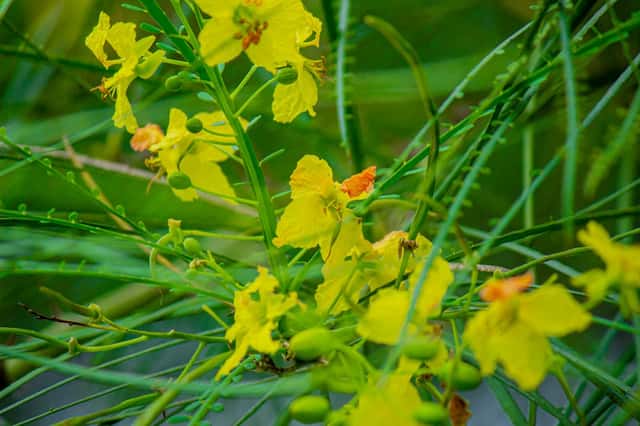
Parkinsonia aculeata is a small thorny tree or shrub in the Fabaceae family, native to a vast area ranging from the southwestern United States and northern Mexico to northern Argentina. It is recognized by its photosynthetic green branches, bipinnate leaves composed of tiny leaflets that drop during dry periods, and its fragrant yellow-orange flowers gathered in pendulous racemes. Fast-growing, it is widely used as an ornamental and shade tree in arid and urban regions with warm climates.
How Big Does Jerusalem thorn Grow?
TLDR: Jerusalem thorn can reach up to 10.0m tall with Fast growth rate.
Max height
10.0m
Spread
7.6m
Growth rate
Fast
Foliage
Deciduous
Plant Uses
Ornamental
Great for decoration
Medicinal
Medicinal properties
Edible
Can be consumed
Medicinal Uses
- Leaf tea traditionally used for fever and respiratory problems
- Leaf infusion used as a regulator of menstrual activity
- Flower and seed infusion used as a tonic and anti-rheumatic (folk use, without scientific proof)
Culinary Uses
- Mature seeds, rich in protein, cooked like beans
- Seeds ground into flour
- Young pods consumed cooked in some regions
Is your plant showing symptoms?
Click on the symptom to discover possible causes:
What Diseases Commonly Affect Jerusalem thorn?
TLDR: Jerusalem thorn is susceptible to 3 known diseases. Monitor regularly for early detection.
Root Rot
Root rot is a serious fungal disease that affects the root system of plants, causing them to decay and die. It is primarily caused by overwatering, poor drainage, or soil-borne fungi such as Pythium, Phytophthora, Rhizoctonia, and Fusarium. The disease thrives in waterlogged conditions where roots are deprived of oxygen, making them susceptible to fungal infection.
Scale Insects
Scale insects are small sap-sucking pests that appear as brown, shell-like bumps on plant stems and leaves. There are over 25 species, divided into armored (hard) and unarmored (soft) scales. They feed by piercing plant tissue and extracting sap, which weakens the plant and can lead to yellowing, stunted growth, and even death if left untreated. They also excrete honeydew, which attracts ants and promotes sooty mold growth.
Caterpillars
Caterpillars are the larval stage of moths and butterflies that feed voraciously on plant foliage, stems, flowers, and fruits. Common species include cabbage loopers, tomato hornworms, armyworms, and cutworms. These pests can cause extensive damage by consuming large amounts of plant tissue in a short time. They vary in size from small (1/4 inch) to large (5 inches), with colors ranging from green to brown, often featuring stripes or spots. Caterpillars are highly mobile and can quickly spread throughout gardens, making them one of the most destructive common pests.
Meaning & Symbolism
Due to its hardiness and ability to bloom even in arid and poor soils, it is often associated with resilience and adaptation.
Compare with similar plants
| Attribute | Difficulty | Light | Watering | Pet Safe |
|---|---|---|---|---|
| Field Maple | Easy | Bright indirect | 14d | ✓ |
| Silver Birch | Easy | Direct sun | 14d | ✓ |
| Common Blanketflower | Easy | Direct sun | 10d | ✓ |
| Cushion Bush | Easy | Direct sun | 14d | ✓ |
Choose & Compare
Sources & References
- Parkinsonia aculeata - Wikipedia
- ENH590/ST431: Parkinsonia aculeata: Jerusalem-Thorn - UF/IFAS
- Parkinsonia aculeata (Jerusalem Thorn) - Gardenia.net
- Complete care and cultivation guide for Parkinsonia (Palo verde)
- Parkinsonia aculeata - Jerusalem Thorn - PFAF Plant Database
- Espinho-de-Jerusalem: Conheca Esta Planta Medicinal
- Propagating Mexican Palo Verde: Step-by-Step Guide
- Cinacina, Palo verde, Espino de Jerusalen, Espinillo - InfoJardin





