Rosaceae
Amelanchier × lamarckii - Juneberry / Snowy Mespilus
Amelanchier × lamarckii
Easy-care small tree for full sun to part shade; keep soil moist but well-drained while establishing, then it tolerates short dry spells. Minimal pruning needed - remove suckers and crossing branches after flowering.
Every 7 days
Bright indirect
-30° - 35°C
40% - 70%
Categories
What is Juneberry?
Juneberry (Amelanchier × lamarckii) is a easy-care plant from the Rosaceae family. Amelanchier × lamarckii is a naturally occurring hybrid serviceberry, most likely a cross between Allegheny serviceberry (A. laevis) and downy serviceberry (A. arborea), first recognized in the early 20th century and now widely planted as an ornamental garden tree. This deciduous, multi-stemmed larg...
Juneberry grows up to 7.5m, spread of 600cm, watering every 7 days, -30°C – 35°C, 40–70% humidity. It is not suitable for indoor environments and safe for pets.
Unlike many tropical plants, Juneberry tolerates watering mistakes. Best for beginners. Unlike many popular species, Juneberry is safe to keep around pets.
How to Care for Juneberry?
TLDR: Juneberry needs Bright indirect, watering every 7 days, and temperatures between -30-35°C with 40-70% humidity.
How Often Should You Water Juneberry?
Water deeply once or twice weekly during the first two growing seasons to establish a deep root system; mature trees only need supplemental watering during prolonged summer drought.
How Much Light Does Juneberry Need?
Best flowering, fruiting and fall color occur in full sun, but the tree tolerates and often thrives as an understory plant in partial shade.
What Is the Best Soil for Juneberry?
Adapts to sandy, loamy or clay soils as long as they are moist and well-drained; prefers slightly acidic to neutral pH and struggles in waterlogged or very alkaline ground.
What Pot Should You Use for Juneberry?
Not typically container-grown; plant directly in the garden with room for its mature spread.
What Is Juneberry and Where Does It Come From?
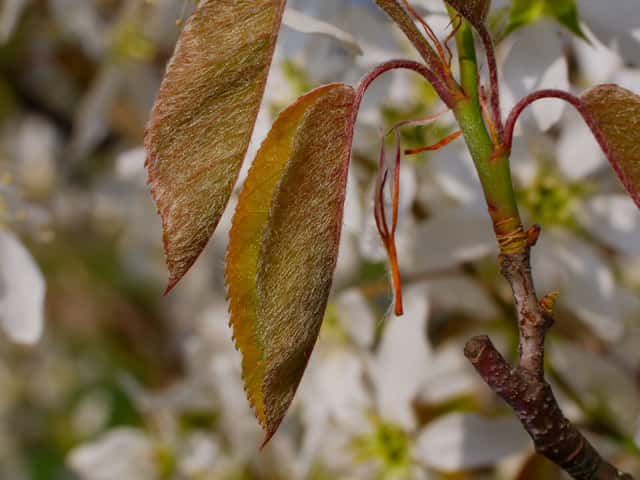
Amelanchier × lamarckii is a naturally occurring hybrid serviceberry, most likely a cross between Allegheny serviceberry (A. laevis) and downy serviceberry (A. arborea), first recognized in the early 20th century and now widely planted as an ornamental garden tree. This deciduous, multi-stemmed large shrub or small tree grows 15-25 ft (roughly 4.5-7.5 m) tall, with an open, rounded crown. In spring, before or as the bronze-tinted young leaves unfurl, it is covered in drooping clusters of star-shaped white flowers. These are followed in early summer by small, round, purple-black pome fruits ("juneberries") that resemble blueberries and are sweet and edible, attracting birds. Fall brings vivid orange-to-red foliage color, making this a four-season interest plant.
How to Propagate Juneberry?
Seed propagation
Fresh seed germinates far more reliably than stored seed, and natural winter stratification outdoors works as well as refrigeration.
- 1 Collect ripe berries in summer and remove the pulp to extract seeds
- 2 Cold-stratify the cleaned seeds in moist sand or peat in the refrigerator for 90-120 days
- 3 Sow stratified seeds in a well-draining seed tray or outdoors in fall
- 4 Keep the growing medium consistently moist until germination in spring
- 5 Transplant seedlings once they have their first true leaves
Materials needed:
Softwood cuttings
Softwood cuttings root inconsistently in Amelanchier, so take several extra cuttings to compensate for losses.
- 1 Take 10-15cm softwood cuttings from new growth in early summer
- 2 Remove lower leaves and dip the cut end in rooting hormone
- 3 Insert cuttings into a moist, well-draining propagation mix
- 4 Keep humidity high with a plastic cover or propagator until roots form
- 5 Pot up rooted cuttings once a healthy root system develops
Materials needed:
How Big Does Juneberry Grow?
TLDR: Juneberry can reach up to 7.5m tall with Medium growth rate.
Max height
7.5m
Spread
6.0m
Growth rate
Medium
Foliage
Deciduous
Plant Uses
Ornamental
Great for decoration
Edible
Can be consumed
Culinary Uses
- Fresh eating out of hand
- Jams, jellies and preserves
- Pies, muffins and baked goods
- Dried like raisins for trail mixes
Is your plant showing symptoms?
Click on the symptom to discover possible causes:
What Diseases Commonly Affect Juneberry?
TLDR: Juneberry is susceptible to 6 known diseases. Monitor regularly for early detection.
Fire Blight
Fire blight is a highly destructive and contagious bacterial disease caused by Erwinia amylovora. It primarily affects plants in the Rosaceae family, including apple, pear, quince trees, and various ornamental plants. The disease can destroy an entire orchard in a single growing season under ideal conditions, with the bacterium moving approximately 11 inches per week in new growth.
Rust
Rust is a common fungal disease caused by fungi in the order Pucciniales that affects a wide variety of plants. The disease gets its name from the characteristic orange, yellow, or reddish-brown pustules that appear on leaves, resembling metal rust. This obligate fungal parasite requires living plants to survive and can cause significant economic losses in agricultural crops.
Powdery Mildew
Powdery mildew is a common fungal disease caused by various fungi species including Erysiphe, Podosphaera, Oïdium, and Leveillula. It affects over 10,000 plant species worldwide. The disease thrives in warm, dry climates with high humidity and appears as a distinctive white powdery coating on plant surfaces.
Canker
Canker is a disease caused by various fungi and bacteria that create necrotic, sunken areas on bark of branches, stems, and trunks. Pathogens enter through wounds and natural openings, especially when plants are stressed. Canker can gradually weaken or kill branches by disrupting water and nutrient flow.
Fun Facts
The common name "Juneberry" refers to the month its sweet purple-black fruit typically ripens in temperate climates.
Amelanchier × lamarckii is believed to be a natural hybrid, likely combining the genes of Allegheny serviceberry (A. laevis) and downy serviceberry (A. arborea).
Its clusters of white star-shaped flowers open in early spring, among the first blooms to appear before most trees have leafed out, making it an important early food source for pollinators.
In autumn the foliage turns brilliant shades of orange and red, giving the tree year-round ornamental interest.
Frequently asked questions
Is Amelanchier × lamarckii the same as a serviceberry?
Are the berries actually edible?
Does Amelanchier × lamarckii need full sun?
How fast does it grow?
Compare with similar plants
| Attribute | Difficulty | Light | Watering | Pet Safe |
|---|---|---|---|---|
| Field Maple | Easy | Bright indirect | 14d | ✓ |
| Silver Birch | Easy | Direct sun | 14d | ✓ |
| Common Blanketflower | Easy | Direct sun | 10d | ✓ |
| Cushion Bush | Easy | Direct sun | 14d | ✓ |
Choose & Compare
Sources & References
- Amelanchier lamarckii - Missouri Botanical Garden Plant Finder
- Amelanchier lamarckii - RHS Gardening
- Amelanchier lamarckii - BBC Gardeners World Magazine
- Amelanchier lamarckii - Plants For A Future (PFAF)
- Amelanchier x lamarckii - NC State Extension Gardener Plant Toolbox
- Amelanchier lamarckii - Van den Berk Nurseries
- Shadbush Serviceberry Amelanchier - CT.gov Plant Pest Handbook
- Amelanchier Lamarckii - iloveflores.com (Portuguese common names)
- Amelanchier lamarckii - Cornijuelo nevado - GuiaVerde.com (Spanish common names)





