Euphorbiaceae
Juniper spurge (Euphorbia pithyusa)
Euphorbia pithyusa
An easy plant for a dry garden. It needs full sun and very free-draining soil (sandy, gravelly or chalky); once established it needs almost no watering. It takes short frosts down to about -10 °C as long as the soil isn't waterlogged. Trim lightly after flowering. Wear gloves when handling: the sap irritates skin and eyes.
Every 14 days
Direct sun
-10° - °C
% - %
Categories
What is Juniper spurge?
Juniper spurge (Euphorbia pithyusa) is a easy-care plant from the Euphorbiaceae family. Euphorbia pithyusa is a small evergreen subshrub in the spurge family (Euphorbiaceae), native to the western and central Mediterranean: the Balearic Islands, Corsica, Sardinia, southern France and Italy. It grows on rocky coasts, cliffs, dunes and dry scrub near the sea, and in the Balearics it form...
Juniper spurge grows up to 50cm, spread of 40cm, watering every 14 days. It is not suitable for indoor environments and not safe for pets.
Unlike many tropical plants, Juniper spurge tolerates watering mistakes. Best for beginners. Without precautions, ingestion can cause irritation in pets. Keep out of reach of cats and dogs.
How to Care for Juniper spurge?
TLDR: Juniper spurge needs Direct sun, watering every 14 days, and temperatures between -10-30°C with 40-70% humidity.
How Often Should You Water Juniper spurge?
Water only in the first year while it establishes. After that, rainfall is usually enough in the ground; in pots or long droughts, water deeply once the soil is completely dry. Waterlogging rots the roots.
How Much Light Does Juniper spurge Need?
Full sun, ideally all day. In shade the stems flop and the plant loses its compact shape.
What Is the Best Soil for Juniper spurge?
Poor, free-draining soil: sand, gravel, chalk or loam. Acid, neutral or alkaline pH is fine. Avoid heavy clay that holds water.
What Pot Should You Use for Juniper spurge?
Terracotta pot with large drainage holes and cactus and succulent compost.
What Is Juniper spurge and Where Does It Come From?
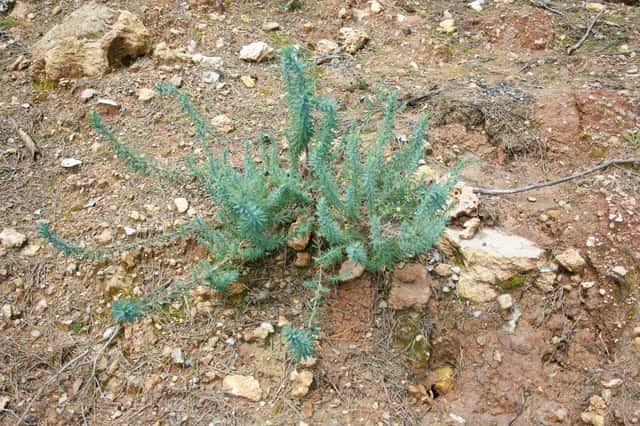
Euphorbia pithyusa is a small evergreen subshrub in the spurge family (Euphorbiaceae), native to the western and central Mediterranean: the Balearic Islands, Corsica, Sardinia, southern France and Italy. It grows on rocky coasts, cliffs, dunes and dry scrub near the sea, and in the Balearics it forms low mats along cliff edges. The plant makes a dome 40-50 cm tall of upright stems clothed in whorls of narrow, pointed blue-grey leaves, which give it the look of a miniature fir or juniper. From late spring to midsummer the stem tips carry clusters of small, petal-less yellow-green flowers that last for weeks. Like every spurge, it has an irritant white latex. In gardens it suits dry borders, gravel and rock gardens, alongside grasses and other Mediterranean plants.
How to Propagate Juniper spurge?
Seed
It often self-seeds; simply move the seedlings that appear around it. Wear gloves because of the sap.
- 1 Collect ripe seed in summer before the capsules burst
- 2 Sow on gritty compost and keep lightly moist
- 3 Keep in a bright, sheltered spot
- 4 Pot on the seedlings once they are a few centimetres tall
Materials needed:
Division
Spurges dislike disturbance; only divide large plants and wear gloves and eye protection.
- 1 Lift the clump carefully in early spring
- 2 Separate pieces that each have their own roots
- 3 Replant in free-draining soil
- 4 Water sparingly until growth resumes
Materials needed:
How Big Does Juniper spurge Grow?
TLDR: Juniper spurge can reach up to 50cm tall with Medium growth rate.
Max height
50cm
Spread
40cm
Foliage
Evergreen
Warning: Toxic Plant
This plant can be toxic if ingested. Keep out of reach of:
Plant Uses
Ornamental
Great for decoration
Is your plant showing symptoms?
Click on the symptom to discover possible causes:
What Diseases Commonly Affect Juniper spurge?
TLDR: Juniper spurge is susceptible to 1 known diseases. Monitor regularly for early detection.
Fun Facts
The name pithyusa refers to the Pityusic Islands, Ibiza and Formentera, whose Greek name comes from the word for pine
In the Balearics it gives its name to an EU-protected habitat: low Euphorbia pithyusa mats along sea cliffs
Dead leaves don't drop: they stay on the base of the stems, pointing downwards
Frequently asked questions
Is Euphorbia pithyusa poisonous?
Does it need much water?
Is it frost hardy?
Does it need pruning?
Compare with similar plants
| Attribute | Difficulty | Light | Watering | Pet Safe |
|---|---|---|---|---|
| Field Maple | Easy | Bright indirect | 14d | ✓ |
| Iberian Houseleek | Easy | Direct sun | 14d | ✓ |
| Silver Birch | Easy | Direct sun | 14d | ✓ |
| Common Blanketflower | Easy | Direct sun | 10d | ✓ |
Choose & Compare
Sources & References
- RHS — Euphorbia pithyusa (little fir spurge)
- Beth Chatto's Plants & Gardens — Euphorbia pithyusa
- Cotswold Garden Flowers — Euphorbia pithyusa
- Herbari Virtual UIB — Euphorbia pithyusa L. (Balearic distribution, habitat)
- CAIB Xarxa Natura — Hábitat 5320: formaciones bajas de Euphorbia pithyusa próximas a acantilados





