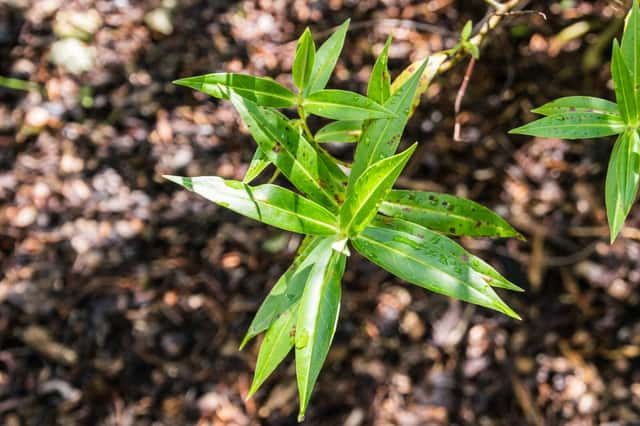
Plantaginaceae
Koromiko (Hebe salicifolia)
Hebe salicifolia
An easy shrub for sun or part shade and well-drained soil. Water often in the first year; after that it copes well with dry spells. Trim lightly after flowering to keep it compact. It tolerates wind, salt spray and frosts down to about -12 °C.
Every 7 days
Bright indirect
-12° - °C
% - %
Categories
What is Koromiko?
Koromiko (Hebe salicifolia) is a easy-care plant from the Plantaginaceae family. Hebe salicifolia (now classified as Veronica salicifolia) is an evergreen shrub in the Plantaginaceae family, native to New Zealand and Chile and known to Māori as koromiko. It forms a rounded bush 1.5 to 2.5 m tall and wide, with narrow, willow-like leaves up to 12 cm long. In summer it carries dro...
Koromiko grows up to 2.5m, spread of 250cm, watering every 7 days. It is not suitable for indoor environments and safe for pets.
Unlike many tropical plants, Koromiko tolerates watering mistakes. Best for beginners. Unlike many popular species, Koromiko is safe to keep around pets.
How to Care for Koromiko?
TLDR: Koromiko needs Bright indirect, watering every 7 days, and temperatures between -12-30°C with 40-70% humidity.
How Often Should You Water Koromiko?
Water when the top few centimetres of soil are dry, roughly once a week in hot weather. Once established, it only needs water in long droughts. Avoid soggy soil, which leads to root rot.
How Much Light Does Koromiko Need?
Full sun or part shade. More sun means more flowers and a tighter shape; in deep shade it grows leggy and flowers poorly.
What Is the Best Soil for Koromiko?
Well-drained soil, sandy to clay, neutral to alkaline. It tolerates chalky and poor soil but not waterlogging.
What Pot Should You Use for Koromiko?
Grows best in the ground. In a pot, use a large container of at least 40 cm with a drainage hole and gritty compost.
Care Schedule
Fertilize
Every 60 days
What Is Koromiko and Where Does It Come From?
Hebe salicifolia (now classified as Veronica salicifolia) is an evergreen shrub in the Plantaginaceae family, native to New Zealand and Chile and known to Māori as koromiko. It forms a rounded bush 1.5 to 2.5 m tall and wide, with narrow, willow-like leaves up to 12 cm long. In summer it carries drooping spikes up to 20 cm long, packed with tiny white to pale lilac flowers that draw bees and butterflies.
How to Propagate Koromiko?
Semi-hardwood cuttings
Roots easily. Covering the pot with a plastic bag helps keep humidity up in the first weeks.
- 1 In late summer, cut shoot tips 8 to 10 cm long that are firm at the base
- 2 Strip the leaves from the lower half
- 3 Insert into moist, gritty compost
- 4 Keep in bright, indirect light with the compost moist until rooted
Materials needed:
Seed
Hebes cross easily, so seedlings may differ from the parent plant.
- 1 Collect dry seed capsules after flowering
- 2 Sow on the surface of fine compost, barely covered
- 3 Keep moist and in good light
- 4 Prick out when seedlings have 2 to 3 pairs of leaves
Materials needed:
How Big Does Koromiko Grow?
TLDR: Koromiko can reach up to 2.5m tall with Fast growth rate.
Max height
2.5m
Spread
2.5m
Growth rate
Fast
Foliage
Evergreen
Plant Uses
Ornamental
Great for decoration
Medicinal
Medicinal properties
Medicinal Uses
- Māori chewed the young shoots for diarrhoea and dysentery (traditional use)
- Bruised leaves were used as a poultice on sores (traditional use)
Is your plant showing symptoms?
Click on the symptom to discover possible causes:
What Diseases Commonly Affect Koromiko?
TLDR: Koromiko is susceptible to 6 known diseases. Monitor regularly for early detection.
Aphids
Aphids are small, soft-bodied, pear-shaped insects (1/16 to 1/8 inch long) that feed by sucking nutrient-rich sap from plants. They reproduce rapidly and can quickly weaken plants, causing distorted growth and transmitting plant viruses. Aphids come in various colors including green, black, red, yellow, brown, and gray. They secrete honeydew, a sticky substance that attracts ants and encourages sooty mold growth.
Downy Mildew
Downy mildew is a fungal-like disease caused by oomycetes (water molds) that thrives in cool, wet conditions. It affects a wide range of plants, causing yellowing leaves with fuzzy white-gray growth underneath, leading to defoliation and reduced yields if left untreated.
Leaf Spot
Leaf spot is a common fungal disease caused by various pathogens including Alternaria, Ascochyta, Colletotrichum, Septoria, and Venturia. It primarily affects leaves, causing discolored spots that can lead to premature leaf drop if left untreated.
Phytophthora Root Rot
The Phytophthora genus consists of soil-borne oomycetes (water molds) that act as plant pathogens, primarily affecting trees and woody plants. It typically spreads through the root system, leading to systemic decline and eventual plant collapse.
Fun Facts
The name koromiko is Māori; the shoots were a traditional remedy for diarrhoea
It grows wild in both New Zealand and Chile
Botanists now place hebes inside the genus Veronica
Frequently asked questions
How big does koromiko get?
When and how should I prune it?
Is it frost hardy?
What pests and diseases affect it?
Compare with similar plants
| Attribute | Difficulty | Light | Watering | Pet Safe |
|---|---|---|---|---|
| Field Maple | Easy | Bright indirect | 14d | ✓ |
| Iberian Houseleek | Easy | Direct sun | 14d | ✓ |
| Silver Birch | Easy | Direct sun | 14d | ✓ |
| Common Blanketflower | Easy | Direct sun | 10d | ✓ |





