Rubiaceae
Kratom: Medicinal Uses & Care Tips
Mitragyna speciosa
A demanding plant for indoor cultivation: it requires bright but filtered light, high humidity (60-85%), stable temperatures between 21 and 32°C (70-90°F), and a substrate that is always slightly moist but never waterlogged. It grows well in pots when young but tends to reach considerable sizes unless contained by regular pruning of the apical shoots.
Every 3 days
Bright indirect
15° - 32°C
60% - 85%
Categories
What is Kratom?
Kratom (Mitragyna speciosa) is a medium-care plant from the Rubiaceae family. Kratom (Mitragyna speciosa) is a tropical evergreen tree in the Rubiaceae family, native to Southeast Asia (Thailand, Malaysia, Indonesia, Myanmar, Papua New Guinea). In the wild, it can reach heights of 15-25 meters, with a sturdy trunk that can exceed 90 cm in diameter. The leaves are large, gloss...
Kratom grows up to 25.0m, watering every 3 days, 15°C – 32°C, 60–85% humidity. It is suitable for indoor environments and not safe for pets.
Without precautions, ingestion can cause irritation in pets. Keep out of reach of cats and dogs. Without adequate drainage, root rot can develop within 7 days.
How to Care for Kratom?
TLDR: Kratom needs Bright indirect, watering every 3 days, and temperatures between 15-32°C with 60-85% humidity.
How Often Should You Water Kratom?
Keep the soil constantly moist, watering when the surface layer of the substrate begins to dry; avoid water stagnation, which promotes root rot, but also avoid letting the root ball dry out completely, which causes rapid leaf wilting.
How Much Light Does Kratom Need?
Prefers bright but indirect or filtered sunlight; moderate exposure to direct morning sun is tolerated, while intense midday sun can scorch the leaves. Indoors, it needs at least 10-12 hours of light per day, potentially supplemented with grow lights.
What Is the Best Soil for Kratom?
Requires a substrate rich in organic matter, porous and well-draining, with a slightly acidic pH (5.5-6.5); a mix of potting soil with perlite or coarse sand helps prevent water stagnation.
What Pot Should You Use for Kratom?
A wide and deep pot, preferably made of terracotta to promote root respiration and reduce the risk of water stagnation; as the tree grows, repotting into progressively larger containers is necessary.
Care Schedule
Fertilize
Every 60 days
Misting
Every 2 days
What Is Kratom and Where Does It Come From?
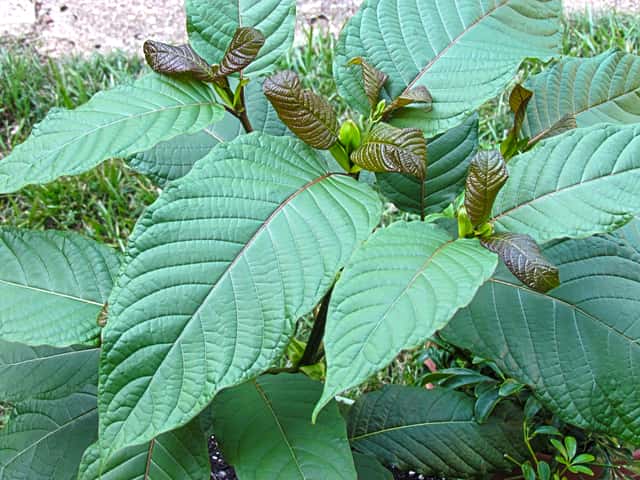
Kratom (Mitragyna speciosa) is a tropical evergreen tree in the Rubiaceae family, native to Southeast Asia (Thailand, Malaysia, Indonesia, Myanmar, Papua New Guinea). In the wild, it can reach heights of 15-25 meters, with a sturdy trunk that can exceed 90 cm in diameter. The leaves are large, glossy, and dark green, growing up to 20 cm long, while the small, yellowish-white flowers gather in spherical inflorescences resembling a bishop's miter, from which the genus name Mitragyna is derived. The leaves have been traditionally used for centuries in Southeast Asian communities, chewed fresh or dried and prepared as an infusion.
How to Propagate Kratom?
How Big Does Kratom Grow?
TLDR: Kratom can reach up to 25.0m tall with Medium growth rate.
Max height
25.0m
Growth rate
Medium
Foliage
Evergreen
Warning: Toxic Plant
This plant can be toxic if ingested. Keep out of reach of:
Plant Uses
Medicinal
Medicinal properties
Ornamental
Great for decoration
Medicinal Uses
- Traditional ethnobotanical use of leaves as a mild stimulant in rural Southeast Asian communities
- Traditional use to relieve physical fatigue in agricultural workers
- Infusion preparations of fresh or dried leaves in Thai and Malaysian folk medicine
Culinary Uses
- Leaves traditionally chewed fresh, often with a pinch of salt to balance the bitter flavor
- Dried leaves prepared as an infusion (tea) according to traditional Southeast Asian customs
Is your plant showing symptoms?
Click on the symptom to discover possible causes:
What Diseases Commonly Affect Kratom?
TLDR: Kratom is susceptible to 7 known diseases. Monitor regularly for early detection.
Spider Mites
Spider mites are tiny arachnids (less than 1/20 inch long) related to spiders and ticks that feed on plant sap. They thrive in hot, dry conditions and can cause significant damage to ornamental and vegetable plants. During severe infestations, crop losses can reach 14% or higher as these pests disrupt vital plant processes including photosynthesis, carbon dioxide absorption, and transpiration.
Aphids
Aphids are small, soft-bodied, pear-shaped insects (1/16 to 1/8 inch long) that feed by sucking nutrient-rich sap from plants. They reproduce rapidly and can quickly weaken plants, causing distorted growth and transmitting plant viruses. Aphids come in various colors including green, black, red, yellow, brown, and gray. They secrete honeydew, a sticky substance that attracts ants and encourages sooty mold growth.
Whiteflies
Whiteflies are small, soft-bodied, winged insects closely related to aphids and mealybugs. They are moth-like in appearance, about 1/16 inch long, triangular in shape, and gray-white in color. These sap-sucking pests feed on plant tissue, causing yellowing, stunted growth, and wilting. They also excrete honeydew, which attracts ants and promotes sooty mold growth. Whiteflies can transmit serious plant viruses.
Root Rot
Root rot is a serious fungal disease that affects the root system of plants, causing them to decay and die. It is primarily caused by overwatering, poor drainage, or soil-borne fungi such as Pythium, Phytophthora, Rhizoctonia, and Fusarium. The disease thrives in waterlogged conditions where roots are deprived of oxygen, making them susceptible to fungal infection.
Meaning & Symbolism
In Southeast Asia, kratom does not have strong ornamental symbolic value, but it is historically linked to rural labor traditions: the leaves were traditionally chewed by field workers to sustain stamina during long working days.
Compare with similar plants
| Attribute | Difficulty | Light | Watering | Pet Safe |
|---|---|---|---|---|
| Dark Fieldcap | Medium | Low light | 2d | ⚠️ |
| Azalea | Medium | Partial shade | 3d | ⚠️ |
| Muriel's Bamboo | Medium | Partial shade | 3d | ✓ |
| Bougainvillea | Medium | Direct sun | 7d | ⚠️ |
Choose & Compare
Sources & References
- How To Grow Kratom Plants: A Detailed Guide
- Kratom (Mitragyna Speciosa) Plant Care & How to Grow, Water
- Step-by-Step Guide to Propagating Kratom
- Pest Management for Rare Mitragyna Plants
- Kratom Toxicity in Dogs and Cats
- Mitragyna speciosa - Wikipedia
- KRATOM (Mitragyna speciosa) - DEA Drug Fact Sheet




