Verbenaceae
Lantana (genus Lantana)
Lantana
Easy and tough: give it full sun (at least 4 to 6 hours), well-drained soil and light feeding. It handles heat, drought, wind and salt but not soggy soil. Tip-prune during flowering to keep new blooms coming. Grows fast; in cold areas the top dies in frost and regrows from the roots if mulched. Toxic to people, dogs, cats and livestock.
Every 5 days
Direct sun
° - °C
% - %
Categories
What is Lantana (genus)?
Lantana (genus) (Lantana) is a easy-care plant from the Verbenaceae family. Lantana is a genus of about 100 to 150 species of shrubs and subshrubs in the verbena family (Verbenaceae), native to tropical America and Africa. The most widely grown are Lantana camara (common lantana), its many garden hybrids and the trailing Lantana montevidensis. They have sometimes rough stem...
Lantana (genus) grows up to 1.8m, spread of 150cm, watering every 5 days. It is not suitable for indoor environments and not safe for pets.
Unlike many tropical plants, Lantana (genus) tolerates watering mistakes. Best for beginners. Without precautions, ingestion can cause irritation in pets. Keep out of reach of cats and dogs.
How to Care for Lantana (genus)?
TLDR: Lantana (genus) needs Direct sun, watering every 5 days, and temperatures between 15-30°C with 40-70% humidity.
How Often Should You Water Lantana (genus)?
Water when the soil surface dries, usually every 4 to 7 days in hot weather, more often in containers. Once established it tolerates drought. Too much water cuts flowering and causes root rot.
How Much Light Does Lantana (genus) Need?
Full sun, at least 4 to 6 hours a day. In shade it flowers poorly and is more prone to disease.
What Is the Best Soil for Lantana (genus)?
Well-drained soil, from sand to clay or rocky ground; poor soil is fine. Lighten clay with sand or coarse bark. Do not overfeed: rich soil gives leaves instead of flowers.
What Pot Should You Use for Lantana (genus)?
Any pot or planter with good drainage and a standard bedding-plant potting mix; 30 cm or larger for shrubby types, hanging baskets for trailing ones.
What Is Lantana (genus) and Where Does It Come From?
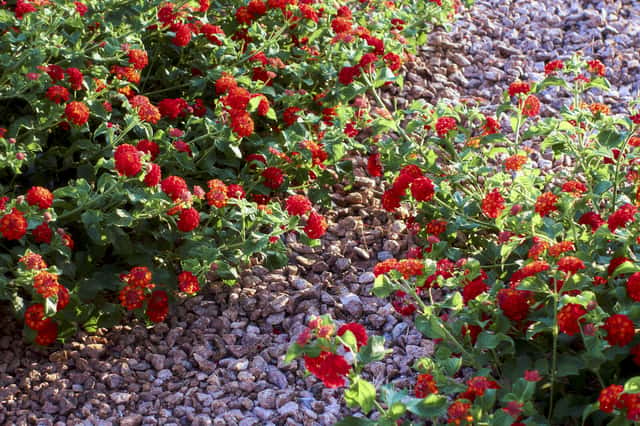
Lantana is a genus of about 100 to 150 species of shrubs and subshrubs in the verbena family (Verbenaceae), native to tropical America and Africa. The most widely grown are Lantana camara (common lantana), its many garden hybrids and the trailing Lantana montevidensis. They have sometimes rough stems, leaves that smell pungent when crushed and small tubular flowers packed into rounded clusters in yellow, orange, red, pink, lavender or white — often two or more colours at once, because the flowers change shade as they age. They bloom from summer until frost (all year in warm climates), draw butterflies and hummingbirds, and set berries that ripen blue-black. Plants range from 30 cm (trailing types) to 2 m. L. camara has become invasive in many tropical regions, and all parts, especially the green berries, are toxic.
How to Propagate Lantana (genus)?
Stem cuttings
The best way to keep a hybrid's colour, since many are sterile or do not come true from seed. Wear gloves: the sap can irritate skin.
- 1 Take 8-10 cm tips from non-flowering shoots
- 2 Strip the lower leaves
- 3 Dip the base in rooting hormone (optional)
- 4 Insert in a light, moist mix in bright light out of harsh sun
Materials needed:
Seed
Germination is slow and uneven, and seedlings may differ from the parent.
- 1 Collect ripe black berries and remove the pulp
- 2 Sow in seed-starting mix somewhere warm
- 3 Keep moist until germination
- 4 Pot on the seedlings
Materials needed:
How Big Does Lantana (genus) Grow?
TLDR: Lantana (genus) can reach up to 1.8m tall with Fast growth rate.
Max height
1.8m
Spread
1.5m
Growth rate
Fast
Foliage
Evergreen
Warning: Toxic Plant
This plant can be toxic if ingested. Keep out of reach of:
Plant Uses
Ornamental
Great for decoration
Is your plant showing symptoms?
Click on the symptom to discover possible causes:
What Diseases Commonly Affect Lantana (genus)?
TLDR: Lantana (genus) is susceptible to 6 known diseases. Monitor regularly for early detection.
Whiteflies
Whiteflies are small, soft-bodied, winged insects closely related to aphids and mealybugs. They are moth-like in appearance, about 1/16 inch long, triangular in shape, and gray-white in color. These sap-sucking pests feed on plant tissue, causing yellowing, stunted growth, and wilting. They also excrete honeydew, which attracts ants and promotes sooty mold growth. Whiteflies can transmit serious plant viruses.
Spider Mites
Spider mites are tiny arachnids (less than 1/20 inch long) related to spiders and ticks that feed on plant sap. They thrive in hot, dry conditions and can cause significant damage to ornamental and vegetable plants. During severe infestations, crop losses can reach 14% or higher as these pests disrupt vital plant processes including photosynthesis, carbon dioxide absorption, and transpiration.
Root Rot
Root rot is a serious fungal disease that affects the root system of plants, causing them to decay and die. It is primarily caused by overwatering, poor drainage, or soil-borne fungi such as Pythium, Phytophthora, Rhizoctonia, and Fusarium. The disease thrives in waterlogged conditions where roots are deprived of oxygen, making them susceptible to fungal infection.
Sooty Mold
Sooty mold is a fungal disease that develops on surfaces coated with honeydew, a sticky sweet substance secreted by sap-sucking insects like aphids, scale insects, and whiteflies. While it does not directly infect plant tissue, it reduces photosynthetic capacity by blocking sunlight and diminishes the plant's aesthetic appearance.
Fun Facts
The flowers change colour as they age, so one cluster can show yellow, orange and red at once
Lantana camara is considered one of the most troublesome invasive plants in the tropics
Butterflies and hummingbirds visit the flowers heavily, and birds eat the ripe berries and spread the seed
Frequently asked questions
Is lantana toxic to dogs and cats?
How much sun does lantana need?
How do I get lantana to bloom more?
Is lantana cold hardy?
Compare with similar plants
| Attribute | Difficulty | Light | Watering | Pet Safe |
|---|---|---|---|---|
| Field Maple | Easy | Bright indirect | 14d | ✓ |
| Iberian Houseleek | Easy | Direct sun | 14d | ✓ |
| Silver Birch | Easy | Direct sun | 14d | ✓ |
| Common Blanketflower | Easy | Direct sun | 10d | ✓ |
Choose & Compare
Sources & References
- NC State Extension Plant Toolbox — Lantana camara (Common Lantana)
- LSU AgCenter — Lantana (L. camara, hybrids, L. montevidensis), pub. 2663
- ASPCA — Lantana (toxic to dogs, cats, horses)
- UF/IFAS Landscape Plant Propagation Information — Lantana
- UNF Botanical Garden — Lantana montevidensis (genus ~100-150 species)
- UF/IFAS Sarasota Master Gardeners — Lantana, the beauty that is a beast