Clusiaceae
Clusia grandiflora: The Giant-Flowered Rainforest Climber
Clusia grandiflora
Thrives in strong indirect light to full sun, prefers moderate watering that allows the topsoil to dry out between waterings, well-draining organic-rich soil, and elevated humidity. Growth is moderate and the plant is fairly resilient once good drainage is in place.
Every 7 days
Bright indirect
15° - 30°C
50% - 80%
Categories
What is Large-flowered Clusia?
Large-flowered Clusia (Clusia grandiflora) is a medium-care plant from the Clusiaceae family. Clusia grandiflora is a hemiepiphytic climber native to the Amazon rainforest and the Guiana region, found across Brazil, Peru, Colombia, Venezuela, Suriname and French Guiana. It begins life as an epiphyte in the canopy of a host tree, later sending roots down to the forest floor and becoming a sel...
Large-flowered Clusia grows up to 10.0m, watering every 7 days, 15°C – 30°C, 50–80% humidity. It is suitable for indoor environments and not safe for pets.
Without precautions, ingestion can cause irritation in pets. Keep out of reach of cats and dogs. Without adequate drainage, root rot can develop within 14 days.
How to Care for Large-flowered Clusia?
TLDR: Large-flowered Clusia needs Bright indirect, watering every 7 days, and temperatures between 15-30°C with 50-80% humidity.
How Often Should You Water Large-flowered Clusia?
Water once the top couple of centimeters of soil feel dry; avoid soggy soil, as overwatering and root rot are the most common problems for this species.
How Much Light Does Large-flowered Clusia Need?
Provide bright indirect light for several hours a day; it tolerates full sun outdoors but may scorch under intense direct sun without acclimation.
What Is the Best Soil for Large-flowered Clusia?
Use a light, organic-rich, well-draining mix with a slightly acidic to neutral pH (5.5-6.5).
What Pot Should You Use for Large-flowered Clusia?
A pot with generous drainage holes, ideally terracotta, which helps prevent excess moisture from lingering around the roots.
Care Schedule
Fertilize
Every 30 days
Misting
Every 7 days
Repot
Every 900 days
What Is Large-flowered Clusia and Where Does It Come From?
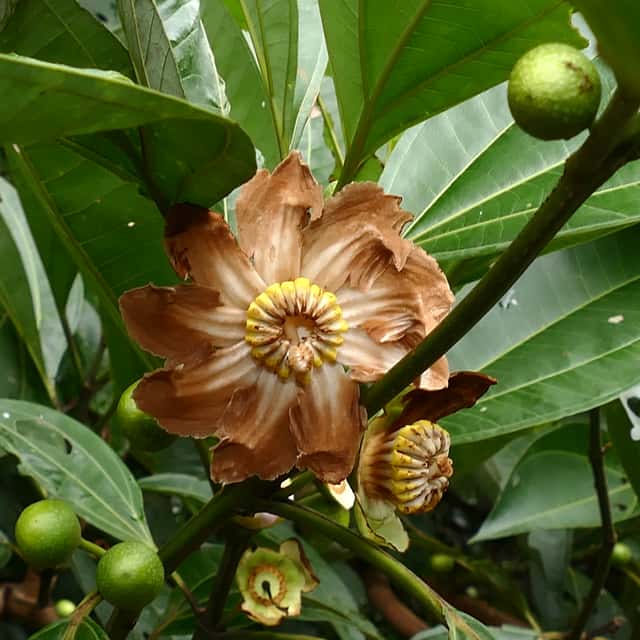
Clusia grandiflora is a hemiepiphytic climber native to the Amazon rainforest and the Guiana region, found across Brazil, Peru, Colombia, Venezuela, Suriname and French Guiana. It begins life as an epiphyte in the canopy of a host tree, later sending roots down to the forest floor and becoming a self-supporting tree up to 10 m tall with distinctive stilt roots. Its thick, leathery leaves are typical of the genus Clusia, and its large white flowers tinged with rose, up to 20 cm across, rank among the showiest in the Clusiaceae family.
How to Propagate Large-flowered Clusia?
Seed propagation
Fresh seeds germinate best; avoid letting them dry out before planting.
- 1 Collect seeds from ripe fruit
- 2 Remove the pulp and rinse the seeds well
- 3 Sow in a light, moist substrate, covering lightly
- 4 Keep warm and moist until germination
Materials needed:
Stem cutting
Use clean tools and maintain high humidity around the cutting until it roots.
- 1 Take a semi-hardwood cutting with 2-3 nodes
- 2 Remove the lower leaves
- 3 Apply rooting hormone to the cut end
- 4 Plant in a light substrate and keep moist
Materials needed:
How Big Does Large-flowered Clusia Grow?
TLDR: Large-flowered Clusia can reach up to 10.0m tall with Medium growth rate.
Max height
10.0m
Growth rate
Medium
Foliage
Evergreen
Warning: Toxic Plant
This plant can be toxic if ingested. Keep out of reach of:
Plant Uses
Ornamental
Great for decoration
Medicinal
Medicinal properties
Medicinal Uses
- Bark latex traditionally used as an antiseptic and wound-healing agent
- Aerial root infusions used in folk medicine for back pain
- Wood decoction used as an antiseptic for sores and cuts
Is your plant showing symptoms?
Click on the symptom to discover possible causes:
What Diseases Commonly Affect Large-flowered Clusia?
TLDR: Large-flowered Clusia is susceptible to 7 known diseases. Monitor regularly for early detection.
Root Rot
Root rot is a serious fungal disease that affects the root system of plants, causing them to decay and die. It is primarily caused by overwatering, poor drainage, or soil-borne fungi such as Pythium, Phytophthora, Rhizoctonia, and Fusarium. The disease thrives in waterlogged conditions where roots are deprived of oxygen, making them susceptible to fungal infection.
Powdery Mildew
Powdery mildew is a common fungal disease caused by various fungi species including Erysiphe, Podosphaera, Oïdium, and Leveillula. It affects over 10,000 plant species worldwide. The disease thrives in warm, dry climates with high humidity and appears as a distinctive white powdery coating on plant surfaces.
Leaf Spot
Leaf spot is a common fungal disease caused by various pathogens including Alternaria, Ascochyta, Colletotrichum, Septoria, and Venturia. It primarily affects leaves, causing discolored spots that can lead to premature leaf drop if left untreated.
Scale Insects
Scale insects are small sap-sucking pests that appear as brown, shell-like bumps on plant stems and leaves. There are over 25 species, divided into armored (hard) and unarmored (soft) scales. They feed by piercing plant tissue and extracting sap, which weakens the plant and can lead to yellowing, stunted growth, and even death if left untreated. They also excrete honeydew, which attracts ants and promotes sooty mold growth.
Meaning & Symbolism
Represents resilience and adaptability, reflecting its rare life strategy of starting life as an epiphyte in the forest canopy before rooting into the ground.
Fun Facts
Close relatives are nicknamed the "autograph tree" because their thick leaves let you carve words into them with a pointed object
It begins life as an epiphyte high in the forest canopy, only sending roots to the ground later in life
Its flowers can reach up to 20 cm across, among the largest in the genus Clusia
Frequently asked questions
Can Clusia grandiflora be grown indoors in a pot?
How often should I water Clusia grandiflora?
Is Clusia grandiflora toxic?
How do you propagate Clusia grandiflora?
Compare with similar plants
| Attribute | Difficulty | Light | Watering | Pet Safe |
|---|---|---|---|---|
| Dark Fieldcap | Medium | Low light | 2d | ⚠️ |
| Azalea | Medium | Partial shade | 3d | ⚠️ |
| Muriel's Bamboo | Medium | Partial shade | 3d | ✓ |
| Bougainvillea | Medium | Direct sun | 7d | ⚠️ |
Choose & Compare
Sources & References
- Clusia grandiflora Splitg. | Plants of the World Online | Kew Science
- Clusia grandiflora - Useful Tropical Plants
- Clusia grandiflora / Kufa - Amazon Conservation Team Biodiversity Database Suriname
- How To Grow Clusia grandiflora | EarthOne
- Clusia Plant Care Guide - Tumbleweed Plants
- Clusia Insect Pests Diseases of Clusia guttifera and Clusia rosea
- Muda de Clusia: Como Fazer, Plantar e Cuidar Corretamente




