Hydrocharitaceae
Brazilian Waterweed: Fast Growing
Egeria densa
An extremely easy aquatic plant to maintain: it lives completely submerged in freshwater, with moderate to intense light, temperatures between 18 and 28°C (64-82°F), and a slightly acidic to alkaline pH (6.5-8). It does not require a nutrient-rich substrate or additional fertilizers in an established tank, as it absorbs nutrients directly from the water. It grows very quickly and requires regular pruning to maintain a compact shape.
Every 7-10 days
Bright indirect
18° - 28°C
100% - 100%
Categories
What is Brazilian Waterweed?
Brazilian Waterweed (Egeria densa) is a easy-care plant from the Hydrocharitaceae family. Egeria densa, commonly known as Brazilian waterweed, is a submerged aquatic plant native to the rivers and lakes of southeastern South America (Brazil, Argentina, Uruguay, Chile). Belonging to the Hydrocharitaceae family, it is among the most popular aquarium plants in the world due to its rapid gro...
Brazilian Waterweed grows up to 1.5m, 18°C – 28°C, 100–100% humidity. It is suitable for indoor environments and safe for pets.
Unlike many tropical plants, Brazilian Waterweed tolerates watering mistakes. Best for beginners. Unlike many popular species, Brazilian Waterweed is safe to keep around pets.
How to Care for Brazilian Waterweed?
TLDR: Brazilian Waterweed needs Bright indirect, watering every 7 days, and temperatures between 18-28°C with 100-100% humidity.
How Often Should You Water Brazilian Waterweed?
Egeria densa is not watered: it is an entirely submerged plant, so the concept of watering frequency does not apply. What matters is the quality of the water it lives in: keep it clean with regular partial water changes (10-20% every 1-2 weeks), avoid untreated chlorine and heavy metals, and pay attention to copper-based products (used against algae or parasites), to which this plant is very sensitive. Good water turnover and proper filtration are more important than any 'watering'.
How Much Light Does Brazilian Waterweed Need?
It prefers moderate to intense light, ideally 6-8 hours a day with dedicated aquarium lighting: the more light it receives, the more compact, robust, and bright green the stems will be. In low-light conditions, it tends to stretch excessively, with sparse leaves and dull color. It should be kept away from direct sunlight, especially in summer, to avoid overheating the water and algae proliferation.
What Is the Best Soil for Brazilian Waterweed?
It does not require a rich substrate: it adapts well to fine gravel or sand, where the roots anchor only for stability, or it can be left to float freely without rooting. It does not need mineral fertilizers in the substrate, as it feeds primarily through its leaves by absorbing nutrients dissolved in the water.
What Pot Should You Use for Brazilian Waterweed?
In an aquarium, a traditional pot is not needed: it is planted directly into the substrate in small bunches weighted with a lead ring, or left to float freely. In a pond, it can be placed in aquatic plant baskets filled with gravel, positioned on the bottom or on shallow ledges.
What Is Brazilian Waterweed and Where Does It Come From?
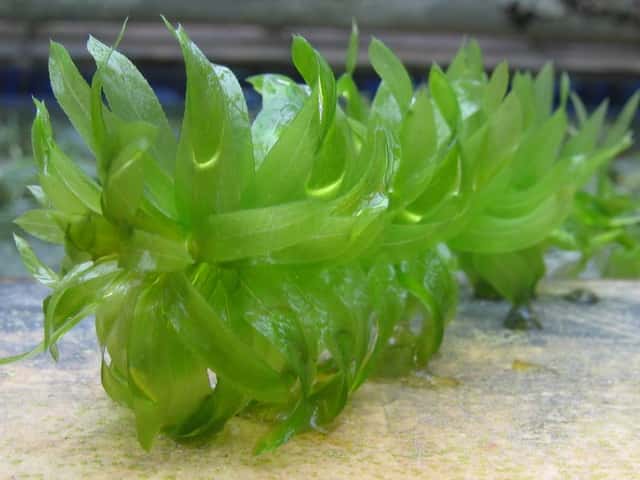
Egeria densa, commonly known as Brazilian waterweed, is a submerged aquatic plant native to the rivers and lakes of southeastern South America (Brazil, Argentina, Uruguay, Chile). Belonging to the Hydrocharitaceae family, it is among the most popular aquarium plants in the world due to its rapid growth, ease of cultivation, and excellent ability to oxygenate water while absorbing nitrates and phosphates, helping to combat algae blooms. It features thin, branched stems that can exceed one meter in length, covered in whorls of bright green, ribbon-like leaves; under favorable conditions, it produces small white three-petaled flowers that float on the water's surface. Due to its vigor, outside of a controlled aquarium or pond, it is considered an invasive species in many regions of the world, where it forms dense submerged mats capable of altering aquatic ecosystems: it must therefore be managed carefully, avoiding the dispersal of stem fragments into natural waterways.
How Big Does Brazilian Waterweed Grow?
TLDR: Brazilian Waterweed can reach up to 1.5m tall with Fast growth rate.
Max height
1.5m
Growth rate
Fast
Foliage
Evergreen
Plant Uses
Ornamental
Great for decoration
Is your plant showing symptoms?
Click on the symptom to discover possible causes:
What Diseases Commonly Affect Brazilian Waterweed?
TLDR: Brazilian Waterweed is susceptible to 3 known diseases. Monitor regularly for early detection.
Slugs and Snails
Slugs and snails are mollusks that feed on plant tissue, causing irregular holes in leaves and damage to young seedlings. They are most active at night and in moist conditions, leaving characteristic silvery slime trails. These pests can quickly devastate gardens, especially during wet seasons.
Animal Feeding Damage
Damage to plants caused by the feeding activities of animals such as insects, slugs, snails, or rodents. This weakens the plant and creates entry points for secondary diseases.
Low Light Stress
Low light stress, also known as etiolation, occurs when plants do not receive adequate light for proper growth and development. This leads to abnormal growth patterns characterized by elongated stems, pale leaves, and weakened overall structure as the plant attempts to reach toward available light sources.
Meaning & Symbolism
Due to its ability to purify water and thrive practically anywhere it is introduced, Egeria densa is often associated with concepts of purification, resilience, and adaptability: a plant that brings balance to an aquatic environment, but also serves as a reminder of how that same vitality, if left unchecked, can become invasive.
Compare with similar plants
| Attribute | Difficulty | Light | Watering | Pet Safe |
|---|---|---|---|---|
| Field Maple | Easy | Bright indirect | 14d | ✓ |
| Silver Birch | Easy | Direct sun | 14d | ✓ |
| Common Blanketflower | Easy | Direct sun | 10d | ✓ |
| Cushion Bush | Easy | Direct sun | 14d | ✓ |





