Araliaceae
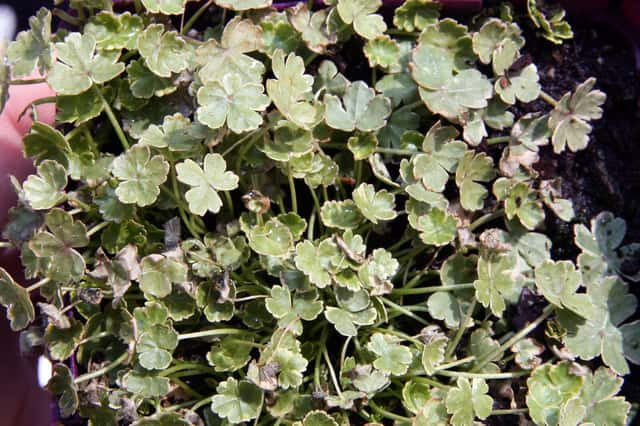
Lawn marshpennywort (Hydrocotyle sibthorpioides)
Hydrocotyle sibthorpioides
Needs soil that stays moist or wet, part shade to sun and warmth between 20 and 28 °C. It grows fast; trim the edges so it does not spread into lawns or nearby beds.
Every 2 days
Partial shade
10° - 30°C
60% - 90%
Categories
What is Lawn marshpennywort?
Lawn marshpennywort (Hydrocotyle sibthorpioides) is a easy-care plant from the Araliaceae family. Lawn marshpennywort (Hydrocotyle sibthorpioides) is a creeping perennial herb in the Araliaceae family, native to Asia from India and Japan to Southeast Asia. It forms a mat 2.5 to 5 cm tall of small (0.5 to 2.5 cm), glossy, round to kidney-shaped leaves with scalloped edges. The flowers are tiny an...
Lawn marshpennywort grows up to 5cm, watering every 2 days, 10°C – 30°C, 60–90% humidity. It is suitable for indoor environments and safe for pets.
Unlike many tropical plants, Lawn marshpennywort tolerates watering mistakes. Best for beginners. Unlike many popular species, Lawn marshpennywort is safe to keep around pets. Without adequate drainage, root rot can develop within 7 days.
How to Care for Lawn marshpennywort?
TLDR: Lawn marshpennywort needs Partial shade, watering every 2 days, and temperatures between 10-30°C with 60-90% humidity.
How Often Should You Water Lawn marshpennywort?
Keep the soil moist at all times; in a pot, water every 2 days in warm weather or stand the pot in a saucer of water. It also grows submerged or floating.
How Much Light Does Lawn marshpennywort Need?
Part shade or full sun. More light gives a denser mat and larger leaves; underwater it needs strong lighting.
What Is the Best Soil for Lawn marshpennywort?
Fertile, humus-rich soil that holds moisture, pH 5 to 7. It tolerates waterlogged soil.
What Pot Should You Use for Lawn marshpennywort?
A shallow pot without drainage holes, or one kept in a saucer of water, or a closed terrarium. It also works as an aquarium or pond-edge plant.
What Is Lawn marshpennywort and Where Does It Come From?
Lawn marshpennywort (Hydrocotyle sibthorpioides) is a creeping perennial herb in the Araliaceae family, native to Asia from India and Japan to Southeast Asia. It forms a mat 2.5 to 5 cm tall of small (0.5 to 2.5 cm), glossy, round to kidney-shaped leaves with scalloped edges. The flowers are tiny and greenish-white, in small clusters. It grows on damp banks, stream edges and lawns. In the United States and Australia it has become a lawn weed; in aquariums and terrariums it is grown as a ground cover.
How to Propagate Lawn marshpennywort?
Stem cuttings
Every node roots easily, so a small piece is enough.
- 1 Cut a piece of creeping stem with at least one node
- 2 Lay it on moist soil or plant it in aquarium substrate
- 3 Keep moist and in good light until it roots
Materials needed:
Mat division
Do not plant it in lawns or near natural areas; it spreads.
- 1 Cut out a rooted piece of the mat
- 2 Replant it in moist soil
- 3 Water well for the first few days
Materials needed:
How Big Does Lawn marshpennywort Grow?
TLDR: Lawn marshpennywort can reach up to 5cm tall with Fast growth rate.
Max height
5cm
Growth rate
Fast
Foliage
Evergreen
Plant Uses
Ornamental
Great for decoration
Ground Cover
Soil coverage
Medicinal
Medicinal properties
Edible
Can be consumed
Medicinal Uses
- Folk remedy in Asia for coughs, fever and jaundice (not clinically proven)
Culinary Uses
- Eaten as a leafy vegetable in Southeast Asia
Is your plant showing symptoms?
Click on the symptom to discover possible causes:
Fun Facts
Every stem node can root and start a new plant.
About 50 compounds have been isolated from it, including asiaticoside, also found in gotu kola.
Frequently asked questions
Is lawn marshpennywort toxic?
Can it grow in an aquarium?
How do I get rid of it in my lawn?
Compare with similar plants
| Attribute | Difficulty | Light | Watering | Pet Safe |
|---|---|---|---|---|
| Field Maple | Easy | Bright indirect | 14d | ✓ |
| Iberian Houseleek | Easy | Direct sun | 14d | ✓ |
| Silver Birch | Easy | Direct sun | 14d | ✓ |
| Common Blanketflower | Easy | Direct sun | 10d | ✓ |





