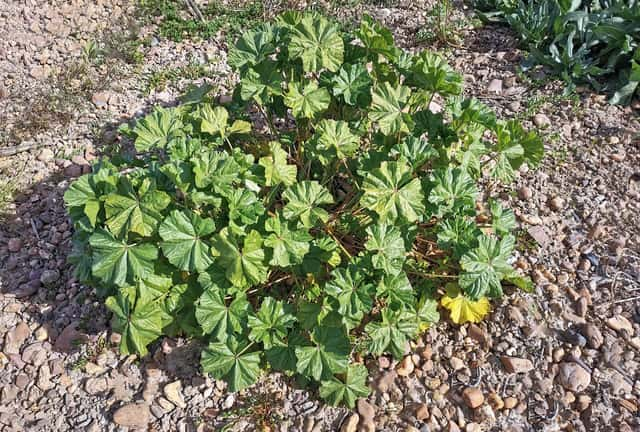
Malvaceae
Least mallow (Malva parviflora)
Malva parviflora
A self-sown plant that grows in almost any soil and needs no care. It likes full sun and grows mostly in the cool, wet season. If you want the leaves, water in dry spells; if it is a weed in your garden, pull it young, before it sets seed, because the taproot quickly gets hard to remove.
Every 7 days
Bright indirect
° - °C
% - %
Categories
What is Least mallow?
Least mallow (Malva parviflora) is a easy-care plant from the Malvaceae family. Least mallow (Malva parviflora) is an annual or biennial herb in the Malvaceae family, native to the Mediterranean, North Africa and western and central Asia, and now found almost worldwide as a weed of gardens, crops, roadsides and waste ground. It grows from 20 cm to a little over 1 m, upright or...
Least mallow grows up to 1.2m, watering every 7 days. It is not suitable for indoor environments and safe for pets.
Unlike many tropical plants, Least mallow tolerates watering mistakes. Best for beginners. Unlike many popular species, Least mallow is safe to keep around pets.
How to Care for Least mallow?
TLDR: Least mallow needs Bright indirect, watering every 7 days, and temperatures between 15-30°C with 40-70% humidity.
How Often Should You Water Least mallow?
Rarely needs watering: rain is enough in the cool season. For tender leaves, water weekly in dry weather. The taproot makes it drought tolerant.
How Much Light Does Least mallow Need?
Full sun. It also grows in part shade but gets taller and flowers less.
What Is the Best Soil for Least mallow?
Any soil from sand to clay, including poor and compacted ground. It does best in fertile soil with some moisture.
What Pot Should You Use for Least mallow?
Not a container plant. If you grow it, use a deep pot (30 cm or more) because of the taproot.
What Is Least mallow and Where Does It Come From?
Least mallow (Malva parviflora) is an annual or biennial herb in the Malvaceae family, native to the Mediterranean, North Africa and western and central Asia, and now found almost worldwide as a weed of gardens, crops, roadsides and waste ground. It grows from 20 cm to a little over 1 m, upright or sprawling, from a strong taproot. The leaves are rounded with 5-7 shallow, toothed lobes and a small red spot at the base. The flowers are small (about 1 cm), white to pale pink, and appear nearly all year. The fruit looks like a tiny wheel of cheese split into wedges, which gives it the name cheeseweed.
How to Propagate Least mallow?
Sowing
It self-seeds very easily; if you don't want it to spread, pick or cut it before the fruits dry.
- 1 Sow directly in place in autumn or late winter
- 2 Cover the seed with a thin layer of soil
- 3 Keep the soil moist until it germinates
- 4 Thin plants to about 30 cm apart
Materials needed:
How Big Does Least mallow Grow?
TLDR: Least mallow can reach up to 1.2m tall with Fast growth rate.
Max height
1.2m
Growth rate
Fast
Plant Uses
Edible
Can be consumed
Medicinal
Medicinal properties
Medicinal Uses
- In folk medicine the leaves are used as a poultice for skin inflammation
- Traditionally used against tapeworm in South Africa; consult a professional before any use
Culinary Uses
- Young leaves cooked like spinach in soups and stews
- Green fruits, husk removed, eaten raw in salads
Is your plant showing symptoms?
Click on the symptom to discover possible causes:
What Diseases Commonly Affect Least mallow?
TLDR: Least mallow is susceptible to 4 known diseases. Monitor regularly for early detection.
Rust
Rust is a common fungal disease caused by fungi in the order Pucciniales that affects a wide variety of plants. The disease gets its name from the characteristic orange, yellow, or reddish-brown pustules that appear on leaves, resembling metal rust. This obligate fungal parasite requires living plants to survive and can cause significant economic losses in agricultural crops.
Powdery Mildew
Powdery mildew is a common fungal disease caused by various fungi species including Erysiphe, Podosphaera, Oïdium, and Leveillula. It affects over 10,000 plant species worldwide. The disease thrives in warm, dry climates with high humidity and appears as a distinctive white powdery coating on plant surfaces.
Flea beetle damage
Flea beetles are small, jumping insects that feed on the leaves of many vegetable crops. They chew numerous small, circular holes, creating a characteristic 'shothole' appearance. While established plants can often tolerate the damage, young seedlings are highly susceptible and can be stunted or killed if the infestation is severe.
Curculionidae
Curculionidae (weevils) are small beetles that feed on plants. Adults chew leaf margins, leaving crescent-shaped notches, primarily at night. The larvae live in the substrate and consume roots, causing decline, yellowing, and wilting even when the substrate is moist, and in severe cases, plant death. They frequently affect ornamentals and garden plants such as strawberries, citrus, roses, hydrangeas, azaleas, blueberries, begonias, and many potted plants.
Fun Facts
The fruit looks like a tiny wheel of cheese cut into wedges, hence the name cheeseweed
Hens that eat the seeds can lay eggs with pink-tinged whites
It is one of the most common weeds of crops in Mediterranean climates
Frequently asked questions
Is least mallow edible?
Is it toxic to animals?
How do I control it in the garden?
How is it different from other mallows?
Compare with similar plants
| Attribute | Difficulty | Light | Watering | Pet Safe |
|---|---|---|---|---|
| Field Maple | Easy | Bright indirect | 14d | ✓ |
| Iberian Houseleek | Easy | Direct sun | 14d | ✓ |
| Silver Birch | Easy | Direct sun | 14d | ✓ |
| Common Blanketflower | Easy | Direct sun | 10d | ✓ |





