Ericaceae
Leatherleaf: the hardy shrub of boreal bogs
Chamaedaphne calyculata
Grow in consistently moist, acidic, peaty soil in full sun to part shade. Extremely cold hardy (USDA zones 2-6), but requires constant moisture and nutrient-poor substrate similar to its native bog habitat.
Every 3 days
Bright indirect
-40° - 24°C
60% - 90%
Categories
What is Leatherleaf?
Leatherleaf (Chamaedaphne calyculata) is a medium-care plant from the Ericaceae family. Chamaedaphne calyculata, commonly called leatherleaf or cassandra, is a perennial dwarf evergreen shrub in the family Ericaceae and the sole species in genus Chamaedaphne. Native to acidic bogs and boreal peatlands across North America, Europe, and Asia, it spreads via rhizomes to form dense thicket...
Leatherleaf grows up to 90cm, spread of 90cm, watering every 3 days, -40°C – 24°C, 60–90% humidity. It is not suitable for indoor environments and safe for pets.
Unlike many popular species, Leatherleaf is safe to keep around pets.
How to Care for Leatherleaf?
TLDR: Leatherleaf needs Bright indirect, watering every 3 days, and temperatures between -40-24°C with 60-90% humidity.
How Often Should You Water Leatherleaf?
Keep the substrate consistently moist but never waterlogged to the point of causing root rot; water with rainwater or distilled water whenever the surface begins to dry.
How Much Light Does Leatherleaf Need?
Prefers full sun to part shade; at least 4-6 hours of direct light daily encourages more abundant flowering.
What Is the Best Soil for Leatherleaf?
Use sphagnum peat or an acidic, organic-rich substrate with pH 3.5-5.5, mimicking natural peatland soil.
What Pot Should You Use for Leatherleaf?
Wide, shallow pot with drainage holes, kept on a water-filled saucer to maintain constant moisture (mimicking bog conditions)
What Is Leatherleaf and Where Does It Come From?
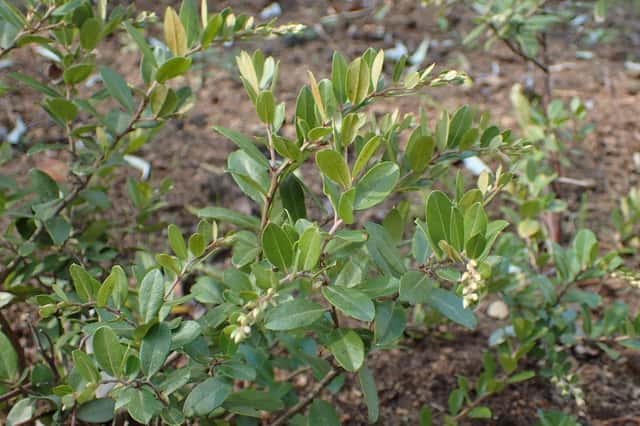
Chamaedaphne calyculata, commonly called leatherleaf or cassandra, is a perennial dwarf evergreen shrub in the family Ericaceae and the sole species in genus Chamaedaphne. Native to acidic bogs and boreal peatlands across North America, Europe, and Asia, it spreads via rhizomes to form dense thickets. Its thick, leathery, dark green leaves turn bronze-red in winter, and it produces small white urn-shaped flowers in one-sided racemes in spring.
How to Propagate Leatherleaf?
Rhizome/clump division
Divide in early spring before new growth starts. Keep substrate constantly moist until established.
- 1 Choose an established clump with multiple rooted shoots
- 2 Carefully dig around the rhizome to avoid damaging roots
- 3 Separate a section with healthy roots and shoots
- 4 Replant immediately in moist, acidic, peaty substrate
Materials needed:
How Big Does Leatherleaf Grow?
TLDR: Leatherleaf can reach up to 90cm tall with Slow growth rate.
Max height
90cm
Spread
90cm
Growth rate
Slow
Foliage
Evergreen
Plant Uses
Ornamental
Great for decoration
Is your plant showing symptoms?
Click on the symptom to discover possible causes:
What Diseases Commonly Affect Leatherleaf?
TLDR: Leatherleaf is susceptible to 4 known diseases. Monitor regularly for early detection.
Aphids
Aphids are small, soft-bodied, pear-shaped insects (1/16 to 1/8 inch long) that feed by sucking nutrient-rich sap from plants. They reproduce rapidly and can quickly weaken plants, causing distorted growth and transmitting plant viruses. Aphids come in various colors including green, black, red, yellow, brown, and gray. They secrete honeydew, a sticky substance that attracts ants and encourages sooty mold growth.
Scale Insects
Scale insects are small sap-sucking pests that appear as brown, shell-like bumps on plant stems and leaves. There are over 25 species, divided into armored (hard) and unarmored (soft) scales. They feed by piercing plant tissue and extracting sap, which weakens the plant and can lead to yellowing, stunted growth, and even death if left untreated. They also excrete honeydew, which attracts ants and promotes sooty mold growth.
Spider Mites
Spider mites are tiny arachnids (less than 1/20 inch long) related to spiders and ticks that feed on plant sap. They thrive in hot, dry conditions and can cause significant damage to ornamental and vegetable plants. During severe infestations, crop losses can reach 14% or higher as these pests disrupt vital plant processes including photosynthesis, carbon dioxide absorption, and transpiration.
Root Rot
Root rot is a serious fungal disease that affects the root system of plants, causing them to decay and die. It is primarily caused by overwatering, poor drainage, or soil-borne fungi such as Pythium, Phytophthora, Rhizoctonia, and Fusarium. The disease thrives in waterlogged conditions where roots are deprived of oxygen, making them susceptible to fungal infection.
Meaning & Symbolism
Symbolizes resilience and quiet endurance, tied to the harsh boreal bog habitats where it thrives.
Fun Facts
It is the only species in the genus Chamaedaphne
Its leaves turn bronze in winter but remain on the plant
It forms colonies that spread slowly via rhizomes, about one foot per decade
Frequently asked questions
Does leatherleaf need acidic soil?
Can this plant tolerate hard frost?
Can I grow it in a pot?
Compare with similar plants
| Attribute | Difficulty | Light | Watering | Pet Safe |
|---|---|---|---|---|
| Dark Fieldcap | Medium | Low light | 2d | ⚠️ |
| Azalea | Medium | Partial shade | 3d | ⚠️ |
| Muriel's Bamboo | Medium | Partial shade | 3d | ✓ |
| Bougainvillea | Medium | Direct sun | 7d | ⚠️ |




