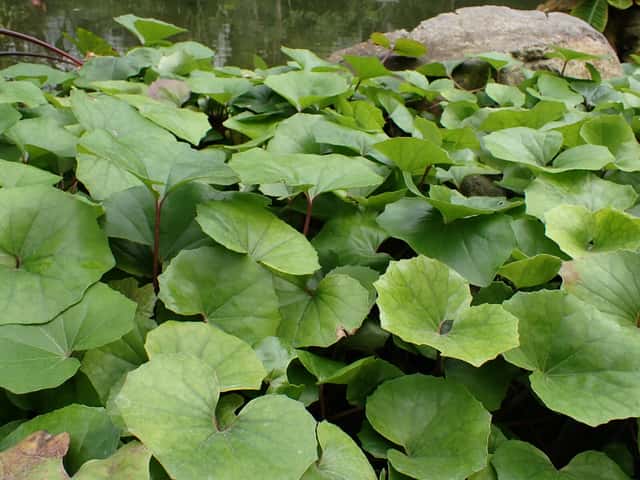
Asteraceae
Leopard plant: Ground Cover Plant
Farfugium japonicum
The leopard plant thrives best in partial to full shade, in consistently moist, fertile soil rich in organic matter. It does not tolerate direct midday sun or soil drying out, and it is sensitive to frost, so in continental regions, it is grown in containers that are moved to a protected location in winter.
Every 6 days
Low light
10° - 27°C
50% - 70%
Categories
What is Leopard plant?
Leopard plant (Farfugium japonicum) is a medium-care plant from the Asteraceae family. Farfugium japonicum, also known as the leopard plant or green leopard plant, is a perennial in the Asteraceae family native to moist coastal areas and stream banks in Japan, Korea, China, and Taiwan. This semi-evergreen plant forms a dense clump of large, round to kidney-shaped leaves with a leather...
Leopard plant grows up to 60cm, spread of 60cm, watering every 6 days, 10°C – 27°C, 50–70% humidity. It is suitable for indoor environments and not safe for pets.
Without precautions, ingestion can cause irritation in pets. Keep out of reach of cats and dogs. Without adequate drainage, root rot can develop within 12 days.
How to Care for Leopard plant?
TLDR: Leopard plant needs Low light, watering every 6 days, and temperatures between 10-27°C with 50-70% humidity.
How Often Should You Water Leopard plant?
Keep the soil consistently moist but not soggy—water as soon as the top few centimeters of the substrate dry out. In summer, the plant requires more frequent and abundant watering, while watering should be reduced in winter. Avoid standing water as the roots rot quickly in poorly drained soil.
How Much Light Does Leopard plant Need?
It thrives best in partial or full shade; direct summer sun, especially at noon, quickly burns its large leaves. Dappled light or eastern/northern exposure is ideal for indoor cultivation.
What Is the Best Soil for Leopard plant?
Use fertile, well-drained soil rich in organic matter (compost, humus), with a slightly acidic to neutral pH (6.0-7.0). Adding peat or compost helps retain moisture without waterlogging the roots.
What Pot Should You Use for Leopard plant?
Choose a wider but not excessively deep terracotta or glazed ceramic pot with mandatory drainage holes—terracotta helps regulate moisture, while glazed ceramic retains moisture longer, which suits a plant prone to leaf drying. Avoid plastic pots without drainage due to the risk of root rot.
Care Schedule
Fertilize
Every 30 days
Rotate
Every 14 days
Repot
Every 730 days
What Is Leopard plant and Where Does It Come From?
Farfugium japonicum, also known as the leopard plant or green leopard plant, is a perennial in the Asteraceae family native to moist coastal areas and stream banks in Japan, Korea, China, and Taiwan. This semi-evergreen plant forms a dense clump of large, round to kidney-shaped leaves with a leathery texture, growing from an underground rhizome on long, fleshy petioles. In the 'Aureomaculatum' cultivar, the leaves are covered with striking yellow spots resembling leopard fur, which gives the plant its name. In autumn and winter, it produces tall flower stalks with clusters of yellow daisy-like flowers. In its natural habitat, it grows in the shade along watercourses, and in gardens, it is used as an ornamental plant for shady areas.
How to Propagate Leopard plant?
How Big Does Leopard plant Grow?
TLDR: Leopard plant can reach up to 60cm tall with Medium growth rate.
Max height
60cm
Spread
60cm
Growth rate
Medium
Foliage
Semi-evergreen
Warning: Toxic Plant
This plant can be toxic if ingested. Keep out of reach of:
Plant Uses
Ornamental
Great for decoration
Medicinal
Medicinal properties
Edible
Can be consumed
Ground Cover
Soil coverage
Medicinal Uses
- Leaves are traditionally used as an antidote for fish poisoning in Far Eastern folk medicine
- External application of crushed leaves on purulent abscesses and skin inflammations
- Leaf juice was traditionally applied for lacquer poisoning (urushiol)
Culinary Uses
- Young leaf petioles (known in Japan as "tsuwabuki") are boiled, peeled, and added to salads and soups after removing the bitter taste
- After boiling and removing bitterness, the petioles are simmered in soy sauce as a traditional Japanese side dish ("kyarabuki")
Is your plant showing symptoms?
Click on the symptom to discover possible causes:
What Diseases Commonly Affect Leopard plant?
TLDR: Leopard plant is susceptible to 5 known diseases. Monitor regularly for early detection.
Root Rot
Root rot is a serious fungal disease that affects the root system of plants, causing them to decay and die. It is primarily caused by overwatering, poor drainage, or soil-borne fungi such as Pythium, Phytophthora, Rhizoctonia, and Fusarium. The disease thrives in waterlogged conditions where roots are deprived of oxygen, making them susceptible to fungal infection.
Alternaria Leaf Spot
Alternaria leaf spot is a common fungal disease caused by Alternaria solani and Alternaria alternata that affects a wide range of plants including tomatoes, potatoes, brassicas, and ornamentals. The disease thrives in warm, humid conditions and can cause significant crop damage if left untreated. Spores overwinter on plant debris and can attach to seeds, making complete elimination difficult.
Powdery Mildew
Powdery mildew is a common fungal disease caused by various fungi species including Erysiphe, Podosphaera, Oïdium, and Leveillula. It affects over 10,000 plant species worldwide. The disease thrives in warm, dry climates with high humidity and appears as a distinctive white powdery coating on plant surfaces.
Slugs and Snails
Slugs and snails are mollusks that feed on plant tissue, causing irregular holes in leaves and damage to young seedlings. They are most active at night and in moist conditions, leaving characteristic silvery slime trails. These pests can quickly devastate gardens, especially during wet seasons.
Meaning & Symbolism
With its spotted, exotic foliage, the leopard plant symbolizes hidden beauty and resilience—it thrives in shaded, seemingly unfavorable conditions where other plants struggle, and is thus associated with adaptability and subtle, unconventional beauty.
Compare with similar plants
| Attribute | Difficulty | Light | Watering | Pet Safe |
|---|---|---|---|---|
| Dark Fieldcap | Medium | Low light | 2d | ⚠️ |
| Azalea | Medium | Partial shade | 3d | ⚠️ |
| Muriel's Bamboo | Medium | Partial shade | 3d | ✓ |
| Bougainvillea | Medium | Direct sun | 7d | ⚠️ |




