Rutaceae
Lime Prickly-Ash (Zanthoxylum fagara)
Zanthoxylum fagara
A tough garden plant for warm climates. It takes sun or part shade, almost any soil and long dry spells once established, and rarely has serious pests. Plant it away from paths: the prickles hurt.
Every 14 days
Bright indirect
-4° - °C
% - %
Categories
What is Lime prickly-ash?
Lime prickly-ash (Zanthoxylum fagara) is a easy-care plant from the Rutaceae family. Zanthoxylum fagara is a shrub or small tree in the citrus family, Rutaceae, native from south Florida and south Texas through Mexico, Central America and the Caribbean to South America as far as Paraguay and southern Brazil. It usually grows 4 to 7 m tall, with a rounded crown and zigzag branches ar...
Lime prickly-ash grows up to 7.6m, spread of 600cm, watering every 14 days. It is not suitable for indoor environments and safe for pets.
Unlike many tropical plants, Lime prickly-ash tolerates watering mistakes. Best for beginners. Unlike many popular species, Lime prickly-ash is safe to keep around pets.
How to Care for Lime prickly-ash?
TLDR: Lime prickly-ash needs Bright indirect, watering every 14 days, and temperatures between -4-30°C with 40-70% humidity.
How Often Should You Water Lime prickly-ash?
During the first year, water every 1 to 2 weeks to establish the roots. Once established it is drought tolerant and mostly lives on rainfall; water only in long dry spells.
How Much Light Does Lime prickly-ash Need?
Grows well in full sun and also in part shade, even under larger trees. More sun makes it denser and more floriferous.
What Is the Best Soil for Lime prickly-ash?
Tolerates sandy, clay or loamy soil, acid or alkaline, as long as it does not stay waterlogged.
What Pot Should You Use for Lime prickly-ash?
Best as a garden plant. In a container, use a large, heavy pot with a drainage hole and a fast-draining mix.
What Is Lime prickly-ash and Where Does It Come From?
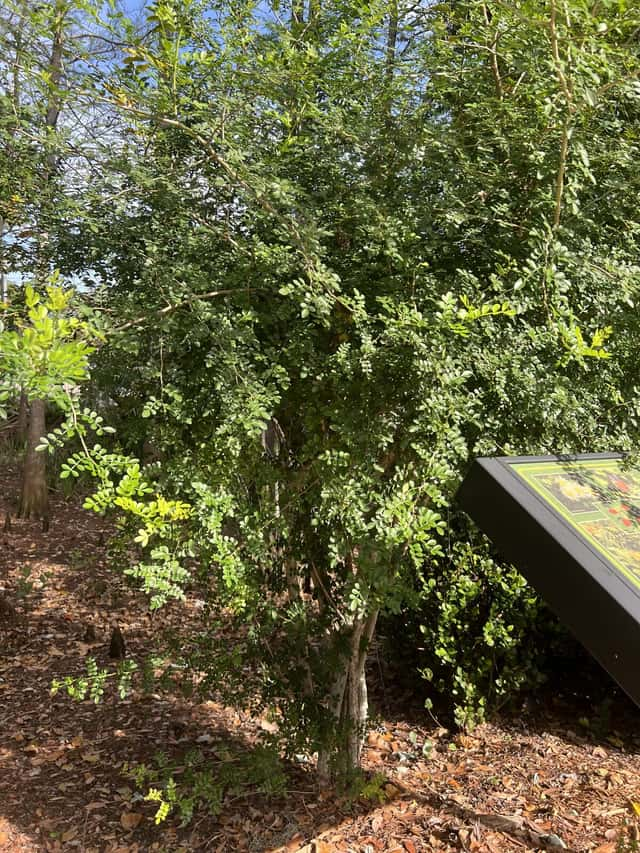
Zanthoxylum fagara is a shrub or small tree in the citrus family, Rutaceae, native from south Florida and south Texas through Mexico, Central America and the Caribbean to South America as far as Paraguay and southern Brazil. It usually grows 4 to 7 m tall, with a rounded crown and zigzag branches armed with hooked prickles. The leaves are compound, with small scalloped leaflets on a flattened, winged stalk, and smell of lime when crushed. The tiny yellow-green flowers are followed by small brown pods holding glossy black seeds. Despite the scent, it is not a true lime: it is more closely related to Sichuan pepper.
How to Propagate Lime prickly-ash?
Seed
Wear gloves when collecting: the branches have hooked prickles. Fresh seed germinates better than stored seed.
- 1 Collect ripe pods when they split to show the black seeds
- 2 Sow promptly, about 1 cm deep, in well-drained mix
- 3 Keep slightly moist in a warm, bright spot
- 4 Transplant seedlings once they have a few leaves
Materials needed:
How Big Does Lime prickly-ash Grow?
TLDR: Lime prickly-ash can reach up to 7.6m tall with Medium growth rate.
Max height
7.6m
Spread
6.0m
Growth rate
Medium
Foliage
Evergreen
Plant Uses
Ornamental
Great for decoration
Aromatic
Pleasant fragrance
Edible
Can be consumed
Medicinal Uses
- Folk medicinal uses are reported but unproven
Culinary Uses
- Powdered bark and leaves have been used as a lime-scented spice
Is your plant showing symptoms?
Click on the symptom to discover possible causes:
What Diseases Commonly Affect Lime prickly-ash?
TLDR: Lime prickly-ash is susceptible to 1 known diseases. Monitor regularly for early detection.
Fun Facts
Linnaeus first named it Schinus fagara; the current name dates from 1890.
It is a larval host plant of the giant swallowtail butterfly.
Powdered bark and leaves have been used as a lime-flavored spice.
Frequently asked questions
Does lime prickly-ash need much water?
Does wild lime produce limes?
Are the prickles dangerous?
Does it attract butterflies?
Compare with similar plants
| Attribute | Difficulty | Light | Watering | Pet Safe |
|---|---|---|---|---|
| Field Maple | Easy | Bright indirect | 14d | ✓ |
| Iberian Houseleek | Easy | Direct sun | 14d | ✓ |
| Silver Birch | Easy | Direct sun | 14d | ✓ |
| Common Blanketflower | Easy | Direct sun | 10d | ✓ |





