Ericaceae
Lingonberry (Vaccinium vitis-idaea)
Vaccinium vitis-idaea
A cold-climate shrub for gardens in USDA zones 3 to 7. It takes extreme cold but struggles in hot summers. Soil acidity matters most: it needs a pH between 4.5 and 5.5 and fails outside that range. Plant in full sun for fruit, keep the soil evenly moist and mulch with peat. For berries, plant two different cultivars near each other.
Every 5 days
Bright indirect
-45° - 27°C
% - %
Categories
What is Lingonberry?
Lingonberry (Vaccinium vitis-idaea) is a medium-care plant from the Ericaceae family. Lingonberry (Vaccinium vitis-idaea) is a dwarf evergreen shrub in the heath family, Ericaceae, related to blueberries and cranberries. It grows wild in boreal forest and Arctic tundra across the Northern Hemisphere. The stems reach 10 to 40 cm and the plant spreads by underground stems into dense ma...
Lingonberry grows up to 40cm, spread of 60cm, watering every 5 days, -45°C – 27°C. It is not suitable for indoor environments and safe for pets.
Unlike many popular species, Lingonberry is safe to keep around pets.
How to Care for Lingonberry?
TLDR: Lingonberry needs Bright indirect, watering every 5 days, and temperatures between -45-27°C with 40-70% humidity.
How Often Should You Water Lingonberry?
The roots are very shallow and dry out fast. Keep the soil evenly moist, watering every 4-6 days in dry weather, ideally at the base and in the morning. Do not let it get waterlogged.
How Much Light Does Lingonberry Need?
Full sun, 8 hours a day in early summer, for good flowering and fruit. It tolerates part shade but bears less. In warm climates, afternoon shade helps.
What Is the Best Soil for Lingonberry?
Strongly acidic soil (pH 4.5 to 5.5), peaty and free-draining, like soil for blueberries or azaleas. Mulch with 5-8 cm of peat. Feed lightly, only in early spring, with a fertilizer for acid-loving plants.
What Pot Should You Use for Lingonberry?
Grows well in a wide, shallow pot with drainage holes and an ericaceous (acid) mix. Use rainwater if your tap water is hard.
Care Schedule
Fertilize
Every 365 days
What Is Lingonberry and Where Does It Come From?
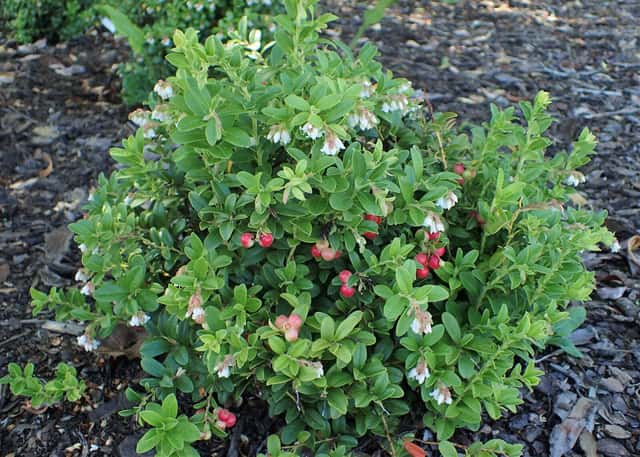
Lingonberry (Vaccinium vitis-idaea) is a dwarf evergreen shrub in the heath family, Ericaceae, related to blueberries and cranberries. It grows wild in boreal forest and Arctic tundra across the Northern Hemisphere. The stems reach 10 to 40 cm and the plant spreads by underground stems into dense mats. The leaves are small, oval, glossy dark green and stay on all year. In spring it bears clusters of bell-shaped white or pale pink flowers. The fruits are tart red berries 6 to 10 mm across that ripen from late summer into fall. In Scandinavia they become the jam served with meatballs and game.
How to Propagate Lingonberry?
Division
Divisions keep the parent cultivar, which matters when you need two cultivars for pollination.
- 1 In early spring, gently lift a section of the clump with roots and underground stems
- 2 Replant at the same depth in acidic soil
- 3 Water well and mulch with peat
- 4 Keep the soil moist until it establishes
Materials needed:
Stem cutting
Do not let the mix dry out while roots form.
- 1 Cut 5-8 cm tips from new shoots
- 2 Remove the lower leaves
- 3 Insert in a moist mix of peat and perlite
- 4 Cover with clear plastic and keep in a bright, cool spot
Materials needed:
Seed
Seeds need light to germinate and must not dry out after cleaning. Seedlings take years to fruit.
- 1 Crush overripe berries in a cup of water and let them ferment for 2-4 weeks
- 2 Discard what floats and strain the seeds that sank
- 3 Sow the same day on moist peat and perlite, without covering
- 4 Cover and keep in a cool, bright spot
Materials needed:
How Big Does Lingonberry Grow?
TLDR: Lingonberry can reach up to 40cm tall with Slow growth rate.
Max height
40cm
Spread
60cm
Growth rate
Slow
Foliage
Evergreen
Plant Uses
Edible
Can be consumed
Ornamental
Great for decoration
Ground Cover
Soil coverage
Culinary Uses
- Jam served with meatballs, game and liver
- Compote, juice and syrup
- Raw berries mashed with sugar
- Sauce for poultry, mixed with pears
Is your plant showing symptoms?
Click on the symptom to discover possible causes:
What Diseases Commonly Affect Lingonberry?
TLDR: Lingonberry is susceptible to 6 known diseases. Monitor regularly for early detection.
Phytophthora Root Rot
Disease caused by fungus-like organisms (oomycetes) that live in soil and can survive for years. It affects roots, stem, and crown of plants, being especially severe in waterlogged or poorly drained soils. It is the second most common cause of root rot in trees and shrubs.
Phomopsis Tip Blight
A disease caused by the Phomopsis fungus that kills young shoots and causes brown spots on leaves. It thrives in humid conditions and spreads through water splashes.
Leaf Spot
Leaf spot is a common fungal disease caused by various pathogens including Alternaria, Ascochyta, Colletotrichum, Septoria, and Venturia. It primarily affects leaves, causing discolored spots that can lead to premature leaf drop if left untreated.
Gray Mold (Botrytis Blight)
Gray mold, caused by the fungus Botrytis cinerea, is one of the most common fungal diseases in plants. It affects over 200 plant species, including ornamentals, vegetables, fruits, and houseplants. The disease thrives in cool, humid conditions with poor air circulation, causing grayish spots and soft rot on infected tissues.
Fun Facts
It survives cold down to about -45 °C (-50 °F) under snow cover.
In Sweden, traditional meatballs come with lingonberry jam.
The berries get sweeter if left on the branch through winter.
Frequently asked questions
Why is my lingonberry yellow and not growing?
Why does it flower but not fruit?
Can I grow lingonberries in a hot climate?
Can you eat lingonberries raw?
Compare with similar plants
| Attribute | Difficulty | Light | Watering | Pet Safe |
|---|---|---|---|---|
| Dark Fieldcap | Medium | Low light | 2d | ⚠️ |
| Azalea | Medium | Partial shade | 3d | ⚠️ |
| Muriel's Bamboo | Medium | Partial shade | 3d | ✓ |
| Bougainvillea | Medium | Direct sun | 7d | ⚠️ |




