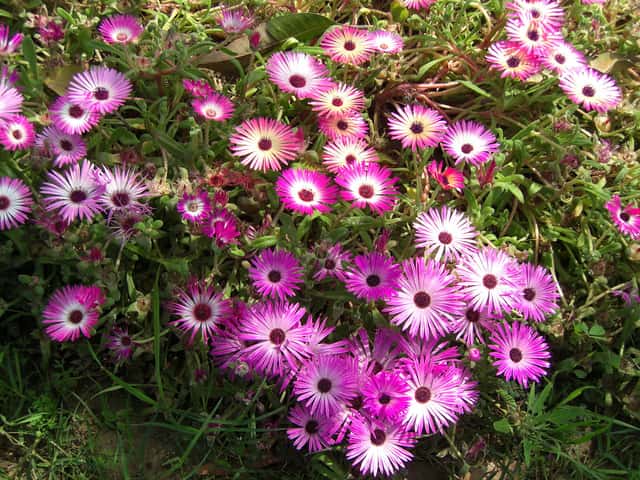
Aizoaceae
Livingstone Daisy (Dorotheanthus bellidiformis)
Dorotheanthus bellidiformis
Grow in full sun in sandy, very well-drained soil. Water sparingly, only when the soil has dried out, as it is drought tolerant. It dislikes frost and wet soil, which lead to root rot. Sow seed under cover in late winter or early spring. It needs no pruning and little feeding.
Every 10 days
Direct sun
° - °C
% - %
Categories
What is Livingstone daisy?
Livingstone daisy (Dorotheanthus bellidiformis) is a easy-care plant from the Aizoaceae family. The Livingstone daisy (Dorotheanthus bellidiformis, syn. Cleretum bellidiforme) is a low-growing succulent annual native to the Cape region of South Africa. It reaches about 25 cm tall and forms a dense mat of fleshy leaves covered in tiny glistening papillae. The solitary, many-petalled flowers res...
Livingstone daisy grows up to 25cm, watering every 10 days. It is not suitable for indoor environments and safe for pets.
Unlike many tropical plants, Livingstone daisy tolerates watering mistakes. Best for beginners. Unlike many popular species, Livingstone daisy is safe to keep around pets.
How to Care for Livingstone daisy?
TLDR: Livingstone daisy needs Direct sun, watering every 10 days, and temperatures between 15-30°C with 40-70% humidity.
How Often Should You Water Livingstone daisy?
Water deeply but only when the soil is completely dry, and never let water sit around the roots.
How Much Light Does Livingstone daisy Need?
Give it as many hours of direct sun as possible; the flowers will not open in shade.
What Is the Best Soil for Livingstone daisy?
Use sandy, free-draining compost, for example soil mixed with coarse sand or perlite.
What Pot Should You Use for Livingstone daisy?
Wide, shallow terracotta pot or trough with drainage holes and sandy compost.
What Is Livingstone daisy and Where Does It Come From?
The Livingstone daisy (Dorotheanthus bellidiformis, syn. Cleretum bellidiforme) is a low-growing succulent annual native to the Cape region of South Africa. It reaches about 25 cm tall and forms a dense mat of fleshy leaves covered in tiny glistening papillae. The solitary, many-petalled flowers resemble daisies, up to 30 mm across, and come in white, cream, yellow, orange, pink and crimson. They open only in bright sunshine and close in dull weather. In the wild it grows on loose sands, clay slopes and rocky outcrops in fynbos and succulent karoo. In temperate climates it is grown as a half-hardy annual for borders, rockeries, window boxes, troughs and pots.
How to Propagate Livingstone daisy?
Sowing seed
Sow in a cold frame or under cover in late winter for earlier flowers.
- 1 Fill a seed tray with sandy, free-draining compost and moisten lightly.
- 2 Scatter the seed on the surface and cover with a very thin layer of sand.
- 3 Keep in a bright, frost-free spot with light moisture.
- 4 Plant out once the risk of frost has passed.
Materials needed:
How Big Does Livingstone daisy Grow?
TLDR: Livingstone daisy can reach up to 25cm tall with Medium growth rate.
Max height
25cm
Growth rate
Medium
Plant Uses
Ornamental
Great for decoration
Is your plant showing symptoms?
Click on the symptom to discover possible causes:
What Diseases Commonly Affect Livingstone daisy?
TLDR: Livingstone daisy is susceptible to 4 known diseases. Monitor regularly for early detection.
Root Rot
Root rot is a serious fungal disease that affects the root system of plants, causing them to decay and die. It is primarily caused by overwatering, poor drainage, or soil-borne fungi such as Pythium, Phytophthora, Rhizoctonia, and Fusarium. The disease thrives in waterlogged conditions where roots are deprived of oxygen, making them susceptible to fungal infection.
Overwatering
Overwatering occurs when plants receive too much water, depriving roots of oxygen and causing root rot. This environmental stress is one of the most common causes of houseplant death, as waterlogged soil prevents roots from breathing and functioning properly.
Grey Mould
Aphids
Aphids are small, soft-bodied, pear-shaped insects (1/16 to 1/8 inch long) that feed by sucking nutrient-rich sap from plants. They reproduce rapidly and can quickly weaken plants, causing distorted growth and transmitting plant viruses. Aphids come in various colors including green, black, red, yellow, brown, and gray. They secrete honeydew, a sticky substance that attracts ants and encourages sooty mold growth.
Fun Facts
Its Afrikaans name is bokbaaivygie, and it is native to the Cape region of South Africa.
The flowers open and close in response to sunlight.
Frequently asked questions
How often should I water a Livingstone daisy?
Why won't my flowers open?
Is it frost hardy?
What soil is best?
Compare with similar plants
| Attribute | Difficulty | Light | Watering | Pet Safe |
|---|---|---|---|---|
| Field Maple | Easy | Bright indirect | 14d | ✓ |
| Silver Birch | Easy | Direct sun | 14d | ✓ |
| Common Blanketflower | Easy | Direct sun | 10d | ✓ |
| Cushion Bush | Easy | Direct sun | 14d | ✓ |





