Convolvulaceae
Man of the earth (Ipomoea pandurata)
Ipomoea pandurata
A tough, fast-growing vine. Plant it in full sun or partial shade in any soil that drains well. Water until it establishes; after that, the large root carries it through drought. Give it a fence, trellis or arbor to climb, or it will smother nearby plants. Deadhead to stop it self-seeding. Once established it is hard to remove because of the deep root.
Every 10 days
Bright indirect
° - °C
% - %
Categories
What is Man of the earth?
Man of the earth (Ipomoea pandurata) is a easy-care plant from the Convolvulaceae family. Man of the earth (Ipomoea pandurata) is a perennial vine in the morning glory family, related to the sweet potato, native to eastern and central North America from Ontario to the southern United States. Its purplish stems twine over fences and shrubs, reaching 5 to 9 m in a season, and the heart-sha...
Man of the earth grows up to 9.0m, spread of 180cm, watering every 10 days. It is not suitable for indoor environments and not safe for pets.
Unlike many tropical plants, Man of the earth tolerates watering mistakes. Best for beginners. Without precautions, ingestion can cause irritation in pets. Keep out of reach of cats and dogs.
How to Care for Man of the earth?
TLDR: Man of the earth needs Bright indirect, watering every 10 days, and temperatures between 15-30°C with 40-70% humidity.
How Often Should You Water Man of the earth?
Water every 1 to 2 weeks in the first year if it does not rain. Once established it needs little or no watering and handles drought. In constantly moist, fertile soil it grows rampantly.
How Much Light Does Man of the earth Need?
Full sun, with at least 6 hours of direct light, gives the best flowering. It tolerates partial shade with 2 to 6 hours of sun.
What Is the Best Soil for Man of the earth?
Not fussy: it grows in clay, sand, rocky ground or rich soil, as long as it drains well.
What Pot Should You Use for Man of the earth?
Best in the ground. In containers, only use deep ones (40 cm or more), since the tuberous root grows very large.
What Is Man of the earth and Where Does It Come From?
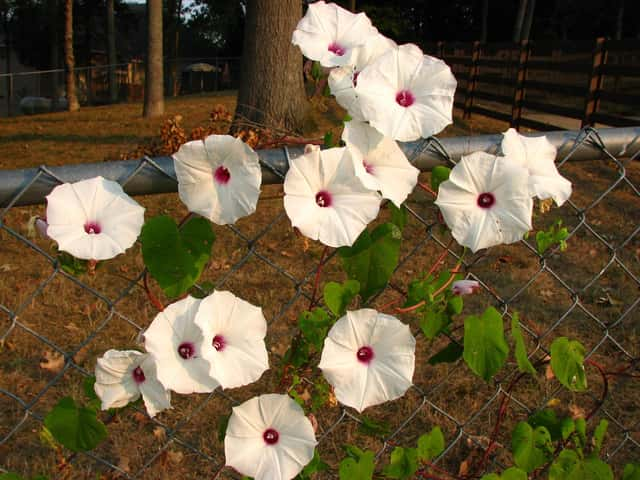
Man of the earth (Ipomoea pandurata) is a perennial vine in the morning glory family, related to the sweet potato, native to eastern and central North America from Ontario to the southern United States. Its purplish stems twine over fences and shrubs, reaching 5 to 9 m in a season, and the heart-shaped leaves grow up to 15 cm long. Funnel-shaped flowers 6 to 8 cm across are white with a deep pink to purple throat; they open early, last less than a day, and appear from late spring to late summer, drawing bees, butterflies and moths. Underground it builds a huge tuberous root that can exceed 70 cm and 10 kg. The top dies back in winter and regrows from the root.
How to Propagate Man of the earth?
Seed
Sow in its final spot: the tuberous root grows deep and resents transplanting. It takes a few years to build a large root.
- 1 Collect dry capsules in late summer or fall
- 2 Nick the hard seed coat lightly or soak the seeds overnight
- 3 Sow directly where it will grow, 1 to 2 cm deep, after the last frost
- 4 Keep the soil moist until the seedlings appear
Materials needed:
How Big Does Man of the earth Grow?
TLDR: Man of the earth can reach up to 9.0m tall with Fast growth rate.
Max height
9.0m
Spread
1.8m
Growth rate
Fast
Foliage
Deciduous
Warning: Toxic Plant
This plant can be toxic if ingested. Keep out of reach of:
Plant Uses
Ornamental
Great for decoration
Edible
Can be consumed
Medicinal
Medicinal properties
Ground Cover
Soil coverage
Medicinal Uses
- Native Americans used root poultices for rheumatic pain and root infusions as a diuretic, expectorant and laxative; efficacy not proven.
Culinary Uses
- The tuberous root can be roasted or boiled like a sweet potato; young roots are best, older ones turn bitter.
- Raw, the root is purgative: always cook it.
Is your plant showing symptoms?
Click on the symptom to discover possible causes:
What Diseases Commonly Affect Man of the earth?
TLDR: Man of the earth is susceptible to 3 known diseases. Monitor regularly for early detection.
Curculionidae
Curculionidae (weevils) are small beetles that feed on plants. Adults chew leaf margins, leaving crescent-shaped notches, primarily at night. The larvae live in the substrate and consume roots, causing decline, yellowing, and wilting even when the substrate is moist, and in severe cases, plant death. They frequently affect ornamentals and garden plants such as strawberries, citrus, roses, hydrangeas, azaleas, blueberries, begonias, and many potted plants.
Flea beetle damage
Flea beetles are small, jumping insects that feed on the leaves of many vegetable crops. They chew numerous small, circular holes, creating a characteristic 'shothole' appearance. While established plants can often tolerate the damage, young seedlings are highly susceptible and can be stunted or killed if the infestation is severe.
Caterpillars
Caterpillars are the larval stage of moths and butterflies that feed voraciously on plant foliage, stems, flowers, and fruits. Common species include cabbage loopers, tomato hornworms, armyworms, and cutworms. These pests can cause extensive damage by consuming large amounts of plant tissue in a short time. They vary in size from small (1/4 inch) to large (5 inches), with colors ranging from green to brown, often featuring stripes or spots. Caterpillars are highly mobile and can quickly spread throughout gardens, making them one of the most destructive common pests.
Fun Facts
The tuberous root can grow over 70 cm long and weigh more than 10 kg.
Each flower opens in the morning and closes around midday in sun; on cloudy days it lasts longer.
Its seeds are hairy, which sets it apart from most other morning glories, whose seeds are smooth.
Frequently asked questions
Is man of the earth toxic?
Is the root edible?
Will it take over my garden?
When does it bloom?
Compare with similar plants
| Attribute | Difficulty | Light | Watering | Pet Safe |
|---|---|---|---|---|
| Field Maple | Easy | Bright indirect | 14d | ✓ |
| Iberian Houseleek | Easy | Direct sun | 14d | ✓ |
| Silver Birch | Easy | Direct sun | 14d | ✓ |
| Common Blanketflower | Easy | Direct sun | 10d | ✓ |





