Phyllanthaceae
Mascarene Island Leaf-Flower (Phyllanthus tenellus)
Phyllanthus tenellus
Practically grows itself: full sun or light shade and moist soil. It flowers and sets seed when only a few centimetres tall and spreads readily, so gardeners and nurseries usually treat it as a weed. If you grow it on purpose, keep it in its own pot and confirm the species before any use.
Every 3 days
Bright indirect
° - °C
% - %
Categories
What is Mascarene Island leaf-flower?
Mascarene Island leaf-flower (Phyllanthus tenellus) is a easy-care plant from the Phyllanthaceae family. Phyllanthus tenellus is a small herb in the Phyllanthaceae family, native to the Mascarene Islands (Mauritius and Réunion) and possibly eastern Africa and Arabia, now naturalised as a weed across the tropics and subtropics. It grows 20–50 cm tall (rarely 60 cm), with a thin, reddish main stem bearin...
Mascarene Island leaf-flower grows up to 60cm, watering every 3 days. It is not suitable for indoor environments and safe for pets.
Unlike many tropical plants, Mascarene Island leaf-flower tolerates watering mistakes. Best for beginners. Unlike many popular species, Mascarene Island leaf-flower is safe to keep around pets.
How to Care for Mascarene Island leaf-flower?
TLDR: Mascarene Island leaf-flower needs Bright indirect, watering every 3 days, and temperatures between 15-30°C with 40-70% humidity.
How Often Should You Water Mascarene Island leaf-flower?
Likes soil that stays lightly moist; water every 2 to 4 days in warm weather. Once established it tolerates dry spells. Dry soil suppresses seed germination.
How Much Light Does Mascarene Island leaf-flower Need?
Full sun or light shade. Germination is highest in direct sun; deep shade and mulch greatly reduce new seedlings.
What Is the Best Soil for Mascarene Island leaf-flower?
Not fussy: it grows in garden soil, potting mix and even cracks in paving. Constant moisture is what favours it most.
What Pot Should You Use for Mascarene Island leaf-flower?
A small to medium pot of any material with drainage holes; keep it apart from other containers so it does not seed into them.
What Is Mascarene Island leaf-flower and Where Does It Come From?
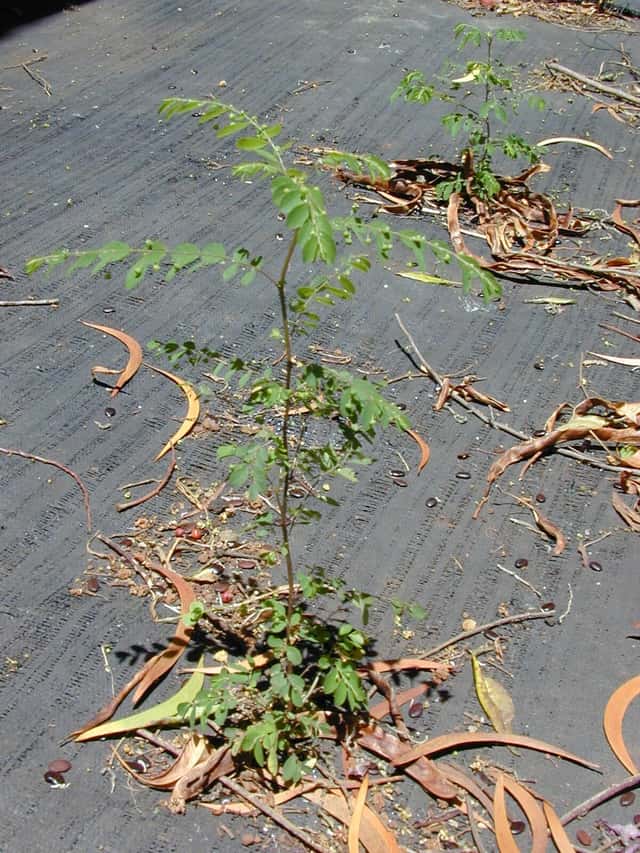
Phyllanthus tenellus is a small herb in the Phyllanthaceae family, native to the Mascarene Islands (Mauritius and Réunion) and possibly eastern Africa and Arabia, now naturalised as a weed across the tropics and subtropics. It grows 20–50 cm tall (rarely 60 cm), with a thin, reddish main stem bearing only scales; the side branches look like compound leaves, with elliptic leaflets about 1 cm long alternating in two rows. Tiny white, star-shaped flowers sit in the leaf axils, followed by round, green 2 mm capsules hanging on long stalks — the feature that separates it from chamberbitter (P. urinaria). The capsules burst and fling seeds more than a metre. It turns up in flower beds, lawns, nursery containers and greenhouses, especially where irrigation is frequent. In Brazil it is one of the herbs sold as quebra-pedra ("stone-breaker").
How to Propagate Mascarene Island leaf-flower?
Seed
Needs warmth and light to germinate. It self-sows freely, so control where it grows.
- 1 Collect stems with ripe capsules inside a paper bag, since they burst
- 2 Scatter the seeds on moist mix without burying them deeply
- 3 Keep warm, sunny and evenly moist
- 4 Thin the seedlings once they appear
Materials needed:
How Big Does Mascarene Island leaf-flower Grow?
TLDR: Mascarene Island leaf-flower can reach up to 60cm tall with Fast growth rate.
Max height
60cm
Growth rate
Fast
Plant Uses
Medicinal
Medicinal properties
Medicinal Uses
- Used in Brazilian folk medicine as quebra-pedra, in teas for kidney stones, and listed with a monograph in the Brazilian Pharmacopoeia. Animal studies give mixed safety results; use only with professional advice and a correctly identified plant.
Is your plant showing symptoms?
Click on the symptom to discover possible causes:
Fun Facts
Its capsules burst when ripe and throw seeds more than a metre away
Plants can flower and set seed when just a few centimetres tall
It has travelled the world in nursery pots, even growing through their drainage holes
Frequently asked questions
How do I tell Phyllanthus tenellus from chamberbitter?
Why does this plant keep appearing in my pots?
How do I get rid of it?
Is Phyllanthus tenellus toxic?
Compare with similar plants
| Attribute | Difficulty | Light | Watering | Pet Safe |
|---|---|---|---|---|
| Field Maple | Easy | Bright indirect | 14d | ✓ |
| Iberian Houseleek | Easy | Direct sun | 14d | ✓ |
| Silver Birch | Easy | Direct sun | 14d | ✓ |
| Common Blanketflower | Easy | Direct sun | 10d | ✓ |
Choose & Compare
Sources & References
- Wikipedia — Phyllanthus tenellus (Mascarene Island leaf flower)
- UF/IFAS EDIS EP518 — Biology and management of long-stalked phyllanthus (Phyllanthus tenellus)
- UF/IFAS MREC — Weeds by flower colour: Phyllanthus tenellus
- Univali — Phyllanthus spp. (quebra-pedra): monografias de P. tenellus e P. niruri na Farmacopeia Brasileira
- UFPE — Estudo comparativo de três espécies de Phyllanthus conhecidas por quebra-pedra (P. niruri, P. amarus, P. tenellus)





