Anacardiaceae
Mastic Tree (Pistacia lentiscus)
Pistacia lentiscus
Tough, low-maintenance plant. It needs full sun, well-drained soil and little water once established. Overwatering can lead to root rot. Prune lightly to remove dead wood and shape.
Every 14 days
Direct sun
-15° - °C
% - %
Categories
What is Mastic Tree?
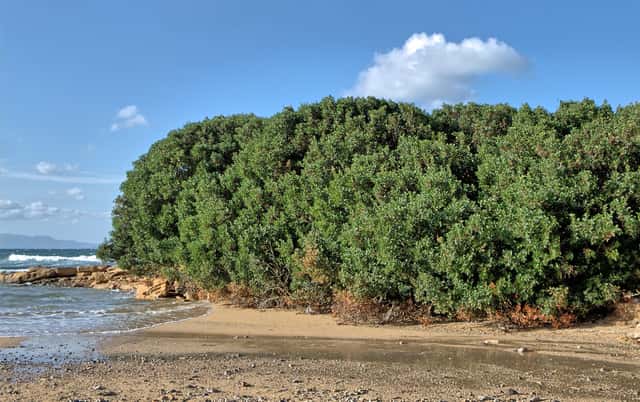
Mastic Tree (Pistacia lentiscus) is a easy-care plant from the Anacardiaceae family. Evergreen Mediterranean shrub or small tree with leathery leaves and a rounded, spreading form. It is dioecious, with tiny green or reddish flowers in spring. Female plants bear bright red berries that turn black when ripe. The bark yields the aromatic resin known as mastic.
Mastic Tree grows up to 5.0m, spread of 300cm, watering every 14 days. It is not suitable for indoor environments and safe for pets.
Unlike many tropical plants, Mastic Tree tolerates watering mistakes. Best for beginners. Unlike many popular species, Mastic Tree is safe to keep around pets.
How to Care for Mastic Tree?
TLDR: Mastic Tree needs Direct sun, watering every 14 days, and temperatures between -15-30°C with 40-70% humidity.
How Often Should You Water Mastic Tree?
Water deeply but infrequently. Young plants need regular watering in the first year or two, then rely mostly on rainfall. Let the soil dry between waterings.
How Much Light Does Mastic Tree Need?
Full sun, at least 6 hours a day. It cannot grow in shade.
What Is the Best Soil for Mastic Tree?
Tolerates poor, stony, sandy, loamy or clay soils, neutral to mildly alkaline, as long as drainage is good.
What Pot Should You Use for Mastic Tree?
Large, deep pot with good drainage for young plants or bonsai. Best planted in the ground.
Care Schedule
Fertilize
Every 14 days
Misting
Every 3 days
Rotate
Every 7 days
Repot
Every 365 days
What Is Mastic Tree and Where Does It Come From?
Evergreen Mediterranean shrub or small tree with leathery leaves and a rounded, spreading form. It is dioecious, with tiny green or reddish flowers in spring. Female plants bear bright red berries that turn black when ripe. The bark yields the aromatic resin known as mastic.
How to Propagate Mastic Tree?
Seed sowing
Sowing in autumn or spring is reported to work better than cuttings. Germination is slow and variable.
- 1 Pre-soak seeds in water and discard those that float
- 2 Sow in a mix of peat and perlite
- 3 Keep cool and lightly moist until they germinate
Materials needed:
Cuttings
Some sources say cuttings are possible, though seed usually gives better results.
- 1 Take a healthy cutting from a young branch
- 2 Plant in a very free-draining mix
- 3 Keep lightly moist
Materials needed:
How Big Does Mastic Tree Grow?
TLDR: Mastic Tree can reach up to 5.0m tall with Slow growth rate.
Max height
5.0m
Spread
3.0m
Growth rate
Slow
Foliage
Evergreen
Plant Uses
Ornamental
Great for decoration
Edible
Can be consumed
Medicinal
Medicinal properties
Medicinal Uses
- The resin has traditionally been used as an analgesic, expectorant, carminative, diuretic and sedative
Culinary Uses
- Mastic resin is used as a sweet, liquorice-flavoured seasoning
- The seeds yield an edible oil
Is your plant showing symptoms?
Click on the symptom to discover possible causes:
What Diseases Commonly Affect Mastic Tree?
TLDR: Mastic Tree is susceptible to 8 known diseases. Monitor regularly for early detection.
Root Rot
Root rot is a serious fungal disease that affects the root system of plants, causing them to decay and die. It is primarily caused by overwatering, poor drainage, or soil-borne fungi such as Pythium, Phytophthora, Rhizoctonia, and Fusarium. The disease thrives in waterlogged conditions where roots are deprived of oxygen, making them susceptible to fungal infection.
Aphids
Aphids are small, soft-bodied, pear-shaped insects (1/16 to 1/8 inch long) that feed by sucking nutrient-rich sap from plants. They reproduce rapidly and can quickly weaken plants, causing distorted growth and transmitting plant viruses. Aphids come in various colors including green, black, red, yellow, brown, and gray. They secrete honeydew, a sticky substance that attracts ants and encourages sooty mold growth.
Scale Insects
Scale insects are small sap-sucking pests that appear as brown, shell-like bumps on plant stems and leaves. There are over 25 species, divided into armored (hard) and unarmored (soft) scales. They feed by piercing plant tissue and extracting sap, which weakens the plant and can lead to yellowing, stunted growth, and even death if left untreated. They also excrete honeydew, which attracts ants and promotes sooty mold growth.
Sooty Mold
Sooty mold is a fungal disease that develops on surfaces coated with honeydew, a sticky sweet substance secreted by sap-sucking insects like aphids, scale insects, and whiteflies. While it does not directly infect plant tissue, it reduces photosynthetic capacity by blocking sunlight and diminishes the plant's aesthetic appearance.
Fun Facts
The bark yields mastic resin, used as an aromatic gum and in varnishes
It is dioecious, with separate male and female plants
The berries turn from bright red to black as they ripen
Frequently asked questions
How often should I water a mastic tree?
Does it need full sun?
What pests does it get?
Can I prune it?
Compare with similar plants
| Attribute | Difficulty | Light | Watering | Pet Safe |
|---|---|---|---|---|
| Field Maple | Easy | Bright indirect | 14d | ✓ |
| Silver Birch | Easy | Direct sun | 14d | ✓ |
| Common Blanketflower | Easy | Direct sun | 10d | ✓ |
| Cushion Bush | Easy | Direct sun | 14d | ✓ |





