Acanthaceae
Mexican Honeysuckle (Justicia spicigera)
Justicia spicigera
An easy shrub for sun or part shade, well-drained soil and little water once established. It takes heat and drought; hard frost kills the leaves but it regrows from the roots. A light trim in late winter keeps it compact and flowering.
Every 7 days
Bright indirect
-4° - °C
% - %
Categories
What is Mexican honeysuckle?
Mexican honeysuckle (Justicia spicigera) is a easy-care plant from the Acanthaceae family. Mexican honeysuckle (Justicia spicigera) is a shrub in the acanthus family (Acanthaceae), native to Mexico and Central America and unrelated to true honeysuckles. It grows to about 1.5 m tall and a little wider, with soft, light green oval leaves in pairs. From spring to autumn, and almost all year...
Mexican honeysuckle grows up to 1.5m, spread of 180cm, watering every 7 days. It is not suitable for indoor environments and safe for pets.
Unlike many tropical plants, Mexican honeysuckle tolerates watering mistakes. Best for beginners. Unlike many popular species, Mexican honeysuckle is safe to keep around pets.
How to Care for Mexican honeysuckle?
TLDR: Mexican honeysuckle needs Bright indirect, watering every 7 days, and temperatures between -4-30°C with 40-70% humidity.
How Often Should You Water Mexican honeysuckle?
Water weekly while it establishes. After that it is drought tolerant; a deep soak every two to four weeks in dry weather keeps it lush. Too much water reduces flowering and rots the roots.
How Much Light Does Mexican honeysuckle Need?
Full sun to part shade. In too much shade it flowers less and gets leggy.
What Is the Best Soil for Mexican honeysuckle?
Well-drained soil, neutral to alkaline. Avoid waterlogged ground.
What Pot Should You Use for Mexican honeysuckle?
A large pot with good drainage and a gritty mix; it does best planted in the garden.
What Is Mexican honeysuckle and Where Does It Come From?
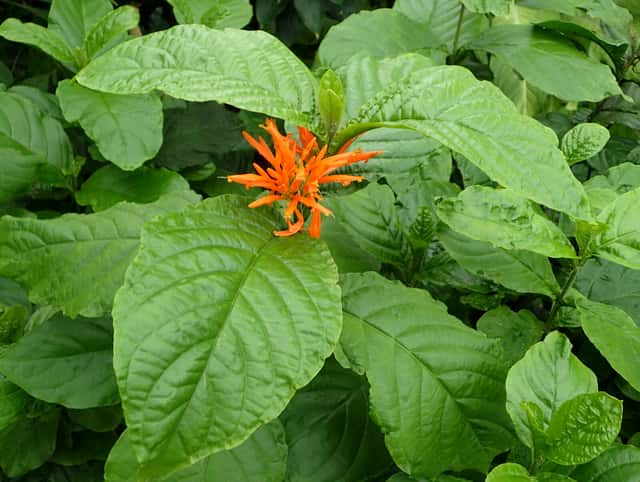
Mexican honeysuckle (Justicia spicigera) is a shrub in the acanthus family (Acanthaceae), native to Mexico and Central America and unrelated to true honeysuckles. It grows to about 1.5 m tall and a little wider, with soft, light green oval leaves in pairs. From spring to autumn, and almost all year in mild climates, it carries clusters of orange tubular flowers that draw hummingbirds, bees and butterflies. In Mexico it has been used since pre-Hispanic times in traditional medicine and as a dye: the leaves turn hot water a violet blue.
How to Propagate Mexican honeysuckle?
Stem cutting
Softwood cuttings in summer and hardwood cuttings in autumn both root well. Do not keep the mix soggy.
- 1 Take a 10-15 cm cutting from a healthy, non-flowering stem
- 2 Remove the leaves from the lower half
- 3 Dip in rooting hormone to speed things up, if you like
- 4 Insert into a light, moist mix
- 5 Keep in indirect light with the mix just moist until it roots
Materials needed:
Separating rooted suckers
Works best on large, well-established plants.
- 1 Pick a sucker with its own roots on a large plant
- 2 Separate it from the parent with a clean spade
- 3 Plant it in well-drained soil
- 4 Water well for the first few weeks
Materials needed:
How Big Does Mexican honeysuckle Grow?
TLDR: Mexican honeysuckle can reach up to 1.5m tall with Medium growth rate.
Max height
1.5m
Spread
1.8m
Growth rate
Medium
Foliage
Evergreen
Plant Uses
Ornamental
Great for decoration
Medicinal
Medicinal properties
Medicinal Uses
- Leaf infusion used in traditional Mexican medicine for respiratory complaints and as a tonic
Is your plant showing symptoms?
Click on the symptom to discover possible causes:
What Diseases Commonly Affect Mexican honeysuckle?
TLDR: Mexican honeysuckle is susceptible to 2 known diseases. Monitor regularly for early detection.
Whiteflies
Whiteflies are small, soft-bodied, winged insects closely related to aphids and mealybugs. They are moth-like in appearance, about 1/16 inch long, triangular in shape, and gray-white in color. These sap-sucking pests feed on plant tissue, causing yellowing, stunted growth, and wilting. They also excrete honeydew, which attracts ants and promotes sooty mold growth. Whiteflies can transmit serious plant viruses.
Root Rot
Root rot is a serious fungal disease that affects the root system of plants, causing them to decay and die. It is primarily caused by overwatering, poor drainage, or soil-borne fungi such as Pythium, Phytophthora, Rhizoctonia, and Fusarium. The disease thrives in waterlogged conditions where roots are deprived of oxygen, making them susceptible to fungal infection.
Fun Facts
Its leaves turn hot water violet blue and were used to dye cloth.
Its tubular flowers are shaped to fit a hummingbird's bill.
The name muicle comes from the Nahuatl word mohuitli.
Frequently asked questions
How often should I water Mexican honeysuckle?
Is it frost hardy?
How do I propagate it?
Is it a real honeysuckle?
Compare with similar plants
| Attribute | Difficulty | Light | Watering | Pet Safe |
|---|---|---|---|---|
| Field Maple | Easy | Bright indirect | 14d | ✓ |
| Iberian Houseleek | Easy | Direct sun | 14d | ✓ |
| Silver Birch | Easy | Direct sun | 14d | ✓ |
| Common Blanketflower | Easy | Direct sun | 10d | ✓ |





