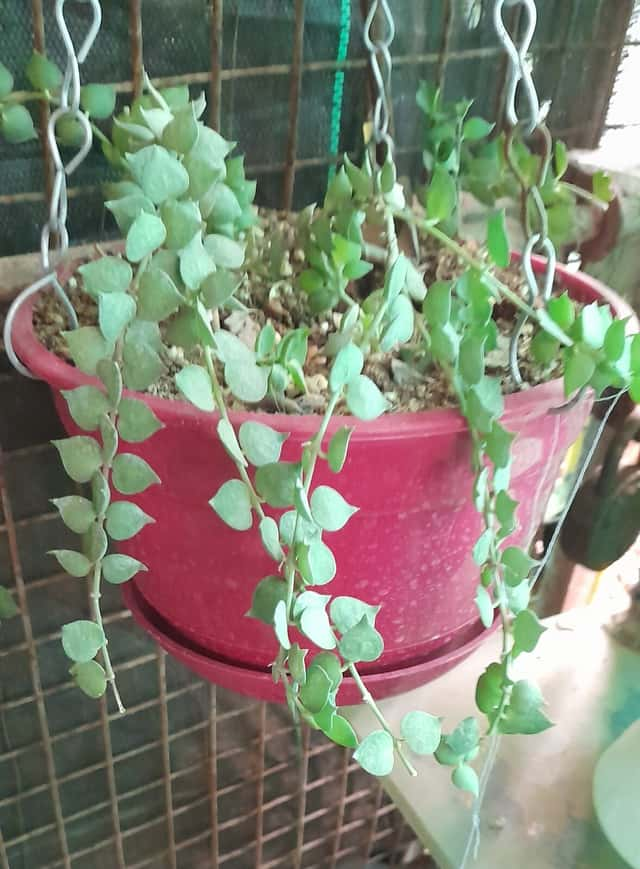
Apocynaceae
Million Hearts (Dischidia ruscifolia)
Dischidia ruscifolia
An easy houseplant. Give it bright indirect light, a chunky epiphyte mix (bark, coco husk chips) and let it dry almost fully between waterings. It likes warmth and humidity and cannot take temperatures below 10 °C. Soggy mix is the main way it is lost.
Every 7 days
Partial shade
10° - 29°C
% - %
Categories
What is Million hearts?
Million hearts (Dischidia ruscifolia) is a easy-care plant from the Apocynaceae family. Dischidia ruscifolia, known as million hearts, is an epiphytic succulent from the Philippines in the family Apocynaceae. In the wild it grows on tree trunks and branches in humid forests. Its thin stems reach 1 m and are lined with pairs of small, fleshy, heart-shaped leaves that form long chains. I...
Million hearts grows up to 1.0m, watering every 7 days, 10°C – 29°C. It is suitable for indoor environments and safe for pets.
Unlike many tropical plants, Million hearts tolerates watering mistakes. Best for beginners. Unlike many popular species, Million hearts is safe to keep around pets. Without adequate drainage, root rot can develop within 14 days.
How to Care for Million hearts?
TLDR: Million hearts needs Partial shade, watering every 7 days, and temperatures between 10-29°C with 40-70% humidity.
How Often Should You Water Million hearts?
Let the mix dry almost completely, then soak it until water drains out, wetting the leaves too. About once a week in summer, less in winter. Yellow leaves can mean too much water or mix left too dry for too long.
How Much Light Does Million hearts Need?
Bright indirect light, such as near an east or west window. A little morning sun helps and may tint the leaves red. Strong midday sun burns them.
What Is the Best Soil for Million hearts?
No regular potting soil. Use orchid bark mix or coco husk chips, very airy and free-draining.
What Pot Should You Use for Million hearts?
A small hanging pot with a drainage hole, or mounted on bark or in an orchid basket.
Care Schedule
Fertilize
Every 30 days
Misting
Every 3 days
Repot
Every 365 days
What Is Million hearts and Where Does It Come From?
Dischidia ruscifolia, known as million hearts, is an epiphytic succulent from the Philippines in the family Apocynaceae. In the wild it grows on tree trunks and branches in humid forests. Its thin stems reach 1 m and are lined with pairs of small, fleshy, heart-shaped leaves that form long chains. It blooms almost all year with tiny, fragrant white flowers about 5 mm across. It is a popular trailing plant for hanging pots.
How to Propagate Million hearts?
Stem cutting
Roots easily in water. Wear gloves if your skin is sensitive, since the sap can irritate.
- 1 Cut stems with several pairs of leaves
- 2 Strip the lowest leaves
- 3 Set the base in water, perlite or moist mix
- 4 Change the water weekly and pot up once roots form
Materials needed:
How Big Does Million hearts Grow?
TLDR: Million hearts can reach up to 1.0m tall with Medium growth rate.
Max height
1.0m
Growth rate
Medium
Foliage
Evergreen
Plant Uses
Ornamental
Great for decoration
Is your plant showing symptoms?
Click on the symptom to discover possible causes:
What Diseases Commonly Affect Million hearts?
TLDR: Million hearts is susceptible to 6 known diseases. Monitor regularly for early detection.
Mealybugs
Mealybugs are small, soft-bodied insects covered with a white, waxy, cottony material. They are common pests of houseplants and outdoor plants in mild climates. These sap-sucking insects feed on plant tissue, causing damage, stunted growth, and can lead to plant death if left untreated. They produce sticky honeydew which attracts sooty mold.
Root Rot
Root rot is a serious fungal disease that affects the root system of plants, causing them to decay and die. It is primarily caused by overwatering, poor drainage, or soil-borne fungi such as Pythium, Phytophthora, Rhizoctonia, and Fusarium. The disease thrives in waterlogged conditions where roots are deprived of oxygen, making them susceptible to fungal infection.
Overwatering
Overwatering occurs when plants receive too much water, depriving roots of oxygen and causing root rot. This environmental stress is one of the most common causes of houseplant death, as waterlogged soil prevents roots from breathing and functioning properly.
Underwatering
Underwatering or drought stress is a physiological disorder that occurs when the amount of water a plant loses through transpiration exceeds the amount its roots can absorb from the soil. This leads to cellular dehydration and various visible symptoms that can compromise plant health and productivity.
Fun Facts
In the wild it lives on trees without touching the ground.
It blooms almost year-round with flowers only 5 mm wide.
It takes up some water through its leaves.
Frequently asked questions
How often should I water million hearts?
Why are the leaves turning yellow?
Is it toxic?
What pests attack it?
Compare with similar plants
| Attribute | Difficulty | Light | Watering | Pet Safe |
|---|---|---|---|---|
| Field Maple | Easy | Bright indirect | 14d | ✓ |
| Iberian Houseleek | Easy | Direct sun | 14d | ✓ |
| Silver Birch | Easy | Direct sun | 14d | ✓ |
| Common Blanketflower | Easy | Direct sun | 10d | ✓ |





