Phrymaceae
Monkey musk: Ground Cover Plant
Erythranthe guttata
An easy plant for wet spots: give it sun or part shade and soil that never dries out. It needs no pruning and little feeding, and it reseeds on its own. Grow it outdoors at a pond edge, in a bog bed or in a damp border.
Every 2 days
Bright indirect
-15° - °C
% - %
Categories
What is Monkey musk?
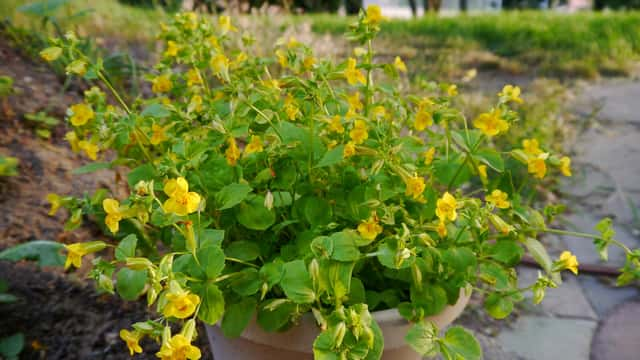
Monkey musk (Erythranthe guttata) is a easy-care plant from the Phrymaceae family. Erythranthe guttata (formerly Mimulus guttatus) is a fast-growing annual or short-lived perennial from western North America, where it grows along streams, seeps and wet meadows from sea level to high mountains. It forms spreading mats of toothed, oval leaves and carries bright yellow, two-lipped tu...
Monkey musk grows up to 1.0m, spread of 100cm, watering every 2 days. It is not suitable for indoor environments and safe for pets.
Unlike many tropical plants, Monkey musk tolerates watering mistakes. Best for beginners. Unlike many popular species, Monkey musk is safe to keep around pets.
How to Care for Monkey musk?
TLDR: Monkey musk needs Bright indirect, watering every 2 days, and temperatures between -15-30°C with 40-70% humidity.
How Often Should You Water Monkey musk?
Keep the soil constantly moist to wet. It tolerates poor drainage and even shallow standing water, but wilts quickly in dry soil, so water every couple of days in warm weather if it is not by water.
How Much Light Does Monkey musk Need?
Full sun to partial shade. In hot, dry summers some afternoon shade keeps it flowering longer; in cool climates full sun is fine.
What Is the Best Soil for Monkey musk?
Fertile, humus-rich soil that stays permanently moist. Clay, loam or sand all work, and it is not fussy about pH.
What Pot Should You Use for Monkey musk?
A large container without drainage holes, a pond basket set at the water's edge, or a self-watering planter so the soil stays wet.
What Is Monkey musk and Where Does It Come From?
Erythranthe guttata (formerly Mimulus guttatus) is a fast-growing annual or short-lived perennial from western North America, where it grows along streams, seeps and wet meadows from sea level to high mountains. It forms spreading mats of toothed, oval leaves and carries bright yellow, two-lipped tubular flowers, usually spotted red in the throat, from spring into summer. Bumblebees pollinate it, and it readily self-seeds.
How to Propagate Monkey musk?
Seed
Plants left to set seed will usually sow themselves around wet ground.
- 1 Scatter the tiny seeds on the surface of moist, rich mix without covering them, since they need light to germinate.
- 2 Keep the mix wet by misting or watering from below.
- 3 Thin or pot on seedlings once they have a few true leaves.
- 4 Plant out into a permanently damp spot after the last frost.
Materials needed:
Division
Rooted pieces of creeping stems can also be cut off and replanted, since stems root at the leaf nodes.
- 1 Lift an established clump as growth starts in spring.
- 2 Pull or cut it into sections, each with roots and shoots.
- 3 Replant straight away into wet soil and keep it well watered.
Materials needed:
How Big Does Monkey musk Grow?
TLDR: Monkey musk can reach up to 1.0m tall with Fast growth rate.
Max height
1.0m
Spread
1.0m
Growth rate
Fast
Foliage
Deciduous
Plant Uses
Ornamental
Great for decoration
Edible
Can be consumed
Ground Cover
Soil coverage
Culinary Uses
- Young leaves eaten raw in salads as a lettuce substitute, with a slightly bitter taste
- Leaves can also be cooked as a green
Is your plant showing symptoms?
Click on the symptom to discover possible causes:
What Diseases Commonly Affect Monkey musk?
TLDR: Monkey musk is susceptible to 4 known diseases. Monitor regularly for early detection.
Powdery Mildew
Powdery mildew is a common fungal disease caused by various fungi species including Erysiphe, Podosphaera, Oïdium, and Leveillula. It affects over 10,000 plant species worldwide. The disease thrives in warm, dry climates with high humidity and appears as a distinctive white powdery coating on plant surfaces.
Slugs and Snails
Slugs and snails are mollusks that feed on plant tissue, causing irregular holes in leaves and damage to young seedlings. They are most active at night and in moist conditions, leaving characteristic silvery slime trails. These pests can quickly devastate gardens, especially during wet seasons.
Gray Mold (Botrytis Blight)
Gray mold, caused by the fungus Botrytis cinerea, is one of the most common fungal diseases in plants. It affects over 200 plant species, including ornamentals, vegetables, fruits, and houseplants. The disease thrives in cool, humid conditions with poor air circulation, causing grayish spots and soft rot on infected tissues.
Pythium Root Rot
Pythium root rot is a serious fungal disease caused by various Pythium species including P. aphanidermatum, P. ultimum, and P. irregulare. These water molds are present in practically all cultivated soils and attack plant roots under wet conditions, causing rapid wet rot that can extend into the stem. The disease is favored by poor drainage, overwatering, and specific temperatures depending on the species.
Compare with similar plants
| Attribute | Difficulty | Light | Watering | Pet Safe |
|---|---|---|---|---|
| Field Maple | Easy | Bright indirect | 14d | ✓ |
| Iberian Houseleek | Easy | Direct sun | 14d | ✓ |
| Silver Birch | Easy | Direct sun | 14d | ✓ |
| Common Blanketflower | Easy | Direct sun | 10d | ✓ |





