Verbenaceae
Moss Verbena (Glandularia pulchella) Care Guide
Glandularia pulchella
An easy plant that wants full sun and well-drained soil, even poor and sandy. Once established it handles drought well: water only when the soil dries and never let it stay soggy, or the roots rot. Cut back old stems at the end of winter and shear the tips in summer to renew flowering. In shady or stuffy spots it is prone to powdery mildew.
Every 5 days
Direct sun
-7° - 38°C
% - %
Categories
What is Moss Verbena?
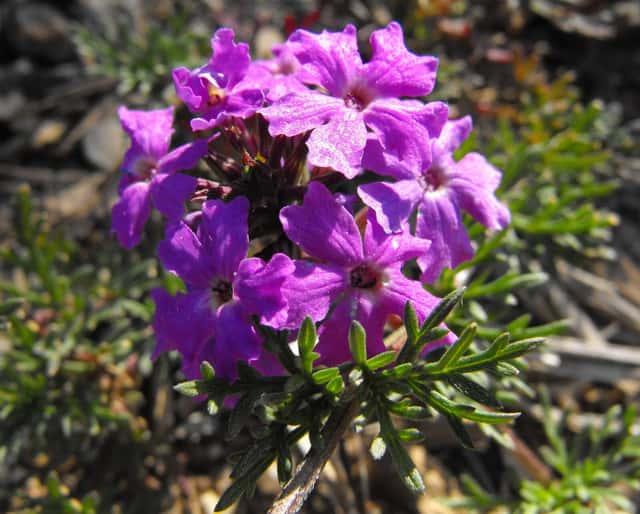
Moss Verbena (Glandularia pulchella) is a easy-care plant from the Verbenaceae family. Glandularia pulchella (also treated as Verbena tenera or Glandularia tenera) is a low, spreading perennial in the family Verbenaceae, native to southern Brazil, Uruguay and Argentina. It forms flat mats of trailing stems that root where they touch the ground, with small, finely divided, lacy leaves....
Moss Verbena grows up to 30cm, spread of 90cm, watering every 5 days, -7°C – 38°C. It is not suitable for indoor environments and safe for pets.
Unlike many tropical plants, Moss Verbena tolerates watering mistakes. Best for beginners. Unlike many popular species, Moss Verbena is safe to keep around pets.
How to Care for Moss Verbena?
TLDR: Moss Verbena needs Direct sun, watering every 5 days, and temperatures between -7-38°C with 40-70% humidity.
How Often Should You Water Moss Verbena?
Water when the top few centimeters of soil are dry, about once or twice a week in hot weather. Water the soil, not the leaves, to avoid powdery mildew. In winter it needs very little water.
How Much Light Does Moss Verbena Need?
Plant in full sun with at least 6 hours of direct light. In partial shade it flowers poorly and is more prone to fungal problems.
What Is the Best Soil for Moss Verbena?
Use light, sandy or gravelly soil with excellent drainage. It tolerates poor soil and neutral to slightly alkaline pH; avoid heavy clay that holds water.
What Pot Should You Use for Moss Verbena?
A wide, shallow clay pot or window box with good drainage holes; it also looks good trailing from hanging baskets.
Care Schedule
Fertilize
Every 30 days
Repot
Every 365 days
What Is Moss Verbena and Where Does It Come From?
Glandularia pulchella (also treated as Verbena tenera or Glandularia tenera) is a low, spreading perennial in the family Verbenaceae, native to southern Brazil, Uruguay and Argentina. It forms flat mats of trailing stems that root where they touch the ground, with small, finely divided, lacy leaves. From spring to fall it bears flat clusters of small lilac, purple, pink or white flowers that attract butterflies and bees. It grows in grasslands, roadsides and sandy ground, and is widely used as a sunny groundcover.
How to Propagate Moss Verbena?
Stem cuttings
Stems that touch the ground often root on their own; just cut and replant those rooted pieces.
- 1 Cut 8-10 cm tips from non-flowering stems.
- 2 Strip the leaves from the lower half.
- 3 Insert the cutting into moist, sandy mix.
- 4 Keep in bright shade and moist until rooted, then move to sun.
Materials needed:
Seed
Germination is uneven; fresh seed and warmth help.
- 1 Sow in spring on light, moist mix, covering lightly.
- 2 Keep in a bright, warm spot.
- 3 Transplant seedlings once they have 4-6 leaves.
Materials needed:
How Big Does Moss Verbena Grow?
TLDR: Moss Verbena can reach up to 30cm tall with Fast growth rate.
Max height
30cm
Spread
90cm
Growth rate
Fast
Foliage
Semi-evergreen
Plant Uses
Ornamental
Great for decoration
Ground Cover
Soil coverage
Is your plant showing symptoms?
Click on the symptom to discover possible causes:
What Diseases Commonly Affect Moss Verbena?
TLDR: Moss Verbena is susceptible to 7 known diseases. Monitor regularly for early detection.
Powdery Mildew
Powdery mildew is a common fungal disease caused by various fungi species including Erysiphe, Podosphaera, Oïdium, and Leveillula. It affects over 10,000 plant species worldwide. The disease thrives in warm, dry climates with high humidity and appears as a distinctive white powdery coating on plant surfaces.
Root Rot
Root rot is a serious fungal disease that affects the root system of plants, causing them to decay and die. It is primarily caused by overwatering, poor drainage, or soil-borne fungi such as Pythium, Phytophthora, Rhizoctonia, and Fusarium. The disease thrives in waterlogged conditions where roots are deprived of oxygen, making them susceptible to fungal infection.
Spider Mites
Spider mites are tiny arachnids (less than 1/20 inch long) related to spiders and ticks that feed on plant sap. They thrive in hot, dry conditions and can cause significant damage to ornamental and vegetable plants. During severe infestations, crop losses can reach 14% or higher as these pests disrupt vital plant processes including photosynthesis, carbon dioxide absorption, and transpiration.
Aphids
Aphids are small, soft-bodied, pear-shaped insects (1/16 to 1/8 inch long) that feed by sucking nutrient-rich sap from plants. They reproduce rapidly and can quickly weaken plants, causing distorted growth and transmitting plant viruses. Aphids come in various colors including green, black, red, yellow, brown, and gray. They secrete honeydew, a sticky substance that attracts ants and encourages sooty mold growth.
Fun Facts
After being introduced to the United States it spread so widely in the South that many people think it is native there.
Its finely cut leaves look like moss, which gave it the name moss verbena.
Its flowers are a favorite of butterflies.
Frequently asked questions
Does moss verbena need full sun?
Why does my moss verbena have white powder on the leaves?
How do I propagate moss verbena?
Is moss verbena toxic to pets?
Compare with similar plants
| Attribute | Difficulty | Light | Watering | Pet Safe |
|---|---|---|---|---|
| Field Maple | Easy | Bright indirect | 14d | ✓ |
| Iberian Houseleek | Easy | Direct sun | 14d | ✓ |
| Silver Birch | Easy | Direct sun | 14d | ✓ |
| Common Blanketflower | Easy | Direct sun | 10d | ✓ |
Choose & Compare
Sources & References
- Verbena tenera (syn. Glandularia pulchella) - Wikipedia
- World Flora Online - Verbena tenera / Glandularia pulchella
- Verbena (moss verbena) - Clemson Cooperative Extension HGIC
- Glandularia pulchella - Southern Nevada Water Authority plant list
- Latin American Mock Vervain (Glandularia pulchella) - Easyscape
- Verbena Diseases - Penn State Extension





