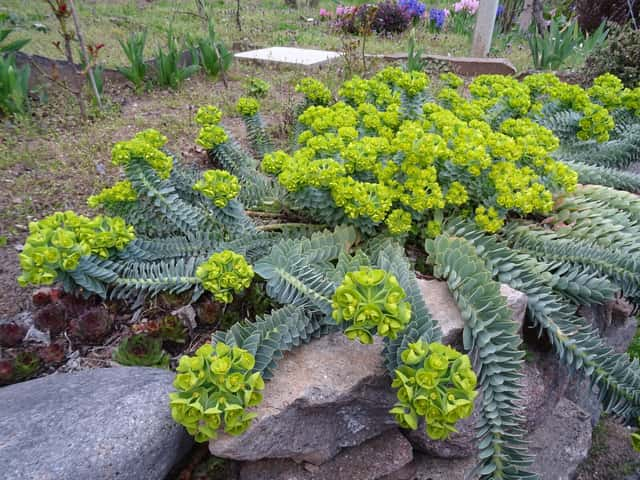
Euphorbiaceae
Myrtle Spurge (Euphorbia myrsinites)
Euphorbia myrsinites
A rock-garden plant: full sun, poor well-drained soil and very little water. Cut flowered stems to the base after bloom to stop it seeding around. Wear gloves: the sap irritates skin and eyes and is toxic to people, dogs and cats.
Every 14 days
Bright indirect
-29° - °C
% - %
Categories
What is Myrtle spurge?
Myrtle spurge (Euphorbia myrsinites) is a easy-care plant from the Euphorbiaceae family. Euphorbia myrsinites is an evergreen succulent perennial in the spurge family, native to southern Europe, Turkey, the Caucasus and Iran, where it grows on dry, stony slopes. Its stems sprawl along the ground for 20-40 cm and are packed with fleshy, blue-grey leaves arranged in a spiral, so each stem...
Myrtle spurge grows up to 20cm, spread of 45cm, watering every 14 days. It is not suitable for indoor environments and not safe for pets.
Unlike many tropical plants, Myrtle spurge tolerates watering mistakes. Best for beginners. Without precautions, ingestion can cause irritation in pets. Keep out of reach of cats and dogs.
How to Care for Myrtle spurge?
TLDR: Myrtle spurge needs Bright indirect, watering every 14 days, and temperatures between -29-30°C with 40-70% humidity.
How Often Should You Water Myrtle spurge?
Drought tolerant. Once established in the ground, rain is usually enough; in a pot, water only when the soil is completely dry, about every 14 days in warm weather and much less in winter. Soggy soil rots the roots.
How Much Light Does Myrtle spurge Need?
Full sun, at least 6 hours a day. In shade the stems get long and floppy and lose their blue color.
What Is the Best Soil for Myrtle spurge?
Dry, lean, sharply drained soil: sandy, gravelly or rocky. Acid, neutral or alkaline soil is fine, but it will not tolerate ground that stays wet.
What Pot Should You Use for Myrtle spurge?
Wide, shallow terracotta pot with drainage holes, or a rock-garden trough.
What Is Myrtle spurge and Where Does It Come From?
Euphorbia myrsinites is an evergreen succulent perennial in the spurge family, native to southern Europe, Turkey, the Caucasus and Iran, where it grows on dry, stony slopes. Its stems sprawl along the ground for 20-40 cm and are packed with fleshy, blue-grey leaves arranged in a spiral, so each stem looks like a scaly tail. The plant stays 10-20 cm tall and spreads to about 45 cm. In spring each stem tip carries a cluster of chartreuse to bright yellow bracts around tiny flowers. Every part contains a milky sap that irritates skin and eyes. It self-seeds freely and is listed as a noxious weed in parts of the western United States.
How to Propagate Myrtle spurge?
Seeds
It self-sows easily; often you only need to move the seedlings that come up around the plant. Wear gloves when handling.
- 1 Collect the capsules as they start to dry, before they burst
- 2 Sow on gritty mix and cover lightly
- 3 Keep barely moist in a bright spot
- 4 Pot on the seedlings once they are a few centimeters tall
Materials needed:
Stem cuttings
Take cuttings in spring or early summer. Protect eyes and skin from the sap.
- 1 Cut a young stem from the base of the plant
- 2 Rinse the sap off the cut in cold water
- 3 Let the cut dry for a day or two
- 4 Insert in nearly dry gritty mix
- 5 Water sparingly until rooted
Materials needed:
Division
It dislikes root disturbance; divide only large, established plants.
- 1 Lift the clump carefully
- 2 Separate pieces that have their own roots
- 3 Replant at the same depth in well-drained soil
- 4 Water once and let the soil dry
Materials needed:
How Big Does Myrtle spurge Grow?
TLDR: Myrtle spurge can reach up to 20cm tall with Medium growth rate.
Max height
20cm
Spread
45cm
Growth rate
Medium
Foliage
Evergreen
Warning: Toxic Plant
This plant can be toxic if ingested. Keep out of reach of:
Plant Uses
Ornamental
Great for decoration
Ground Cover
Soil coverage
Is your plant showing symptoms?
Click on the symptom to discover possible causes:
What Diseases Commonly Affect Myrtle spurge?
TLDR: Myrtle spurge is susceptible to 6 known diseases. Monitor regularly for early detection.
Root Rot
Root rot is a serious fungal disease that affects the root system of plants, causing them to decay and die. It is primarily caused by overwatering, poor drainage, or soil-borne fungi such as Pythium, Phytophthora, Rhizoctonia, and Fusarium. The disease thrives in waterlogged conditions where roots are deprived of oxygen, making them susceptible to fungal infection.
Overwatering
Overwatering occurs when plants receive too much water, depriving roots of oxygen and causing root rot. This environmental stress is one of the most common causes of houseplant death, as waterlogged soil prevents roots from breathing and functioning properly.
Aphids
Aphids are small, soft-bodied, pear-shaped insects (1/16 to 1/8 inch long) that feed by sucking nutrient-rich sap from plants. They reproduce rapidly and can quickly weaken plants, causing distorted growth and transmitting plant viruses. Aphids come in various colors including green, black, red, yellow, brown, and gray. They secrete honeydew, a sticky substance that attracts ants and encourages sooty mold growth.
Mealybugs
Mealybugs are small, soft-bodied insects covered with a white, waxy, cottony material. They are common pests of houseplants and outdoor plants in mild climates. These sap-sucking insects feed on plant tissue, causing damage, stunted growth, and can lead to plant death if left untreated. They produce sticky honeydew which attracts sooty mold.
Fun Facts
Its seed capsules burst and can throw seeds up to 4.5 meters.
Growing it is banned in Colorado, where it is a Class A noxious weed.
It holds the Royal Horticultural Society's Award of Garden Merit in the UK.
Frequently asked questions
Is myrtle spurge poisonous?
How often should I water it?
How do I stop it from spreading?
Can it grow indoors?
Compare with similar plants
| Attribute | Difficulty | Light | Watering | Pet Safe |
|---|---|---|---|---|
| Field Maple | Easy | Bright indirect | 14d | ✓ |
| Iberian Houseleek | Easy | Direct sun | 14d | ✓ |
| Silver Birch | Easy | Direct sun | 14d | ✓ |
| Common Blanketflower | Easy | Direct sun | 10d | ✓ |





