Rosaceae
Mysore Raspberry (Rubus niveus)
Rubus niveus
A tough, fast-growing shrub: sun or part shade, well-drained, moist loam and a mulch. It only takes light frost (to about -2 °C for mature plants). Cut out canes that have fruited every year. Note that it spreads by bird-dispersed seed and root suckers and is invasive in several regions; only plant it where allowed and keep it contained.
Every 7 days
Partial shade
-2° - °C
% - %
Categories
What is Mysore raspberry?
Mysore raspberry (Rubus niveus) is a easy-care plant from the Rosaceae family. Rubus niveus is a prickly shrub in the rose family (Rosaceae), a relative of the raspberry native to southern and south-east Asia, from Afghanistan and the Himalayas to China, Taiwan, Indochina, Java and Sri Lanka, where it grows on forest edges, clearings, thickets and streamsides at 500-2,800 m. I...
Mysore raspberry grows up to 2.5m, watering every 7 days. It is not suitable for indoor environments and safe for pets.
Unlike many tropical plants, Mysore raspberry tolerates watering mistakes. Best for beginners. Unlike many popular species, Mysore raspberry is safe to keep around pets.
How to Care for Mysore raspberry?
TLDR: Mysore raspberry needs Partial shade, watering every 7 days, and temperatures between -2-30°C with 40-70% humidity.
How Often Should You Water Mysore raspberry?
Water about once a week, letting the soil surface dry slightly between waterings. Give more during flowering and fruiting; a layer of mulch keeps the roots cool and moist. Avoid waterlogged soil.
How Much Light Does Mysore raspberry Need?
Full sun to part shade. More sun means more fruit; it tolerates partial shade under trees.
What Is the Best Soil for Mysore raspberry?
Fertile, well-drained loam; drainage is essential. Mulch with straw or leaves to hold moisture.
What Pot Should You Use for Mysore raspberry?
If grown in a container, use a large one (40 cm or more) with good drainage, which also helps keep suckers in check.
What Is Mysore raspberry and Where Does It Come From?
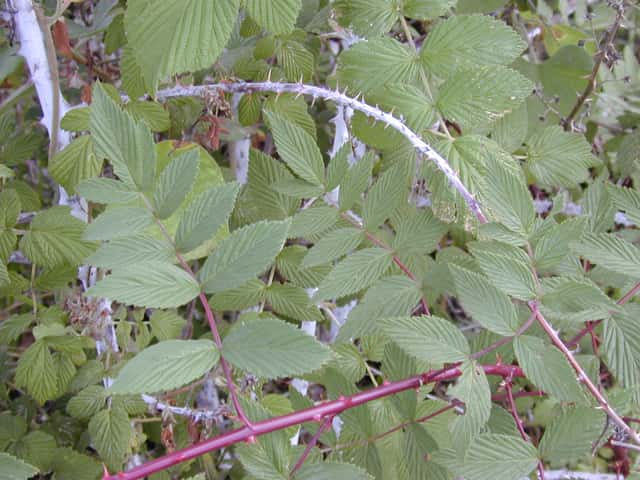
Rubus niveus is a prickly shrub in the rose family (Rosaceae), a relative of the raspberry native to southern and south-east Asia, from Afghanistan and the Himalayas to China, Taiwan, Indochina, Java and Sri Lanka, where it grows on forest edges, clearings, thickets and streamsides at 500-2,800 m. It forms thickets 1-2.5 m tall of arching canes covered in hooked prickles; young canes are whitish and waxy, later turning green or purple. The leaves are pinnate, with 5-11 leaflets (usually 7 or 9), dark green above and whitish-grey beneath. Canes bear only leaves in their first year, flower and fruit in the second, then die. The flowers, about 1 cm across, have dark pink to red petals; the fruits turn red, then black when ripe, sweet and juicy. It is a serious invasive weed in Hawaii and the Galápagos.
How to Propagate Mysore raspberry?
Tip layering
The easiest method: the plant does this on its own in the wild.
- 1 Bend a cane tip down to the ground
- 2 Bury 5-10 cm of the tip and pin it with a peg or stone
- 3 Keep the soil moist
- 4 Once rooted, cut it from the parent cane and transplant
Materials needed:
Semi-ripe cuttings
Wear gloves: the canes carry hooked prickles.
- 1 In midsummer, take 10-15 cm cuttings of half-ripe wood
- 2 Strip the lower leaves
- 3 Insert in moist, free-draining mix
- 4 Keep in bright light and humid conditions until rooted
Materials needed:
Seeds
Seeds need a cold period to germinate well.
- 1 Sow in early autumn in a pot outdoors or in a cold frame
- 2 Let it go through winter cold (stratification)
- 3 Keep the mix moist until germination
- 4 Plant out the seedlings in spring
Materials needed:
How Big Does Mysore raspberry Grow?
TLDR: Mysore raspberry can reach up to 2.5m tall with Fast growth rate.
Max height
2.5m
Growth rate
Fast
Foliage
Deciduous
Plant Uses
Edible
Can be consumed
Medicinal
Medicinal properties
Medicinal Uses
- In traditional Asian medicine the leaves are used as a tonic and the fruits and roots against dysentery
Culinary Uses
- Fresh fruit eaten raw (eat within 24 hours, it is very soft)
- Pies, jams and preserves
Is your plant showing symptoms?
Click on the symptom to discover possible causes:
What Diseases Commonly Affect Mysore raspberry?
TLDR: Mysore raspberry is susceptible to 1 known diseases. Monitor regularly for early detection.
Fun Facts
It reached the Galápagos in 1968 as a fruit plant and is now one of the islands' most troublesome invaders
The name niveus is Latin for snow-white, after the whitish canes and leaf undersides
Breeders use it in raspberry crosses for vigour and leaf spot resistance
Frequently asked questions
Is Mysore raspberry fruit edible?
Why is Rubus niveus considered invasive?
How do I prune it?
Is it cold hardy?
Compare with similar plants
| Attribute | Difficulty | Light | Watering | Pet Safe |
|---|---|---|---|---|
| Field Maple | Easy | Bright indirect | 14d | ✓ |
| Iberian Houseleek | Easy | Direct sun | 14d | ✓ |
| Silver Birch | Easy | Direct sun | 14d | ✓ |
| Common Blanketflower | Easy | Direct sun | 10d | ✓ |
Choose & Compare
Sources & References
- Rubus niveus - Wikipedia
- Useful Temperate Plants - Rubus niveus (Ceylon raspberry)
- Plant Pono - Hawaii-Pacific Weed Risk Assessment: Rubus niveus
- Hawaii Invasive Species Council - Mysore raspberry (Rubus niveus)
- Top Tropicals - Rubus niveus (Mysore raspberry)
- Galapagos Conservation Trust - Hill raspberry (Rubus niveus)





