Apocynaceae
Schweinfurth's Carrion Flower: Low Water Needs
Orbea schweinfurthii
A true desert succulent that wants bright, indirect light, a fast-draining mineral soil, and long dry spells between waterings. Its biggest enemy is excess moisture: soggy, compacted soil quickly leads to root and stem rot, so err on the side of underwatering, especially in winter. Keep humidity low and skip misting altogether.
Every 21 days
Bright indirect
10° - 35°C
20% - 40%
Categories
What is Schweinfurth's Carrion Flower?
Schweinfurth's Carrion Flower (Orbea schweinfurthii) is a medium-care plant from the Apocynaceae family. Orbea schweinfurthii is a low, mat-forming succulent in the milkweed subfamily of the Apocynaceae, native to the savannas and rocky grasslands of eastern and southern Africa -- from Botswana and Namibia through Zimbabwe, Zambia, Malawi, the Democratic Republic of Congo, Tanzania, Rwanda and Uganda....
Schweinfurth's Carrion Flower grows up to 15cm, watering every 21 days, 10°C – 35°C, 20–40% humidity. It is suitable for indoor environments and not safe for pets.
Without precautions, ingestion can cause irritation in pets. Keep out of reach of cats and dogs. Without adequate drainage, root rot can develop within 42 days.
How to Care for Schweinfurth's Carrion Flower?
TLDR: Schweinfurth's Carrion Flower needs Bright indirect, watering every 21 days, and temperatures between 10-35°C with 20-40% humidity.
How Often Should You Water Schweinfurth's Carrion Flower?
Let the soil dry out completely before watering again -- this can take up to four weeks depending on season and pot size. Water sparingly (rainwater is ideal) through the warmer growing months and cut back to almost nothing in winter.
How Much Light Does Schweinfurth's Carrion Flower Need?
Give it bright, indirect light or light partial shade; a few hours of gentle morning sun is fine, but harsh, direct midday sun can scorch the stems. Too little light will keep it from flowering.
What Is the Best Soil for Schweinfurth's Carrion Flower?
Plant in a gritty, mineral-heavy mix made for cacti and succulents -- roughly 30% potting soil to 70% pumice or perlite -- so water never lingers around the roots.
What Pot Should You Use for Schweinfurth's Carrion Flower?
Use a shallow, unglazed terracotta pot with generous drainage holes -- the porous clay wicks away excess moisture and suits this mat-forming succulent's shallow root system.
Care Schedule
Fertilize
Every 60 days
Repot
Every 1095 days
What Is Schweinfurth's Carrion Flower and Where Does It Come From?
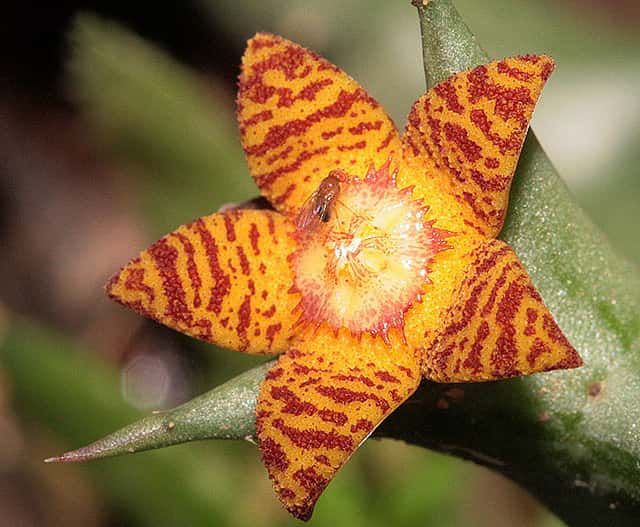
Orbea schweinfurthii is a low, mat-forming succulent in the milkweed subfamily of the Apocynaceae, native to the savannas and rocky grasslands of eastern and southern Africa -- from Botswana and Namibia through Zimbabwe, Zambia, Malawi, the Democratic Republic of Congo, Tanzania, Rwanda and Uganda. Its leafless, four- to five-angled stems creep and branch along the ground, rarely exceeding 15 cm, with widely spaced tubercles that taper to a small conical tooth and often blush purple-red under strong sun or stress. In summer and autumn it produces star-shaped flowers with a deep yellow, densely papillate corolla marked with dark maroon spots and a cream corona flecked with purple. Unlike most of its carrion-flower relatives, its scent is mild and fruity rather than foul, resembling overripe orange, pineapple or red wine, and it draws small fruit flies rather than blowflies as pollinators.
How to Propagate Schweinfurth's Carrion Flower?
Stem cutting
Do not water right after cutting or potting -- the wound needs to dry and seal first to avoid rot.
- 1 Cut a healthy stem segment with clean, sharp scissors or a knife
- 2 Let the cutting callus over in a dry, shaded spot for about a week before potting
- 3 Insert the callused end into a dry, gritty cactus mix
- 4 Withhold water until roots form, then water sparingly as with a mature plant
Materials needed:
How Big Does Schweinfurth's Carrion Flower Grow?
TLDR: Schweinfurth's Carrion Flower can reach up to 15cm tall with Medium growth rate.
Max height
15cm
Foliage
Evergreen
Warning: Toxic Plant
This plant can be toxic if ingested. Keep out of reach of:
Plant Uses
Ornamental
Great for decoration
Is your plant showing symptoms?
Click on the symptom to discover possible causes:
What Diseases Commonly Affect Schweinfurth's Carrion Flower?
TLDR: Schweinfurth's Carrion Flower is susceptible to 5 known diseases. Monitor regularly for early detection.
Root Rot
Root rot is a serious fungal disease that affects the root system of plants, causing them to decay and die. It is primarily caused by overwatering, poor drainage, or soil-borne fungi such as Pythium, Phytophthora, Rhizoctonia, and Fusarium. The disease thrives in waterlogged conditions where roots are deprived of oxygen, making them susceptible to fungal infection.
Scale Insects
Scale insects are small sap-sucking pests that appear as brown, shell-like bumps on plant stems and leaves. There are over 25 species, divided into armored (hard) and unarmored (soft) scales. They feed by piercing plant tissue and extracting sap, which weakens the plant and can lead to yellowing, stunted growth, and even death if left untreated. They also excrete honeydew, which attracts ants and promotes sooty mold growth.
Mealybugs
Mealybugs are small, soft-bodied insects covered with a white, waxy, cottony material. They are common pests of houseplants and outdoor plants in mild climates. These sap-sucking insects feed on plant tissue, causing damage, stunted growth, and can lead to plant death if left untreated. They produce sticky honeydew which attracts sooty mold.
Crown Rot
Crown rot is a serious fungal disease that attacks the crown (base) of the plant where the stem meets the soil. It is caused by various fungal pathogens including Phytophthora, Fusarium, and Rhizoctonia. The disease thrives in waterlogged conditions and can quickly spread to kill the entire plant if not addressed promptly.
Meaning & Symbolism
In the arid grasslands where it grows, Orbea schweinfurthii survives long droughts and scorching heat by storing water in its stems -- stapeliads like it are often taken as small emblems of quiet resilience and making do with little.
Compare with similar plants
| Attribute | Difficulty | Light | Watering | Pet Safe |
|---|---|---|---|---|
| Dark Fieldcap | Medium | Low light | 2d | ⚠️ |
| Azalea | Medium | Partial shade | 3d | ⚠️ |
| Muriel's Bamboo | Medium | Partial shade | 3d | ✓ |
| Bougainvillea | Medium | Direct sun | 7d | ⚠️ |




