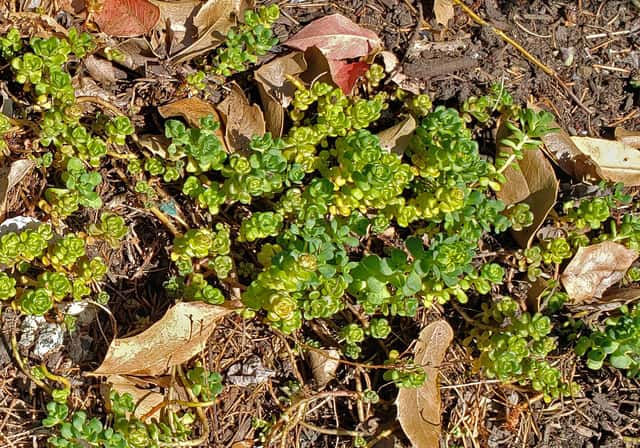
Crassulaceae
Oregon Stonecrop (Sedum oreganum)
Sedum oreganum
A very easy rock-garden plant: sun, sharp drainage and hardly any watering. It needs no pruning or feeding. What kills it is waterlogged soil, which rots roots and crowns.
Every 14 days
Bright indirect
-40° - °C
% - %
Categories
What is Oregon Stonecrop?
Oregon Stonecrop (Sedum oreganum) is a easy-care plant from the Crassulaceae family. Sedum oreganum is a creeping succulent in the stonecrop family (Crassulaceae), native to western North America from Alaska to northern California, where it grows on rocks and dry slopes. It forms low mats 10 to 15 cm high made of rosettes of fleshy, spoon-shaped, glossy green leaves that turn bronze...
Oregon Stonecrop grows up to 15cm, spread of 50cm, watering every 14 days. It is not suitable for indoor environments and safe for pets.
Unlike many tropical plants, Oregon Stonecrop tolerates watering mistakes. Best for beginners. Unlike many popular species, Oregon Stonecrop is safe to keep around pets.
How to Care for Oregon Stonecrop?
TLDR: Oregon Stonecrop needs Bright indirect, watering every 14 days, and temperatures between -40-30°C with 40-70% humidity.
How Often Should You Water Oregon Stonecrop?
Water every 2 weeks in a dry summer, only when the soil is completely dry. In winter rainfall is enough. In pots, never leave water in the saucer.
How Much Light Does Oregon Stonecrop Need?
Full sun, ideally a south- or west-facing spot. It tolerates part shade but loses its red tint and flowers less.
What Is the Best Soil for Oregon Stonecrop?
Poor, sandy or gravelly soil with excellent drainage. In pots use succulent mix with plenty of coarse sand or grit.
What Pot Should You Use for Oregon Stonecrop?
A shallow terracotta pot, stone trough or planter with drainage, kept outdoors. Good for green roofs and walls.
What Is Oregon Stonecrop and Where Does It Come From?
Sedum oreganum is a creeping succulent in the stonecrop family (Crassulaceae), native to western North America from Alaska to northern California, where it grows on rocks and dry slopes. It forms low mats 10 to 15 cm high made of rosettes of fleshy, spoon-shaped, glossy green leaves that turn bronze-red in summer sun. In summer it bears clusters of star-shaped yellow flowers that draw bees and butterflies. It is extremely tolerant of cold and drought.
How to Propagate Oregon Stonecrop?
Division
Divide in spring or early autumn. Even small pieces establish well.
- 1 Lift a section of the mat with a hand trowel
- 2 Pull it apart into rooted pieces
- 3 Replant at the same depth in well-drained soil
- 4 Water lightly and let it dry before watering again
Materials needed:
Stem cutting
Use non-flowering shoots in early summer. Even fallen leaves can root.
- 1 Cut non-flowering shoots 3-5 cm long
- 2 Let the cut ends dry for 1-2 days
- 3 Push the cuttings into dry, gritty mix
- 4 Water sparingly until new leaves appear
Materials needed:
How Big Does Oregon Stonecrop Grow?
TLDR: Oregon Stonecrop can reach up to 15cm tall with Medium growth rate.
Max height
15cm
Spread
50cm
Growth rate
Medium
Foliage
Evergreen
Plant Uses
Ornamental
Great for decoration
Ground Cover
Soil coverage
Is your plant showing symptoms?
Click on the symptom to discover possible causes:
What Diseases Commonly Affect Oregon Stonecrop?
TLDR: Oregon Stonecrop is susceptible to 6 known diseases. Monitor regularly for early detection.
Root Rot
Root rot is a serious fungal disease that affects the root system of plants, causing them to decay and die. It is primarily caused by overwatering, poor drainage, or soil-borne fungi such as Pythium, Phytophthora, Rhizoctonia, and Fusarium. The disease thrives in waterlogged conditions where roots are deprived of oxygen, making them susceptible to fungal infection.
Crown Rot
Crown rot is a serious fungal disease that attacks the crown (base) of the plant where the stem meets the soil. It is caused by various fungal pathogens including Phytophthora, Fusarium, and Rhizoctonia. The disease thrives in waterlogged conditions and can quickly spread to kill the entire plant if not addressed promptly.
Slugs and Snails
Slugs and snails are mollusks that feed on plant tissue, causing irregular holes in leaves and damage to young seedlings. They are most active at night and in moist conditions, leaving characteristic silvery slime trails. These pests can quickly devastate gardens, especially during wet seasons.
Curculionidae
Curculionidae (weevils) are small beetles that feed on plants. Adults chew leaf margins, leaving crescent-shaped notches, primarily at night. The larvae live in the substrate and consume roots, causing decline, yellowing, and wilting even when the substrate is moist, and in severe cases, plant death. They frequently affect ornamentals and garden plants such as strawberries, citrus, roses, hydrangeas, azaleas, blueberries, begonias, and many potted plants.
Fun Facts
It grows wild in rock crevices along the Pacific coast from Alaska to California
The petals are yellow and turn pinkish as the flowers age
It is used on green roofs in the Pacific Northwest
Frequently asked questions
Is Sedum oreganum cold hardy?
Why have the leaves turned red?
Can I grow it as a houseplant?
Why is my stonecrop rotting?
Compare with similar plants
| Attribute | Difficulty | Light | Watering | Pet Safe |
|---|---|---|---|---|
| Field Maple | Easy | Bright indirect | 14d | ✓ |
| Iberian Houseleek | Easy | Direct sun | 14d | ✓ |
| Silver Birch | Easy | Direct sun | 14d | ✓ |
| Common Blanketflower | Easy | Direct sun | 10d | ✓ |





