Crassulaceae
Kalanchoe porphyrocalyx (Pearl Bells)
Kalanchoe porphyrocalyx
An easy-care succulent that thrives in bright light with some direct morning sun, fast-draining soil, and infrequent watering. Let the soil dry out completely between waterings and protect from cold drafts and temperatures below about 16C (60F).
Every 14 days
Bright indirect
16° - 27°C
30% - 50%
Categories
What is Pearl Bells?
Pearl Bells (Kalanchoe porphyrocalyx) is a easy-care plant from the Crassulaceae family. Kalanchoe porphyrocalyx, commonly called Pearl Bells or the pendent kalanchoe, is a succulent species in the family Crassulaceae native to the rainforests of central and north-eastern Madagascar, where it often grows epiphytically. It forms slender, upright stems bearing blue-grey, rectangular leave...
Pearl Bells grows up to 40cm, spread of 45cm, watering every 14 days, 16°C – 27°C, 30–50% humidity. It is suitable for indoor environments and not safe for pets.
Unlike many tropical plants, Pearl Bells tolerates watering mistakes. Best for beginners. Without precautions, ingestion can cause irritation in pets. Keep out of reach of cats and dogs. Without adequate drainage, root rot can develop within 28 days.
How to Care for Pearl Bells?
TLDR: Pearl Bells needs Bright indirect, watering every 14 days, and temperatures between 16-27°C with 30-50% humidity.
How Often Should You Water Pearl Bells?
Water thoroughly only when the top 2-3 cm of soil is completely dry, roughly every 2-3 weeks. Overwatering is the most common cause of root rot in this species, so always err on the side of underwatering.
How Much Light Does Pearl Bells Need?
Provide bright light with 1-2 hours of gentle morning sun (south, east or west exposure). Avoid harsh direct summer sun, which can scorch the blue-grey foliage; more direct sun is tolerated from fall through early spring.
What Is the Best Soil for Pearl Bells?
Use a fast-draining cactus/succulent mix enriched with organic matter -- a blend of peat, perlite and coarse sand works well. Terracotta pots help the roots stay aerated and dry out faster.
What Pot Should You Use for Pearl Bells?
A small unglazed terracotta or clay pot with generous drainage holes, sized only slightly larger than the root ball -- this species prefers to be slightly pot-bound and benefits from annual repotting into fresh, fast-draining mix.
What Is Pearl Bells and Where Does It Come From?
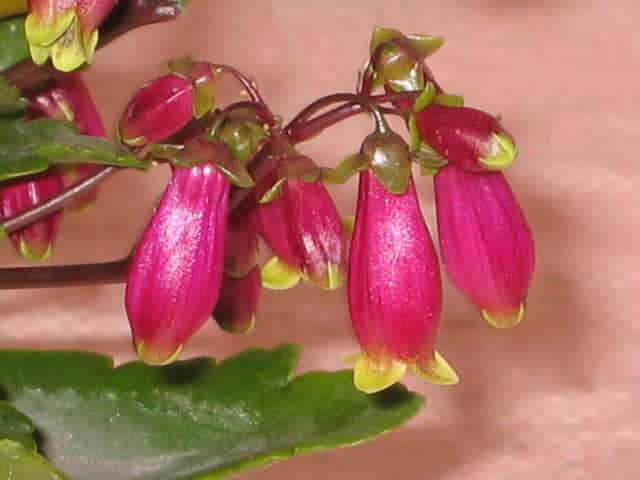
Kalanchoe porphyrocalyx, commonly called Pearl Bells or the pendent kalanchoe, is a succulent species in the family Crassulaceae native to the rainforests of central and north-eastern Madagascar, where it often grows epiphytically. It forms slender, upright stems bearing blue-grey, rectangular leaves with gently serrated edges. In late winter through spring it produces pendent, bell-shaped flowers with a tube in shades of red, rose-pink or pale yellow topped by yellow-green to orange petals, all held within a distinctive purple calyx -- the source of its species name porphyrocalyx ("purple calyx").
How to Propagate Pearl Bells?
Stem Cutting
Rooting is faster in summer (about 3 weeks) than in winter (4-6 weeks); warm substrate around 21-23C speeds the process.
- 1 Cut a healthy stem section a few centimeters long using clean, sharp scissors.
- 2 Let the cutting callus over in a dry, shaded spot for 1-2 days before planting.
- 3 Insert the cut end into a fast-draining succulent mix and keep barely moist.
- 4 Provide bottom heat and bright indirect light to speed up rooting.
Materials needed:
How Big Does Pearl Bells Grow?
TLDR: Pearl Bells can reach up to 40cm tall with Slow growth rate.
Max height
40cm
Spread
45cm
Growth rate
Slow
Foliage
Evergreen
Warning: Toxic Plant
This plant can be toxic if ingested. Keep out of reach of:
Plant Uses
Ornamental
Great for decoration
Is your plant showing symptoms?
Click on the symptom to discover possible causes:
What Diseases Commonly Affect Pearl Bells?
TLDR: Pearl Bells is susceptible to 9 known diseases. Monitor regularly for early detection.
Root Rot
Root rot is a serious fungal disease that affects the root system of plants, causing them to decay and die. It is primarily caused by overwatering, poor drainage, or soil-borne fungi such as Pythium, Phytophthora, Rhizoctonia, and Fusarium. The disease thrives in waterlogged conditions where roots are deprived of oxygen, making them susceptible to fungal infection.
Overwatering
Overwatering occurs when plants receive too much water, depriving roots of oxygen and causing root rot. This environmental stress is one of the most common causes of houseplant death, as waterlogged soil prevents roots from breathing and functioning properly.
Aphids
Aphids are small, soft-bodied, pear-shaped insects (1/16 to 1/8 inch long) that feed by sucking nutrient-rich sap from plants. They reproduce rapidly and can quickly weaken plants, causing distorted growth and transmitting plant viruses. Aphids come in various colors including green, black, red, yellow, brown, and gray. They secrete honeydew, a sticky substance that attracts ants and encourages sooty mold growth.
Mealybugs
Mealybugs are small, soft-bodied insects covered with a white, waxy, cottony material. They are common pests of houseplants and outdoor plants in mild climates. These sap-sucking insects feed on plant tissue, causing damage, stunted growth, and can lead to plant death if left untreated. They produce sticky honeydew which attracts sooty mold.
Meaning & Symbolism
Like many Kalanchoe species, Pearl Bells is often associated with enduring affection and resilience, reflecting its ability to thrive with minimal care and produce long-lasting winter blooms.
Fun Facts
Its species name porphyrocalyx comes from the Greek for "purple calyx," describing the deep purple sepals that cradle each flower.
It is native to Madagascar, where it grows epiphytically in rainforest trees rather than rooted in soil.
It was originally described in the genus Kitchingia before being reclassified into Kalanchoe.
Frequently asked questions
Is Kalanchoe porphyrocalyx toxic to cats and dogs?
How often should I water Kalanchoe porphyrocalyx?
Why is it called Pearl Bells?
How do I propagate Kalanchoe porphyrocalyx?
Compare with similar plants
| Attribute | Difficulty | Light | Watering | Pet Safe |
|---|---|---|---|---|
| Field Maple | Easy | Bright indirect | 14d | ✓ |
| Silver Birch | Easy | Direct sun | 14d | ✓ |
| Common Blanketflower | Easy | Direct sun | 10d | ✓ |
| Cushion Bush | Easy | Direct sun | 14d | ✓ |
Choose & Compare
Sources & References
- Kalanchoe porphyrocalyx | Bryophyllum porphyrocalyx - Plant Lust
- Kalanchoe porphyrocalyx care and culture - Travaldo's blog
- Toxic and Non-toxic Plants: Kalanchoe - ASPCA
- Taxonomic notes on Kalanchoe porphyrocalyx (Crassulaceae subfam. Kalanchooideae) and its horticultural derivatives - Phytotaxa
- List of kalanchoe diseases - Wikipedia





