Crassulaceae
Echeveria 'Perle von Nurnberg' Care Guide
Echeveria 'Perle von Nurnberg'
Give it full sun to very bright light, water deeply only once the soil is bone-dry (about every two weeks), and plant it in a gritty, fast-draining succulent mix. It tolerates neglect far better than overwatering.
Every 14 days
Bright indirect
4° - °C
% - %
Categories
What is Pearl of Nuremberg?
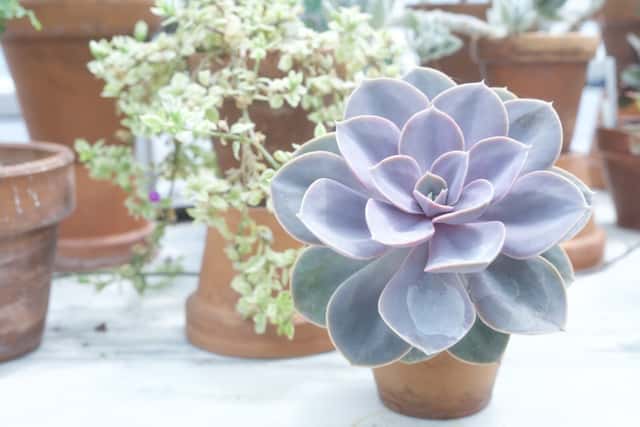
Pearl of Nuremberg (Echeveria 'Perle von Nurnberg') is a easy-care plant from the Crassulaceae family. Echeveria 'Perle von Nurnberg' is a compact rosette succulent hybrid bred in 1930s Germany by crossing Echeveria gibbiflora 'Metallica' with Echeveria elegans. Its spoon-shaped leaves are dusted with a pale, powdery bloom over lavender-grey and rosy-pink tones, deepening to purple under bright light...
Pearl of Nuremberg grows up to 15cm, spread of 18cm, watering every 14 days. It is suitable for indoor environments and safe for pets.
Unlike many tropical plants, Pearl of Nuremberg tolerates watering mistakes. Best for beginners. Unlike many popular species, Pearl of Nuremberg is safe to keep around pets. Without adequate drainage, root rot can develop within 28 days.
How to Care for Pearl of Nuremberg?
TLDR: Pearl of Nuremberg needs Bright indirect, watering every 14 days, and temperatures between 4-30°C with 40-70% humidity.
How Often Should You Water Pearl of Nuremberg?
Soak the soil thoroughly, then let it dry out completely before watering again -- roughly every 10-14 days, less in winter. Water at the base in the morning so the leaves and crown stay dry.
How Much Light Does Pearl of Nuremberg Need?
Give it at least 4-6 hours of bright, direct or very bright indirect light daily; a sunny south- or east-facing window works well. Low light makes it stretch (etiolate) and lose its purple color.
What Is the Best Soil for Pearl of Nuremberg?
Use a gritty, fast-draining cactus/succulent mix -- ordinary potting soil cut 1:1 with perlite, pumice or coarse sand -- in a pot with drainage holes.
What Pot Should You Use for Pearl of Nuremberg?
A shallow terracotta or other unglazed, porous pot with a drainage hole -- it wicks away excess moisture and suits the plant's slow, compact growth.
Care Schedule
Fertilize
Every 60 days
Rotate
Every 14 days
Repot
Every 1095 days
What Is Pearl of Nuremberg and Where Does It Come From?
Echeveria 'Perle von Nurnberg' is a compact rosette succulent hybrid bred in 1930s Germany by crossing Echeveria gibbiflora 'Metallica' with Echeveria elegans. Its spoon-shaped leaves are dusted with a pale, powdery bloom over lavender-grey and rosy-pink tones, deepening to purple under bright light. A slow grower that rarely needs repotting, it forms a single dense rosette prized as one of the most photogenic succulents in cultivation.
How to Propagate Pearl of Nuremberg?
Leaf cutting
Only leaves removed whole with an intact base will root; discard any that snap in half.
- 1 Gently twist a plump, healthy leaf from the stem, keeping its base intact
- 2 Let the leaf callus (dry) for 2-3 days in a warm, shaded spot
- 3 Lay it flat on top of well-draining succulent soil, base touching the soil
- 4 Mist lightly every few days until tiny roots and a new rosette appear, then water normally
Materials needed:
Stem cutting (beheading)
The beheaded base often sprouts new offset rosettes, giving you extra plants for free.
- 1 Slice the rosette off about 1 inch (2.5cm) below the head with a clean, sharp blade
- 2 Let the cut end callus for 3-5 days until dry to the touch
- 3 Set the rosette upright on or just into dry succulent soil
- 4 Water lightly once roots form, then resume normal watering
Materials needed:
Offsets (pups)
Pups form slowly on this cultivar, so patience pays off more than forcing an early separation.
- 1 Wait until a pup is about 1 inch (2.5cm) across with its own small root system
- 2 Gently separate it from the mother plant with a clean blade or by hand
- 3 Let the wound callus for a day or two
- 4 Plant in gritty succulent soil and water sparingly until established
Materials needed:
How Big Does Pearl of Nuremberg Grow?
TLDR: Pearl of Nuremberg can reach up to 15cm tall with Slow growth rate.
Max height
15cm
Spread
18cm
Growth rate
Slow
Foliage
Evergreen
Plant Uses
Ornamental
Great for decoration
Is your plant showing symptoms?
Click on the symptom to discover possible causes:
What Diseases Commonly Affect Pearl of Nuremberg?
TLDR: Pearl of Nuremberg is susceptible to 6 known diseases. Monitor regularly for early detection.
Root Rot
Root rot is a serious fungal disease that affects the root system of plants, causing them to decay and die. It is primarily caused by overwatering, poor drainage, or soil-borne fungi such as Pythium, Phytophthora, Rhizoctonia, and Fusarium. The disease thrives in waterlogged conditions where roots are deprived of oxygen, making them susceptible to fungal infection.
Scale Insects
Scale insects are small sap-sucking pests that appear as brown, shell-like bumps on plant stems and leaves. There are over 25 species, divided into armored (hard) and unarmored (soft) scales. They feed by piercing plant tissue and extracting sap, which weakens the plant and can lead to yellowing, stunted growth, and even death if left untreated. They also excrete honeydew, which attracts ants and promotes sooty mold growth.
Mealybugs
Mealybugs are small, soft-bodied insects covered with a white, waxy, cottony material. They are common pests of houseplants and outdoor plants in mild climates. These sap-sucking insects feed on plant tissue, causing damage, stunted growth, and can lead to plant death if left untreated. They produce sticky honeydew which attracts sooty mold.
Aphids
Aphids are small, soft-bodied, pear-shaped insects (1/16 to 1/8 inch long) that feed by sucking nutrient-rich sap from plants. They reproduce rapidly and can quickly weaken plants, causing distorted growth and transmitting plant viruses. Aphids come in various colors including green, black, red, yellow, brown, and gray. They secrete honeydew, a sticky substance that attracts ants and encourages sooty mold growth.
Meaning & Symbolism
Its jewel-toned rosette is often read as a symbol of enduring beauty and quiet resilience, echoing the broader Echeveria association with lasting affection.
Fun Facts
It was bred in Germany in the 1930s by Richard Graessner, crossing Echeveria gibbiflora 'Metallica' with Echeveria elegans.
The pale, powdery coating on its leaves is called 'pruinose' or farina, and it helps the plant reflect intense sunlight.
A variegated sport of this cultivar, called Echeveria 'Rainbow', shows the same colors split into bold stripes.
Frequently asked questions
Is Echeveria 'Perle von Nurnberg' toxic to cats and dogs?
Why is my Echeveria 'Perle von Nurnberg' losing its purple color and turning green?
How often should I water it?
Why is my plant stretching upward and looking leggy?
How do I propagate Echeveria 'Perle von Nurnberg'?
Compare with similar plants
| Attribute | Difficulty | Light | Watering | Pet Safe |
|---|---|---|---|---|
| Field Maple | Easy | Bright indirect | 14d | ✓ |
| Silver Birch | Easy | Direct sun | 14d | ✓ |
| Common Blanketflower | Easy | Direct sun | 10d | ✓ |
| Cushion Bush | Easy | Direct sun | 14d | ✓ |





