Fabaceae
Pigeon pea: Edible Plant
Cajanus cajan
Requires full sun, moderate watering allowing the substrate to dry between waterings, and well-drained soil; it tolerates heat and drought very well but cannot withstand frost.
Every 10 days
Direct sun
15° - 35°C
40% - 60%
Categories
What is Pigeon pea?
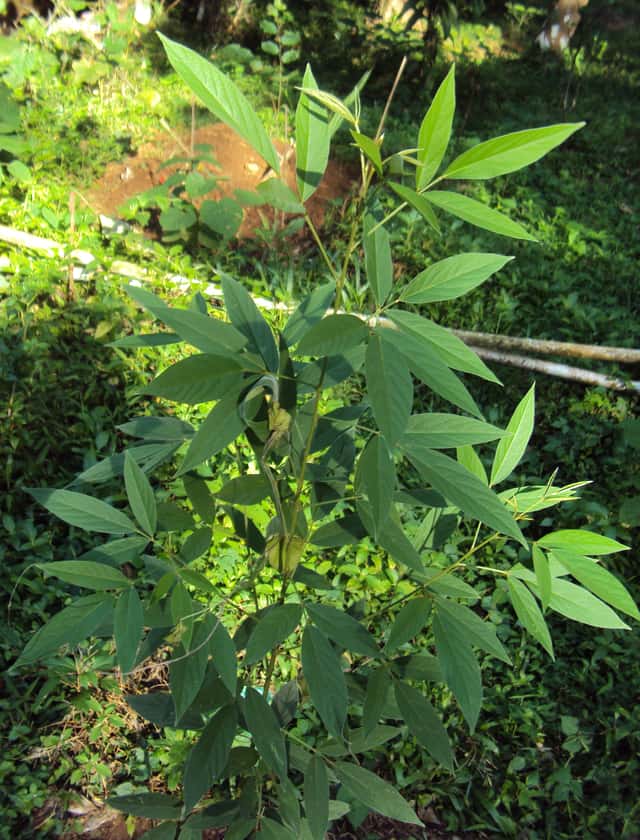
Pigeon pea (Cajanus cajan) is a easy-care plant from the Fabaceae family. The pigeon pea (Cajanus cajan) is a fast-growing, semi-perennial leguminous shrub, native to India or Africa and cultivated for over 3,000 years. It reaches between 1 and 3 meters in height, featuring trifoliate leaves and yellow flowers—sometimes with reddish streaks—that give way to pods containin...
Pigeon pea grows up to 3.0m, spread of 150cm, watering every 10 days, 15°C – 35°C, 40–60% humidity. It is not suitable for indoor environments and safe for pets.
Unlike many tropical plants, Pigeon pea tolerates watering mistakes. Best for beginners. Unlike many popular species, Pigeon pea is safe to keep around pets.
How to Care for Pigeon pea?
TLDR: Pigeon pea needs Direct sun, watering every 10 days, and temperatures between 15-35°C with 40-60% humidity.
How Often Should You Water Pigeon pea?
Water deeply and wait for the substrate to dry almost completely before watering again; pigeon peas resist water scarcity better than excess moisture.
How Much Light Does Pigeon pea Need?
Place in full sun, with at least 5-6 hours of direct light per day; indoors, it requires a very bright south-facing window or grow lights.
What Is the Best Soil for Pigeon pea?
Prefers well-drained soils, ranging from sandy to clayey, with a pH between 5 and 7.5; it tolerates poor soils thanks to its ability to fix nitrogen.
What Pot Should You Use for Pigeon pea?
If grown in a pot, choose a large and deep container (minimum 40 cm) with good drainage, as it develops a deep taproot.
Care Schedule
Fertilize
Every 60 days
What Is Pigeon pea and Where Does It Come From?
The pigeon pea (Cajanus cajan) is a fast-growing, semi-perennial leguminous shrub, native to India or Africa and cultivated for over 3,000 years. It reaches between 1 and 3 meters in height, featuring trifoliate leaves and yellow flowers—sometimes with reddish streaks—that give way to pods containing 2 to 9 edible seeds. Thanks to its deep taproot and nitrogen-fixing capacity, it tolerates poor soils and drought periods, making it a key crop in tropical and subtropical agriculture.
How Big Does Pigeon pea Grow?
TLDR: Pigeon pea can reach up to 3.0m tall with Fast growth rate.
Max height
3.0m
Spread
1.5m
Growth rate
Fast
Foliage
Semi-evergreen
Plant Uses
Edible
Can be consumed
Medicinal
Medicinal properties
Medicinal Uses
- Boiled leaves in infusions or baths to relieve flu symptoms and respiratory conditions
- Traditional use on wounds and as an anti-diabetic in folk medicine across Africa, Asia, and the Caribbean
Culinary Uses
- Dried or fresh seeds in stews and rice dishes, such as 'arroz con gandules'
- Base for Dominican 'moro de guandules' and other Caribbean dishes
- Pigeon pea flour for various preparations
- Green pods cooked as a vegetable
Is your plant showing symptoms?
Click on the symptom to discover possible causes:
What Diseases Commonly Affect Pigeon pea?
TLDR: Pigeon pea is susceptible to 7 known diseases. Monitor regularly for early detection.
Fusarium Wilt
Fusarium wilt is a serious fungal disease caused by the soil-borne fungus Fusarium oxysporum. The fungus invades roots and blocks the water-conducting vessels (xylem) of the plant, causing progressive wilting and eventual death. Host-specific forms of the pathogen exist that attack different plant species.
Phytophthora Blight
Devastating fungal disease caused by Phytophthora species (primarily P. capsici and P. infestans), famously responsible for the Irish Potato Famine in the 1840s. Affects all plant parts including roots, stems, leaves, and fruits in warm, wet conditions. The pathogen is technically an oomycete (water mold) that thrives in saturated soils and can survive in soil for 5+ years.
Leaf Spot
Leaf spot is a common fungal disease caused by various pathogens including Alternaria, Ascochyta, Colletotrichum, Septoria, and Venturia. It primarily affects leaves, causing discolored spots that can lead to premature leaf drop if left untreated.
Rust
Rust is a common fungal disease caused by fungi in the order Pucciniales that affects a wide variety of plants. The disease gets its name from the characteristic orange, yellow, or reddish-brown pustules that appear on leaves, resembling metal rust. This obligate fungal parasite requires living plants to survive and can cause significant economic losses in agricultural crops.
Meaning & Symbolism
Represents sustenance and resilience: a plant capable of regenerating the soil while feeding entire communities.
Compare with similar plants
| Attribute | Difficulty | Light | Watering | Pet Safe |
|---|---|---|---|---|
| Field Maple | Easy | Bright indirect | 14d | ✓ |
| Silver Birch | Easy | Direct sun | 14d | ✓ |
| Common Blanketflower | Easy | Direct sun | 10d | ✓ |
| Cushion Bush | Easy | Direct sun | 14d | ✓ |





