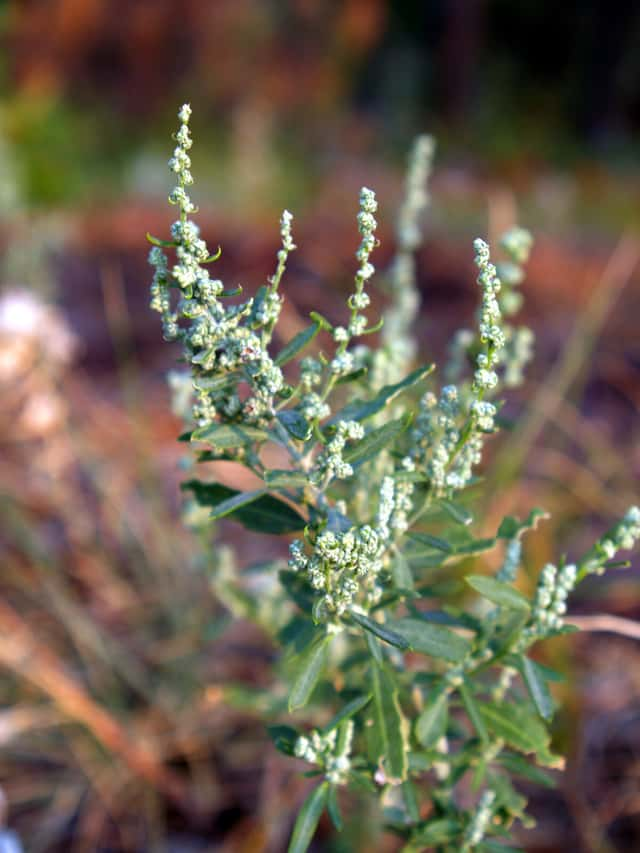
Amaranthaceae
Pitseed goosefoot (Chenopodium berlandieri)
Chenopodium berlandieri
Full sun, almost any soil, and little watering once established. Sow in place; harvest young leaves and flower shoots before the seed ripens.
Every 7 days
Direct sun
° - °C
% - %
Categories
What is Pitseed goosefoot?
Pitseed goosefoot (Chenopodium berlandieri) is a easy-care plant from the Amaranthaceae family. Chenopodium berlandieri is an annual herb in the amaranth family (Amaranthaceae), native across North America from Canada to Michoacán, Mexico. It grows fast and upright and can exceed 3 m. The small green, petal-less flowers are wind-pollinated and appear from July to October, with seeds ripening A...
Pitseed goosefoot grows up to 3.0m, watering every 7 days. It is not suitable for indoor environments and safe for pets.
Unlike many tropical plants, Pitseed goosefoot tolerates watering mistakes. Best for beginners. Unlike many popular species, Pitseed goosefoot is safe to keep around pets.
How to Care for Pitseed goosefoot?
TLDR: Pitseed goosefoot needs Direct sun, watering every 7 days, and temperatures between 15-30°C with 40-70% humidity.
How Often Should You Water Pitseed goosefoot?
Keep the soil moist until germination, then water only during long dry spells.
How Much Light Does Pitseed goosefoot Need?
Needs full sun; it dislikes shade.
What Is the Best Soil for Pitseed goosefoot?
Tolerates a wide range of soils; loose, fertile soil gives more leaves and shoots.
What Pot Should You Use for Pitseed goosefoot?
Best in the ground; in a container, use a deep pot of at least 30 cm.
What Is Pitseed goosefoot and Where Does It Come From?
Chenopodium berlandieri is an annual herb in the amaranth family (Amaranthaceae), native across North America from Canada to Michoacán, Mexico. It grows fast and upright and can exceed 3 m. The small green, petal-less flowers are wind-pollinated and appear from July to October, with seeds ripening August to October. Indigenous peoples of eastern North America domesticated it as a pseudocereal by about 1700 BC; in Mexico it is still grown as huauzontle for its broccoli-like flowering shoots, leaves and grain. Outside cultivation it is widely regarded as a weed and self-seeds freely.
How to Propagate Pitseed goosefoot?
Direct sowing
It self-seeds easily and seeds can stay dormant in the soil for years, so cut the seed heads before they dry if you don't want it to spread.
- 1 Prepare a bed in full sun
- 2 Scatter the seeds and cover with a thin layer of soil
- 3 Keep moist until they germinate
- 4 Thin to the strongest seedlings
Materials needed:
How Big Does Pitseed goosefoot Grow?
TLDR: Pitseed goosefoot can reach up to 3.0m tall with Fast growth rate.
Max height
3.0m
Growth rate
Fast
Foliage
Deciduous
Plant Uses
Edible
Can be consumed
Culinary Uses
- Cooked flowering shoots (huauzontle fritters stuffed with cheese)
- Young leaves cooked like spinach
- Seeds milled into flour or grits after rinsing off saponins
Is your plant showing symptoms?
Click on the symptom to discover possible causes:
What Diseases Commonly Affect Pitseed goosefoot?
TLDR: Pitseed goosefoot is susceptible to 3 known diseases. Monitor regularly for early detection.
leaf miners
Larval stages of leaf-mining insects are feeding on the leaf tissue of plants, building little tunnels under the leaf surface.
Aphids
Aphids are small, soft-bodied, pear-shaped insects (1/16 to 1/8 inch long) that feed by sucking nutrient-rich sap from plants. They reproduce rapidly and can quickly weaken plants, causing distorted growth and transmitting plant viruses. Aphids come in various colors including green, black, red, yellow, brown, and gray. They secrete honeydew, a sticky substance that attracts ants and encourages sooty mold growth.
Downy Mildew
Downy mildew is a fungal-like disease caused by oomycetes (water molds) that thrives in cool, wet conditions. It affects a wide range of plants, causing yellowing leaves with fuzzy white-gray growth underneath, leading to defoliation and reduced yields if left untreated.
Fun Facts
It was domesticated as a grain crop in eastern North America around 1700 BC
It is a close relative of quinoa
It can grow taller than 3 m in a single season
Frequently asked questions
Is pitseed goosefoot edible?
Do the seeds need rinsing?
Who should be careful eating it?
Can it become a weed?
Compare with similar plants
| Attribute | Difficulty | Light | Watering | Pet Safe |
|---|---|---|---|---|
| Field Maple | Easy | Bright indirect | 14d | ✓ |
| Iberian Houseleek | Easy | Direct sun | 14d | ✓ |
| Silver Birch | Easy | Direct sun | 14d | ✓ |
| Common Blanketflower | Easy | Direct sun | 10d | ✓ |





