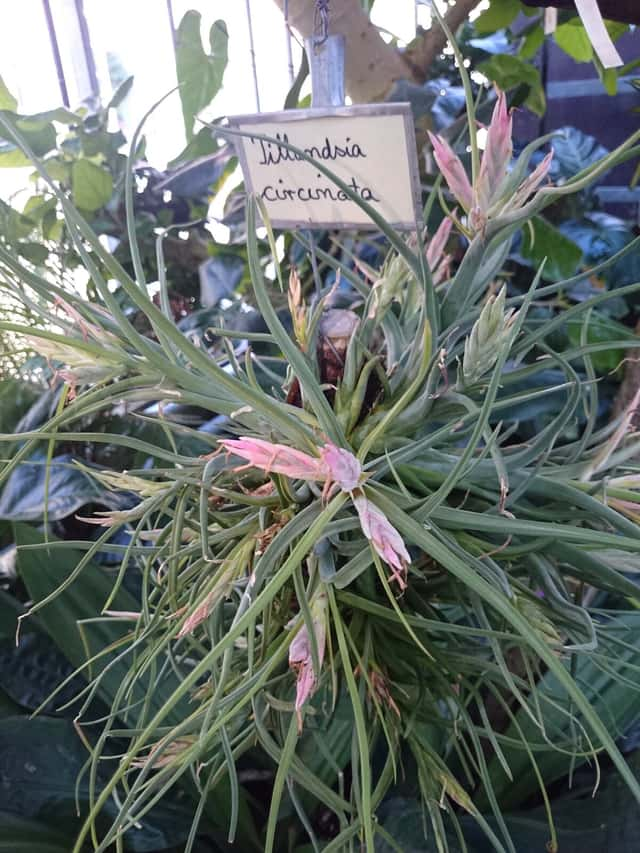
Bromeliaceae
Potbelly airplant (Tillandsia paucifolia)
Tillandsia paucifolia
An easy air plant that wants lots of light and quick waterings that dry fast. Mount it on wood, stone or shell, with no moss at the base, in a bright, airy spot. The main risk is rot from staying wet.
Every 7 days
Bright indirect
10° - 32°C
40% - 70%
Categories
What is Potbelly airplant?
Potbelly airplant (Tillandsia paucifolia) is a easy-care plant from the Bromeliaceae family. Tillandsia paucifolia, often sold as Tillandsia circinnata, is an air plant in the bromeliad family that grows attached to trunks and branches, with no soil. It is native to Florida, the Caribbean, Mexico, Central America, Colombia and Venezuela. The rosette is about 18 cm tall and 15 cm wide, with...
Potbelly airplant grows up to 18cm, spread of 15cm, watering every 7 days, 10°C – 32°C, 40–70% humidity. It is suitable for indoor environments and safe for pets.
Unlike many tropical plants, Potbelly airplant tolerates watering mistakes. Best for beginners. Unlike many popular species, Potbelly airplant is safe to keep around pets. Without adequate drainage, root rot can develop within 14 days.
How to Care for Potbelly airplant?
TLDR: Potbelly airplant needs Bright indirect, watering every 7 days, and temperatures between 10-32°C with 40-70% humidity.
How Often Should You Water Potbelly airplant?
Soak or mist thoroughly 2-3 times a week in summer and 1-2 times in winter, ideally in the morning. Use rainwater or dechlorinated water. Turn it upside down afterwards to drain: it must dry within a few hours.
How Much Light Does Potbelly airplant Need?
Bright light up to full sun, with afternoon shade in summer if it is not acclimatised. In a dark spot it slowly declines.
What Is the Best Soil for Potbelly airplant?
No soil needed. Glue or wire it to wood, cork, stone or shell that does not hold water, leaving the base free.
What Pot Should You Use for Potbelly airplant?
Not for a pot of soil. Use wood, cork, stone, shell or a wire holder, with the plant tilted so water does not collect at the base.
Care Schedule
Fertilize
Every 30 days
Misting
Every 3 days
What Is Potbelly airplant and Where Does It Come From?
Tillandsia paucifolia, often sold as Tillandsia circinnata, is an air plant in the bromeliad family that grows attached to trunks and branches, with no soil. It is native to Florida, the Caribbean, Mexico, Central America, Colombia and Venezuela. The rosette is about 18 cm tall and 15 cm wide, with a swollen bulb-like base and 5 to 10 thick, recurved leaves covered in silvery scales that take up water and nutrients from the air. When it blooms, in spring and summer, the plant blushes pink and sends up a spike with pink bracts and tubular purple to lavender flowers. It then produces pups that grow at right angles, like spokes on a wheel.
How to Propagate Potbelly airplant?
Separating pups
The mother plant lives on for a while after blooming and can produce several pups. You can also leave them to grow into a clump.
- 1 Wait until the pup is at least a third the size of the mother
- 2 Gently twist or cut it off where it joins the parent
- 3 Let it dry for a day
- 4 Mount the pup and care for it like an adult plant
Materials needed:
Seed
It is slow: seedlings take years to reach adult size.
- 1 Collect the feathery seeds from ripe capsules
- 2 Scatter on moist peat or fine bark without covering, as they need light
- 3 Keep moist by misting in a bright, warm place
Materials needed:
How Big Does Potbelly airplant Grow?
TLDR: Potbelly airplant can reach up to 18cm tall with Slow growth rate.
Max height
18cm
Spread
15cm
Growth rate
Slow
Foliage
Evergreen
Plant Uses
Ornamental
Great for decoration
Is your plant showing symptoms?
Click on the symptom to discover possible causes:
What Diseases Commonly Affect Potbelly airplant?
TLDR: Potbelly airplant is susceptible to 3 known diseases. Monitor regularly for early detection.
Crown Rot
Crown rot is a serious fungal disease that attacks the crown (base) of the plant where the stem meets the soil. It is caused by various fungal pathogens including Phytophthora, Fusarium, and Rhizoctonia. The disease thrives in waterlogged conditions and can quickly spread to kill the entire plant if not addressed promptly.
Overwatering
Overwatering occurs when plants receive too much water, depriving roots of oxygen and causing root rot. This environmental stress is one of the most common causes of houseplant death, as waterlogged soil prevents roots from breathing and functioning properly.
Cold Damage
Cold damage, also known as frost injury, occurs when plants are exposed to freezing or near-freezing temperatures. This environmental stress can cause cellular damage as ice crystals form within plant tissues, rupturing cells and disrupting normal plant functions. Chilling injury can also occur in sensitive species at temperatures between 32-55°F (0-10°C), even without actual freezing.
Fun Facts
Its pups grow at right angles, like spokes on a wheel
Besides bees and hummingbirds, moths and bats have been reported pollinating its flowers at night
In Florida it lives mainly on slash pines but is not a parasite: it only uses the tree for support
Frequently asked questions
Are Tillandsia circinnata and Tillandsia paucifolia the same plant?
How often should I water it?
Why is the base dark and mushy?
Is it toxic to cats and dogs?
Compare with similar plants
| Attribute | Difficulty | Light | Watering | Pet Safe |
|---|---|---|---|---|
| Field Maple | Easy | Bright indirect | 14d | ✓ |
| Iberian Houseleek | Easy | Direct sun | 14d | ✓ |
| Silver Birch | Easy | Direct sun | 14d | ✓ |
| Common Blanketflower | Easy | Direct sun | 10d | ✓ |





