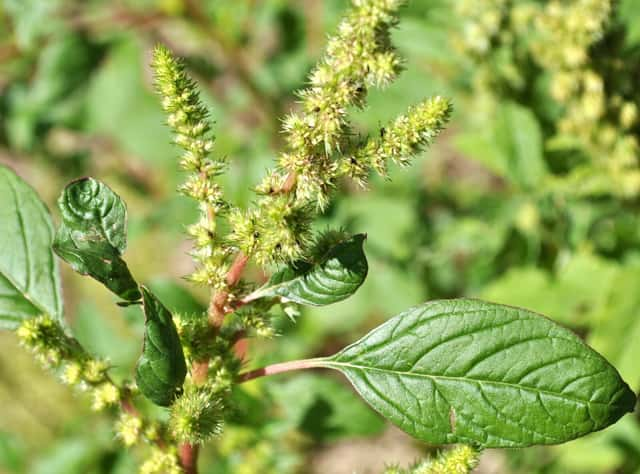
Amaranthaceae
Powell's Amaranth (Amaranthus powellii)
Amaranthus powellii
A wild plant rarely grown on purpose: full sun, heat and fertile, well-drained soil, and it tolerates drought. It self-sows readily in warm soil. Leaves and seeds are edible cooked, but avoid plants from chemically fertilized soil because of nitrate.
Every 7 days
Direct sun
° - °C
% - %
Categories
What is Powell's Amaranth?
Powell's Amaranth (Amaranthus powellii) is a easy-care plant from the Amaranthaceae family. Amaranthus powellii is an annual amaranth native to the southwestern United States and northern Mexico, now naturalized as a weed across temperate regions of several continents. It grows upright, 30 cm to 1.5 m tall, rarely 2 m, with green to reddish stems and pale green oval leaves, narrower toward...
Powell's Amaranth grows up to 1.5m, watering every 7 days. It is not suitable for indoor environments and safe for pets.
Unlike many tropical plants, Powell's Amaranth tolerates watering mistakes. Best for beginners. Unlike many popular species, Powell's Amaranth is safe to keep around pets.
How to Care for Powell's Amaranth?
TLDR: Powell's Amaranth needs Direct sun, watering every 7 days, and temperatures between 15-30°C with 40-70% humidity.
How Often Should You Water Powell's Amaranth?
Needs little water and handles drought and heat. Water seedlings, and give a weekly soak in dry spells if you want tender leaves for eating.
How Much Light Does Powell's Amaranth Need?
Full sun in a warm, sheltered spot. In shade it grows weak and stores more nitrate in its leaves.
What Is the Best Soil for Powell's Amaranth?
Fertile, well-drained soil. Skip synthetic nitrogen fertilizer if you plan to eat the leaves: the plant concentrates nitrate.
What Pot Should You Use for Powell's Amaranth?
Best grown in the ground. In a container, use a deep pot of 20 L or more with drainage holes.
What Is Powell's Amaranth and Where Does It Come From?
Amaranthus powellii is an annual amaranth native to the southwestern United States and northern Mexico, now naturalized as a weed across temperate regions of several continents. It grows upright, 30 cm to 1.5 m tall, rarely 2 m, with green to reddish stems and pale green oval leaves, narrower toward the top. In summer and fall it forms long, rather stiff green spikes of tiny flowers that produce many small dark seeds. It turns up in crop fields, waste ground, roadsides and riverbanks, and is easily confused with redroot pigweed (A. retroflexus) and smooth amaranth (A. hybridus).
How to Propagate Powell's Amaranth?
Seeds
Germination is poor in cold soil; a nightly drop in temperature helps. Cut the spikes before they shed seed if you do not want it to spread.
- 1 Wait for the soil to warm up in late spring
- 2 Scatter seeds where they will grow and cover very lightly
- 3 Keep moist until they sprout
- 4 Thin seedlings to give each plant room
Materials needed:
Stem cuttings
Shoots from actively growing plants root easily.
- 1 Cut a young shoot 10-15 cm long
- 2 Strip the lower leaves
- 3 Plant in moist mix or stand in water
- 4 Keep in light shade until rooted
Materials needed:
How Big Does Powell's Amaranth Grow?
TLDR: Powell's Amaranth can reach up to 1.5m tall with Fast growth rate.
Max height
1.5m
Growth rate
Fast
Foliage
Deciduous
Plant Uses
Edible
Can be consumed
Culinary Uses
- Young leaves cooked like spinach (discard the cooking water)
- Seeds cooked whole or ground into flour
Is your plant showing symptoms?
Click on the symptom to discover possible causes:
What Diseases Commonly Affect Powell's Amaranth?
TLDR: Powell's Amaranth is susceptible to 2 known diseases. Monitor regularly for early detection.
Insect Chewing Damage
Damage caused by pests such as caterpillars, beetles, and grasshoppers that possess chewing mouthparts. They consume plant tissue, reducing the plant's photosynthetic capacity and creating wounds that serve as entry points for fungi and bacteria.
Flea beetle damage
Flea beetles are small, jumping insects that feed on the leaves of many vegetable crops. They chew numerous small, circular holes, creating a characteristic 'shothole' appearance. While established plants can often tolerate the damage, young seedlings are highly susceptible and can be stunted or killed if the infestation is severe.
Fun Facts
Like other amaranths, it uses C4 photosynthesis, which works best in strong sun, heat and drought.
The whole plant yields yellow and green dyes.
A drop in temperature at night helps its seeds germinate.
Frequently asked questions
Is Powell's amaranth edible?
Is it poisonous?
How is it different from redroot pigweed?
Does it need watering?
Compare with similar plants
| Attribute | Difficulty | Light | Watering | Pet Safe |
|---|---|---|---|---|
| Field Maple | Easy | Bright indirect | 14d | ✓ |
| Iberian Houseleek | Easy | Direct sun | 14d | ✓ |
| Silver Birch | Easy | Direct sun | 14d | ✓ |
| Common Blanketflower | Easy | Direct sun | 10d | ✓ |





