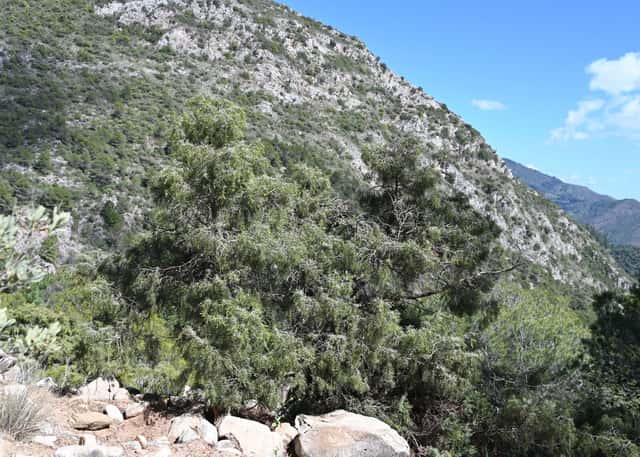
Cupressaceae
Prickly juniper (Juniperus oxycedrus)
Juniperus oxycedrus
A tough, sun-loving shrub that copes with drought, wind and poor or chalky soil. Drainage is what matters: plant it where water never sits and water only until it is established. It needs no pruning and little or no feeding.
Every 14 days
Bright indirect
° - °C
% - %
Categories
What is Prickly juniper?
Prickly juniper (Juniperus oxycedrus) is a easy-care plant from the Cupressaceae family. Juniperus oxycedrus is a conifer in the cypress family native to the Mediterranean, from Iberia and southern France to Italy and north-west Africa. In the wild it grows as a spreading shrub of 2-3 m or a small tree up to 15 m; in gardens it usually reaches 2.5-4 m. The sharp needles are 5-20 mm long...
Prickly juniper grows up to 4.0m, spread of 400cm, watering every 14 days. It is not suitable for indoor environments and safe for pets.
Unlike many tropical plants, Prickly juniper tolerates watering mistakes. Best for beginners. Unlike many popular species, Prickly juniper is safe to keep around pets.
How to Care for Prickly juniper?
TLDR: Prickly juniper needs Bright indirect, watering every 14 days, and temperatures between 15-30°C with 40-70% humidity.
How Often Should You Water Prickly juniper?
In the first year, water every one to two weeks once the soil is dry. Established plants handle long dry spells; in a pot, water only when the mix is dry a few centimetres down.
How Much Light Does Prickly juniper Need?
Full sun is best; it tolerates part shade but grows sparser. It is not a houseplant.
What Is the Best Soil for Prickly juniper?
Sandy, clay, chalky or stony soil, acid or alkaline, all work as long as it drains well. Waterlogged soil invites root rot.
What Pot Should You Use for Prickly juniper?
A large, deep terracotta or ceramic pot with drainage holes and a layer of gravel at the bottom.
What Is Prickly juniper and Where Does It Come From?
Juniperus oxycedrus is a conifer in the cypress family native to the Mediterranean, from Iberia and southern France to Italy and north-west Africa. In the wild it grows as a spreading shrub of 2-3 m or a small tree up to 15 m; in gardens it usually reaches 2.5-4 m. The sharp needles are 5-20 mm long, in whorls of three, with two white bands on the upper face. Its berry-like cones, 7-12 mm across, take about 18 months to ripen from green to orange-red. Cade oil, distilled from the wood, is used in cosmetics and skin treatments.
How to Propagate Prickly juniper?
Semi-hardwood cuttings
Wear gloves: the needles are sharp and the resin can irritate skin. Junipers root slowly, so be patient.
- 1 In late summer, cut 10-15 cm tips of this year's growth that are firm at the base
- 2 Strip the needles from the lower half
- 3 Dip the base in rooting hormone
- 4 Insert into moist sandy mix and keep in a bright, sheltered spot
Materials needed:
Seed
Seeds are deeply dormant; winter cold helps break dormancy.
- 1 Collect ripe orange-red cones
- 2 Remove the flesh and wash the seeds
- 3 Sow in a pot of sandy mix and leave it outdoors over winter
- 4 Keep moist and wait; germination can take more than a year
Materials needed:
How Big Does Prickly juniper Grow?
TLDR: Prickly juniper can reach up to 4.0m tall with Slow growth rate.
Max height
4.0m
Spread
4.0m
Growth rate
Slow
Foliage
Evergreen
Warning: Toxic Plant
This plant can be toxic if ingested. Keep out of reach of:
Plant Uses
Ornamental
Great for decoration
Medicinal
Medicinal properties
Aromatic
Pleasant fragrance
Medicinal Uses
- Cade oil, distilled from the wood, traditionally used on skin conditions such as psoriasis and dandruff (external use; can cause allergic reactions)
Is your plant showing symptoms?
Click on the symptom to discover possible causes:
What Diseases Commonly Affect Prickly juniper?
TLDR: Prickly juniper is susceptible to 5 known diseases. Monitor regularly for early detection.
Aphids
Aphids are small, soft-bodied, pear-shaped insects (1/16 to 1/8 inch long) that feed by sucking nutrient-rich sap from plants. They reproduce rapidly and can quickly weaken plants, causing distorted growth and transmitting plant viruses. Aphids come in various colors including green, black, red, yellow, brown, and gray. They secrete honeydew, a sticky substance that attracts ants and encourages sooty mold growth.
Scale Insects
Scale insects are small sap-sucking pests that appear as brown, shell-like bumps on plant stems and leaves. There are over 25 species, divided into armored (hard) and unarmored (soft) scales. They feed by piercing plant tissue and extracting sap, which weakens the plant and can lead to yellowing, stunted growth, and even death if left untreated. They also excrete honeydew, which attracts ants and promotes sooty mold growth.
Caterpillars
Caterpillars are the larval stage of moths and butterflies that feed voraciously on plant foliage, stems, flowers, and fruits. Common species include cabbage loopers, tomato hornworms, armyworms, and cutworms. These pests can cause extensive damage by consuming large amounts of plant tissue in a short time. They vary in size from small (1/4 inch) to large (5 inches), with colors ranging from green to brown, often featuring stripes or spots. Caterpillars are highly mobile and can quickly spread throughout gardens, making them one of the most destructive common pests.
Phytophthora Root Rot
Disease caused by fungus-like organisms (oomycetes) that live in soil and can survive for years. It affects roots, stem, and crown of plants, being especially severe in waterlogged or poorly drained soils. It is the second most common cause of root rot in trees and shrubs.
Fun Facts
Cade oil distilled from its wood has been used for centuries in soaps and skin treatments
Its berry-like cones take about a year and a half to ripen
In Spain it is called enebro de la miera, after the dark oil taken from its wood
Frequently asked questions
Is prickly juniper cold hardy?
Is it toxic?
Does it need pruning?
What pests and diseases affect it?
Compare with similar plants
| Attribute | Difficulty | Light | Watering | Pet Safe |
|---|---|---|---|---|
| Field Maple | Easy | Bright indirect | 14d | ✓ |
| Iberian Houseleek | Easy | Direct sun | 14d | ✓ |
| Silver Birch | Easy | Direct sun | 14d | ✓ |
| Common Blanketflower | Easy | Direct sun | 10d | ✓ |





