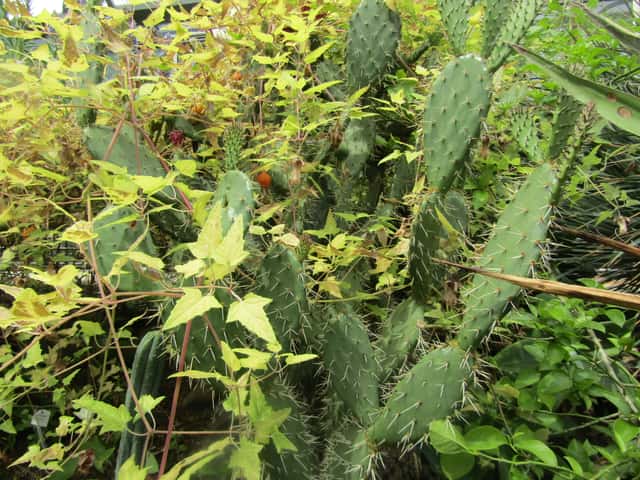
Cactaceae
Prickly Pear: Edible Plant
Opuntia orbiculata
Easy to cultivate for those with access to full sun. It thrives in heat, intense direct light, and substrate that dries out completely between waterings. The greatest risk is overwatering, especially in winter, when it should remain practically dry.
Every 14 days
Direct sun
2° - 35°C
20% - 40%
Categories
What is Prickly Pear?
Prickly Pear (Opuntia orbiculata) is a easy-care plant from the Cactaceae family. Opuntia orbiculata is a paddle-type cactus belonging to the Cactaceae family, native to arid and semi-arid regions of the Americas. It forms shrubby clumps with flattened, succulent segments (pads) covered in glochids—tiny, fine, barbed spines that detach easily when touched. It is a hardy plant tha...
Prickly Pear grows up to 4.0m, spread of 300cm, watering every 14 days, 2°C – 35°C, 20–40% humidity. It is suitable for indoor environments and safe for pets.
Unlike many tropical plants, Prickly Pear tolerates watering mistakes. Best for beginners. Unlike many popular species, Prickly Pear is safe to keep around pets. Without adequate drainage, root rot can develop within 28 days.
How to Care for Prickly Pear?
TLDR: Prickly Pear needs Direct sun, watering every 14 days, and temperatures between 2-35°C with 20-40% humidity.
How Often Should You Water Prickly Pear?
Water only when the substrate is completely dry, usually every 10-14 days during spring and summer. In winter, drastically reduce or suspend watering, as the plant enters dormancy and excess moisture is the primary cause of rot.
How Much Light Does Prickly Pear Need?
Prefers full, direct sun for at least 6 hours daily. Indoors, place it near the sunniest window in the house; low light causes etiolation (weak, elongated growth) of the pads.
What Is the Best Soil for Prickly Pear?
Use a fast-draining mineral substrate, with 70-80% inert material (coarse sand, pumice, or perlite) and the remainder organic matter. Ideally, the substrate should dry within 1 to 3 days after watering.
What Pot Should You Use for Prickly Pear?
Prefer terracotta or unglazed ceramic pots, which help evaporate excess moisture, always with generous drainage holes.
Care Schedule
Fertilize
Every 45 days
Rotate
Every 14 days
Repot
Every 730 days
What Is Prickly Pear and Where Does It Come From?
Opuntia orbiculata is a paddle-type cactus belonging to the Cactaceae family, native to arid and semi-arid regions of the Americas. It forms shrubby clumps with flattened, succulent segments (pads) covered in glochids—tiny, fine, barbed spines that detach easily when touched. It is a hardy plant that grows in stacked segments, blooming in late spring and early summer with large, showy flowers followed by edible fruits (known as 'tunas').
How to Propagate Prickly Pear?
Propagation by segment (pad/cutting)
Use thick gloves because of the glochids. Keeping the substrate dry at the beginning is essential for success.
- 1 Cut a healthy pad using a clean, sharp knife
- 2 Allow the cut to callus (dry) in a dry, shaded spot for 3 to 7 days
- 3 Plant the segment vertically, burying about 1/4 of it in well-draining mineral substrate
- 4 Do not water for the first 7 to 10 days to prevent rot
- 5 After rooting, water sporadically like an adult plant
Materials needed:
Propagation by seeds
Slow and irregular germination; method used more for curiosity than for rapid seedling production.
- 1 Extract seeds from the pulp of ripe fruit and wash thoroughly
- 2 Allow to dry for a few days
- 3 Sow on the surface of slightly moist mineral substrate
- 4 Keep in a warm location with indirect light until germination
- 5 Transplant young seedlings once they are a few centimeters tall
Materials needed:
How Big Does Prickly Pear Grow?
TLDR: Prickly Pear can reach up to 4.0m tall with Medium growth rate.
Max height
4.0m
Spread
3.0m
Growth rate
Medium
Foliage
Evergreen
Plant Uses
Ornamental
Great for decoration
Edible
Can be consumed
Medicinal
Medicinal properties
Medicinal Uses
- Traditional use of pulp and juice in treating digestive and urinary tract inflammations
- Popular use in the care of minor wounds and burns
Culinary Uses
- Young pads (nopales) consumed cooked in salads, tacos, and stir-fries
- Fruits (tunas) consumed fresh, in juices, and in preserves
Is your plant showing symptoms?
Click on the symptom to discover possible causes:
What Diseases Commonly Affect Prickly Pear?
TLDR: Prickly Pear is susceptible to 8 known diseases. Monitor regularly for early detection.
Root Rot
Root rot is a serious fungal disease that affects the root system of plants, causing them to decay and die. It is primarily caused by overwatering, poor drainage, or soil-borne fungi such as Pythium, Phytophthora, Rhizoctonia, and Fusarium. The disease thrives in waterlogged conditions where roots are deprived of oxygen, making them susceptible to fungal infection.
Overwatering
Overwatering occurs when plants receive too much water, depriving roots of oxygen and causing root rot. This environmental stress is one of the most common causes of houseplant death, as waterlogged soil prevents roots from breathing and functioning properly.
Mealybugs
Mealybugs are small, soft-bodied insects covered with a white, waxy, cottony material. They are common pests of houseplants and outdoor plants in mild climates. These sap-sucking insects feed on plant tissue, causing damage, stunted growth, and can lead to plant death if left untreated. They produce sticky honeydew which attracts sooty mold.
Scale Insects
Scale insects are small sap-sucking pests that appear as brown, shell-like bumps on plant stems and leaves. There are over 25 species, divided into armored (hard) and unarmored (soft) scales. They feed by piercing plant tissue and extracting sap, which weakens the plant and can lead to yellowing, stunted growth, and even death if left untreated. They also excrete honeydew, which attracts ants and promotes sooty mold growth.
Meaning & Symbolism
In Mexican culture, the Opuntia (nopal) symbolizes endurance and overcoming adversity, appearing on the national flag; more broadly, cacti represent perseverance, protection, and resilience in the face of hardship.
Compare with similar plants
| Attribute | Difficulty | Light | Watering | Pet Safe |
|---|---|---|---|---|
| Field Maple | Easy | Bright indirect | 14d | ✓ |
| Silver Birch | Easy | Direct sun | 14d | ✓ |
| Common Blanketflower | Easy | Direct sun | 10d | ✓ |
| Cushion Bush | Easy | Direct sun | 14d | ✓ |





